
Infinite Nampin Hell..
I am a candlestick FX trader.
Recently, I received a question like this.
“In Tenkan FX, when you lose, how much is it? The win rate is high, but surely it isn’t infinite averaging-down, right?”
“I’m concerned because the win rate is high, but I hope it isn’t something like unlimited averaging-down.”
That’s the gist.
Unlimited averaging-down...
From what I heard, when they previously purchased an EA with a high win rate,
they found that, when they opened the lid, it was an unlimited averaging-down type EA,
and they were worried.
Unlimited averaging-down means continuing to place entries in the opposite direction of the price’s movement.
For example, you enter a buy position,
and afterward the price drops.
At this point, by adding to the position,
the average buy price goes down,
and if the price later rebounds,
you can reach profitability at an early stage, improving the win rate.
And this method tends to be effective in ranges.
Since, sooner or later, the price returns to its original level,
whether you go long or short,
you will eventually win.
Moreover, about seven-tenths of the market is
a ranging market.
Furthermore, the more you view this from a broader perspective,
particularly in the FX market, there is a tendency to become range-bound.
Therefore, as a tip,
if you enter with a small lot size,
and continue averaging down,
you have a high probability of eventually turning a profit.
This method works in most cases, so
even after backtesting for a certain period,
you can achieve a fairly high win rate.
However, of course, there are pitfalls.
If the price moves in one direction and never returns to the original price,
you can blow up in a single hit.
Because you keep averaging down,
the lot sizes grow bigger,
and once the margin maintenance rate is exceeded,
you are forcibly closed out, ending the trade.
In fact, there are many EAs like this.
On the surface, you can create an EA with a high win rate,
and it becomes popular.
But, as with the person who contacted me this time,
it will eventually go bankrupt and end.
And fearing this, I think they asked the question at the top.
To answer upfront,
Of course,“Tenjo FX Logic”does not employ averaging-down at all.
So, please rest assured.
Now, let’s actually see what kind of trades it entails.
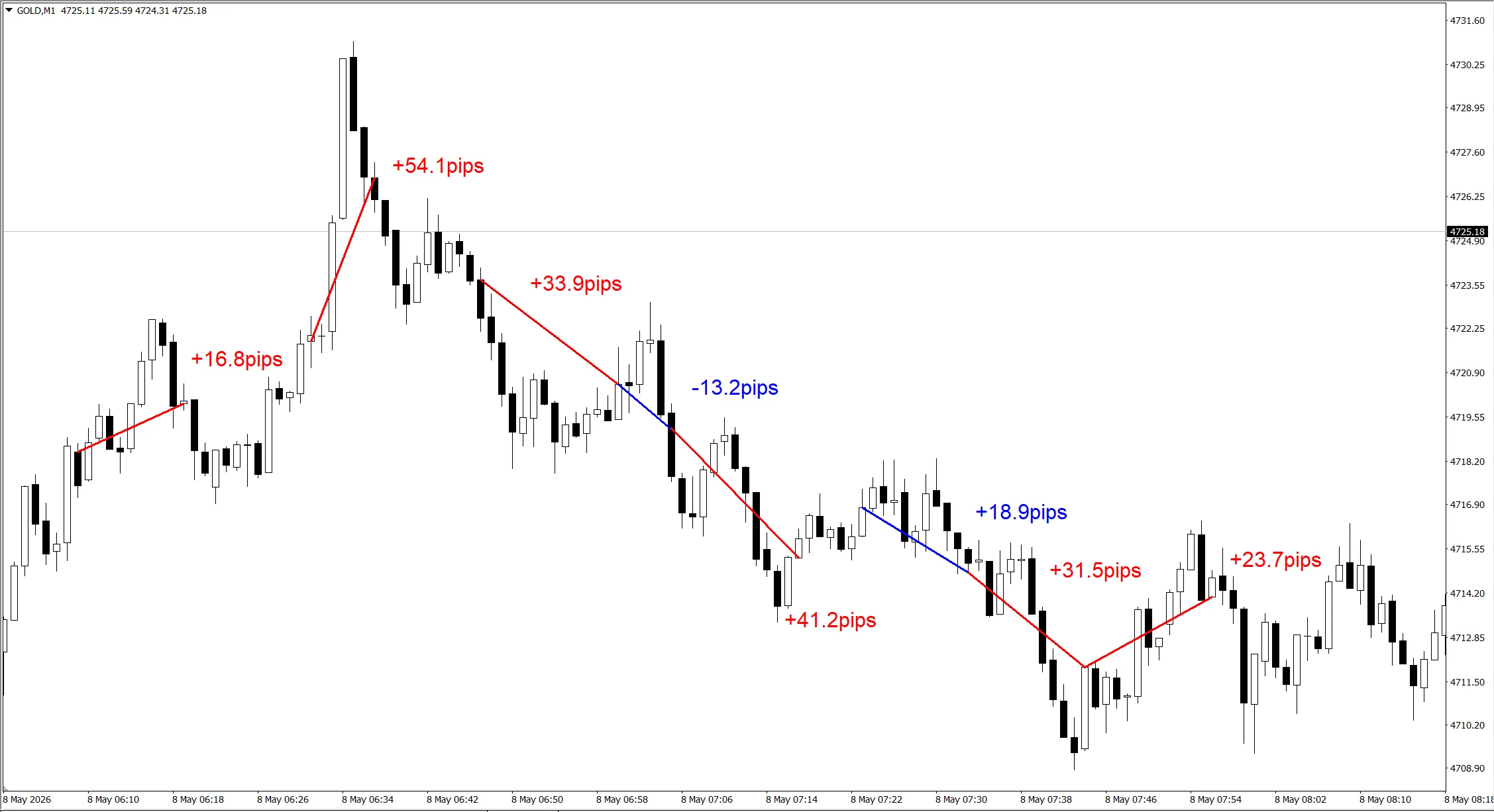
This is“Tenjo FX Logic”traded in.
This time, we deliberately picked the parts with many losses.
“Tenjo FX Logic”is traded mechanically according to its rules.
The result was, in about two hours,+169.1 pipsin profit.
The blue line marks losing trades, and the red line marks winning trades.
There were about two losses,
but you can see that they were quickly recovered afterward.
This logic, in a sense, does the opposite of averaging-down.
You enter a buy position,
and afterward, if some material arises and the price falls,
you do not admit defeat and continue to add to the buy position,
which goes against the crowd’s movement.
On the other hand, I quickly admit my mistakes,
cut losses,
and then switch to positions in the same direction as the crowd.
As a result, rather than just recouping, you can actually win more than you lost.
What matters is not clinging to your own position, but
consistently following the crowd.
If you don’t do this, no matter how high your win rate is,
you will eventually go bankrupt.
And people often ask about the size of losses when you lose.
There are logic approaches that increase win rate by making the stop range extremely wide.
In extreme terms,
taking profits at 10 pips
and cutting losses at 100 pips,
will make the win rate higher.
It’s a classic long-shot, long-kap style,
where you can show a higher win rate for a while.
But even if you do that,
your assets will not grow.
Rather, they will decrease.
And because this causes anxiety, people ask questions like these.
If you look at the chart above,
losses are quite limited,
smaller than the profit margin, I think.
In this way,“Tenjo FX Logic”neither averages down nor sets an extremely wide stop relative to the profit margin.
Of course you will lose at times, but
the logic is designed to quickly recover,
and many who have already acquired it say they trade with peace of mind.
So this time,
since there were questions about stop-loss and risk,
I’ve provided an explanation.
Have a great weekend.
If you want to trade using only candlesticks with a discretionary-only approach,
please see here.