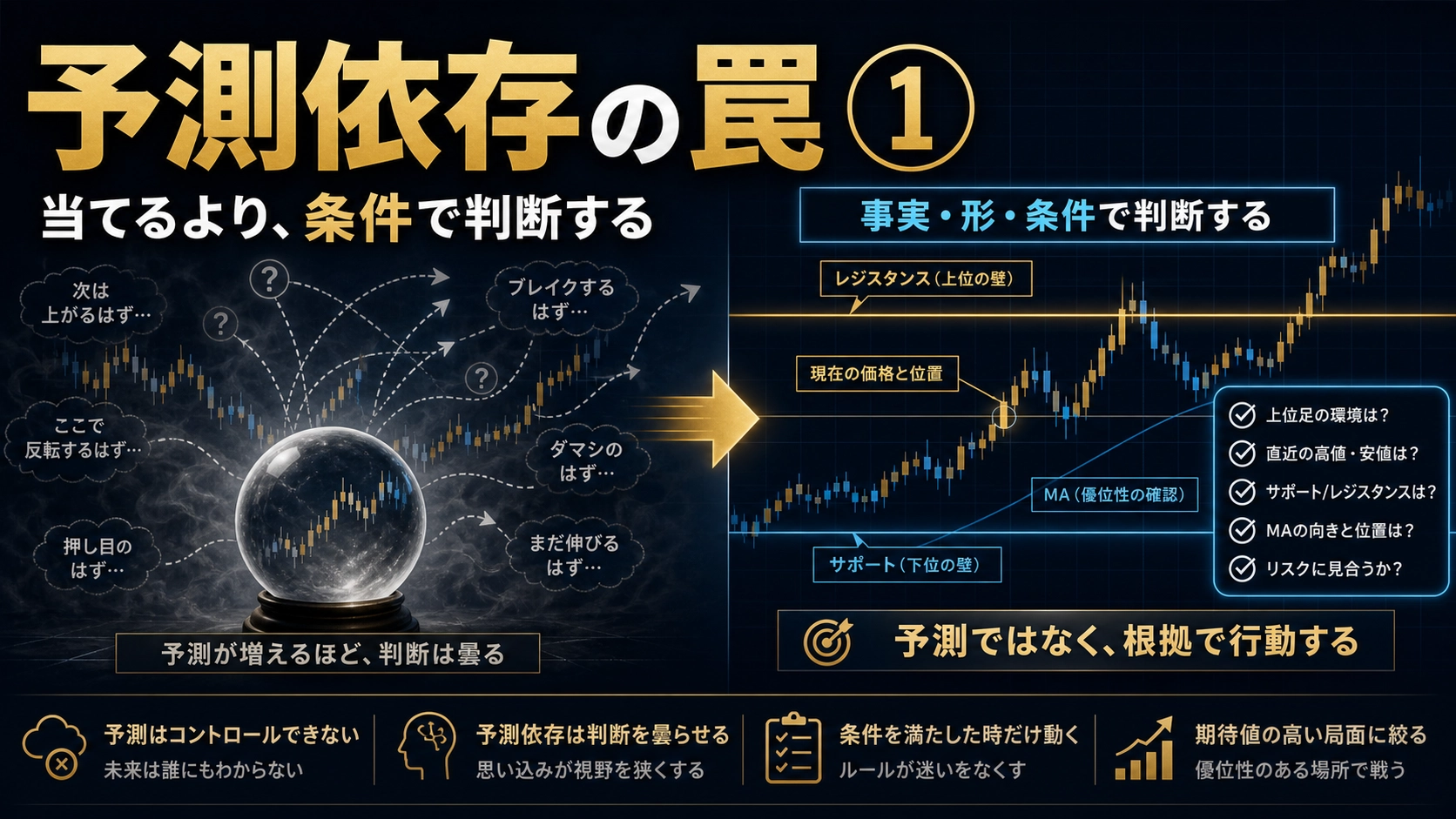

[Trap of Predictive Dependence ①] The real causes and solutions taught by an 18-year trader
【The Trap of Prediction Dependency Part 1】The Real Cause and Solutions Taught by an 18-Year Trader
Are you troubled by the “Trap of Prediction Dependency”?
Many traders face this issue.
I too, in my 18-year trading career, have run into this wall many times.
Whether you can overcome the Trap of Prediction Dependency depends on whether you can see the “structure.”。
In this article, I will share thetrue causeand theconcrete solutions you can practice starting tomorrow.
? 1. Why do many traders fall into the “Trap of Prediction Dependency”
“I feel like it will go up next.”
“It should reverse here.”
“It’s going to move upward soon.”
Suchprediction-based thinkingleads to entries.
? Nearly everyone does this.
For the first few years, I couldn’t break free from this line of thinking.
Why do we end up predicting?
The answer is simple,“I want an answer.”.
When you are in an uncertain market, people unconsciously search for the “correct answer.”
But there is no correct answer in the market.
What exists are “conditions” and “probabilities.”
? While you are predicting, you are aligning your emotions with the market movements.
This won’t lead to winning.
? Prediction Dependency arises from the anxiety of wanting an answer
? 2. The true cause of the “Trap of Prediction Dependency” lies in the structure
The real cause of the “Trap of Prediction Dependency” is not a problem of method.It is a problem with the structure you can see in the chart.
Most people chase only the candlestick movement.
When it goes up, they want to buy; when it goes down, they want to sell.
This is human psychology, but it is the opposite of the mindset needed to win at trading.
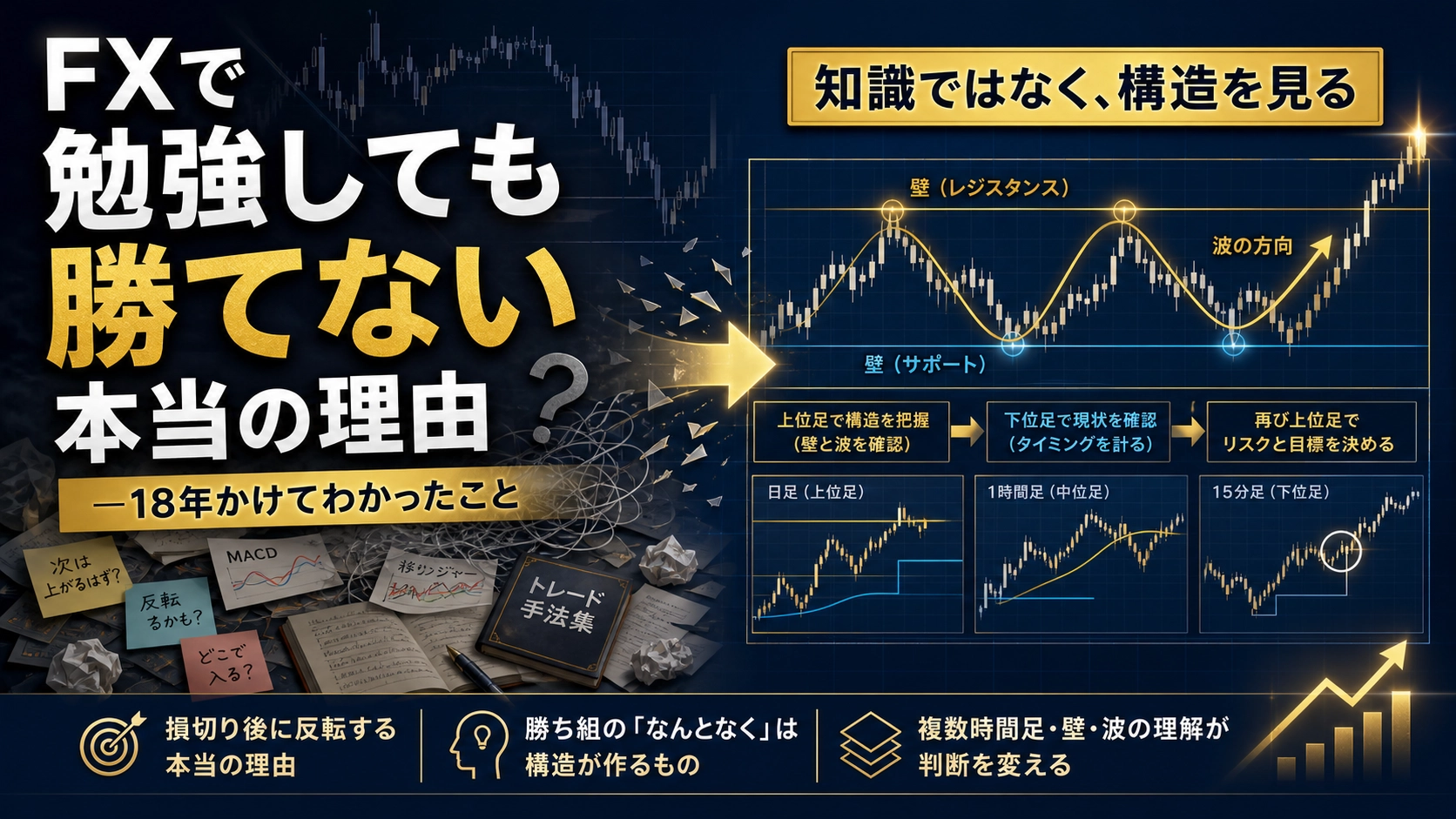
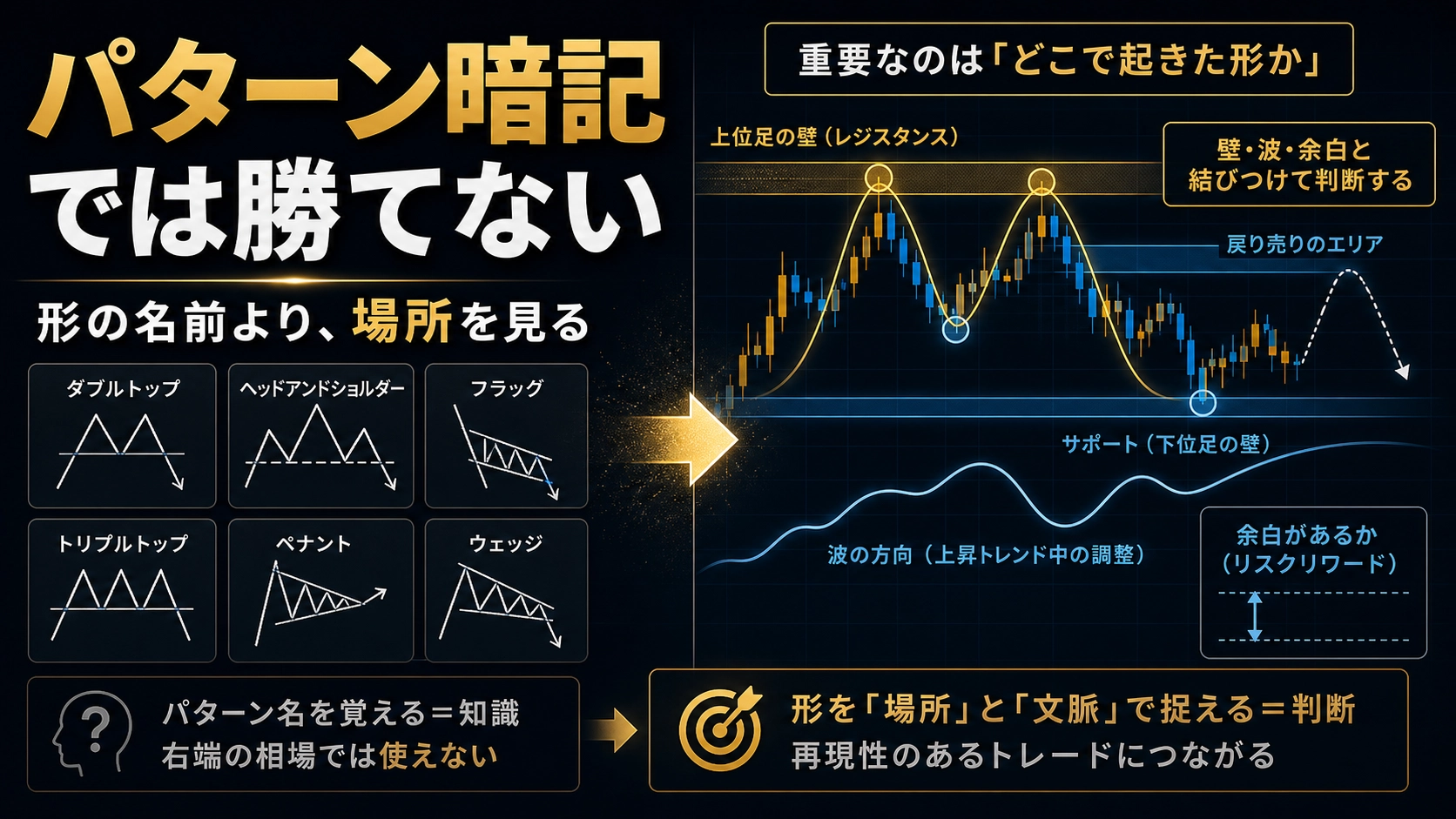
? The market has walls.A wall.иж
Vertical lines where price has bounced repeatedly, higher-timeframe pivot points, recent highs and lows.
If you enter without seeing that wall, your judgment will naturally become a “prediction.”
Conversely, if you can see the structure, your judgment becomes a “condition check.”
? You can’t judge because you can’t see the structure, so you rely on predictions
? 3. What makes winning traders different
The winning traders and the losing traders differ mainly in
“what they look at.”.
The losing trader looks atthe candlestick movements themselves.
The winning trader looks atthe relationships between walls, waves, and timeframes.
Even when looking at the same chart, their perspectives differ.
? When you ask a winner, “Why did you enter here?”, they answer like this.
?️ “Because the wave stopped just before the wall.”
?️ “Because the direction of the higher-timeframe wave aligned.”
?️ “Because if it reverses here, it will move straight up to the next wall.”
All of these are aboutconditions.
There is no talk of predictions.
? Winners judge by “conditions,” not by “predictions”
? 4. A way to solve with walls, waves, and timeframes
To break free from prediction dependency, you need to havethree viewpoints.
?Wall
?Wave: Is it in an uptrend or a downtrend, and at what stage?
⏱️Timeframe: Use lower and higher timeframes with distinct roles
What matters is how you use the timeframes.
?Check the current situation on the lower timeframe → Check the wall/wave state on the higher timeframe → Make entry decision on the lower timeframe.
Not by looking from the top down, butalternating between lower and higher timeframes.
Use the 4-hour chart to check the wall’s position and state.
If you are conscious of this, your judgment will become much more stable.
⚖️ The three-point set of Wall, Wave, and Timeframe forms the foundation to cut prediction dependency
✅ 5. Five steps you can practice starting tomorrow
Specifically, what should you start with?
Here are five steps you can implement starting tomorrow.
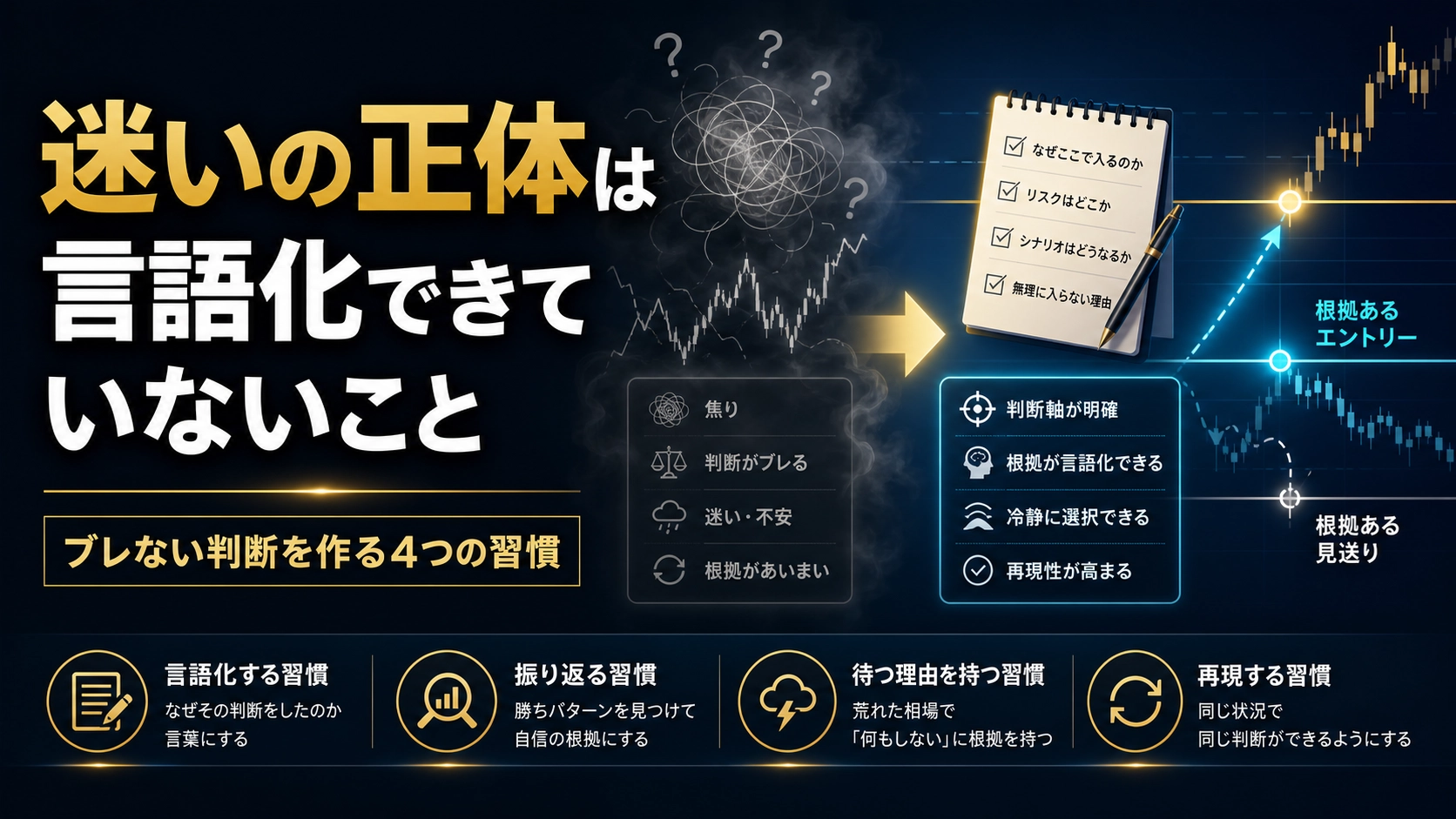
✅Step 1: Before entering, always say aloud where the wall is
✅Step 2: Be able to briefly explain which stage of the up-wave you are in
✅Step 3: Check both lower and higher timeframes before entering
✅Step 4: Record the moment you feel the urge to predict (understand your own habits)
✅Step 5: Write the entry reason in three lines (if you can’t write it, don’t enter)
? Step 5 is especially effective.Writing is saying that you don’t have a basis for judgment if you can’t write it.
Just stopping entries that you can’t write reduces prediction dependency significantly.
✍️ If you can’t write the entry reason in three lines, that’s proof you are predicting
? Summary
In this article, I explained the Trap of Prediction Dependency from its root causes to concrete solutions.
What’s important is not relying on predictions, but reading the chart’s structure.
? By having the three viewpoints of wall, wave, and timeframes, your trading quality will change significantly.
? Once you develop the skill to read the structure, trading becomes not a gamble but a judgment
Take your time and tackle each part step by step^^
If you want to study the ideas introduced in this article more deeply, please see my material“The Answer of the Market”
It summarizes the essence of discretionary trading based on 18 years of experience.
? For more details
https://www.gogojungle.co.jp/tools/ebooks/77829
? Also try the AI tool for free trade analysis^^
https://trade-ai-free.streamlit.app/
【A classic technique for massive gains】
▼ GOLD Remedy Manual
https://www.gogojungle.co.jp/tools/ebooks/50406
? Free gift|Part of the manual is publicly released
https://www.gogojungle.co.jp/info/22533