

【FX】Complete攻略 of Dow Theory trend reversal! How to discern the "perspective" to avoid traps
“I entered thinking it was a trend reversal, but it immediately went against me…” This is a problem many traders face in FX.
The cause lies inmisunderstanding the shift in perspective.
In this article, we will clearly explain the true trend reversal based on Dow Theory and the essential concept of “complex waves” to avoid false signals, with diagrams
the boundary between “trend” and “no-trend” in Dow Theory
As a premise, let’s reconfirm the definition of trend in Dow Theory.
If this becomes ambiguous, you will be forced to deal with false signals forever.
Definition of a Downtrend
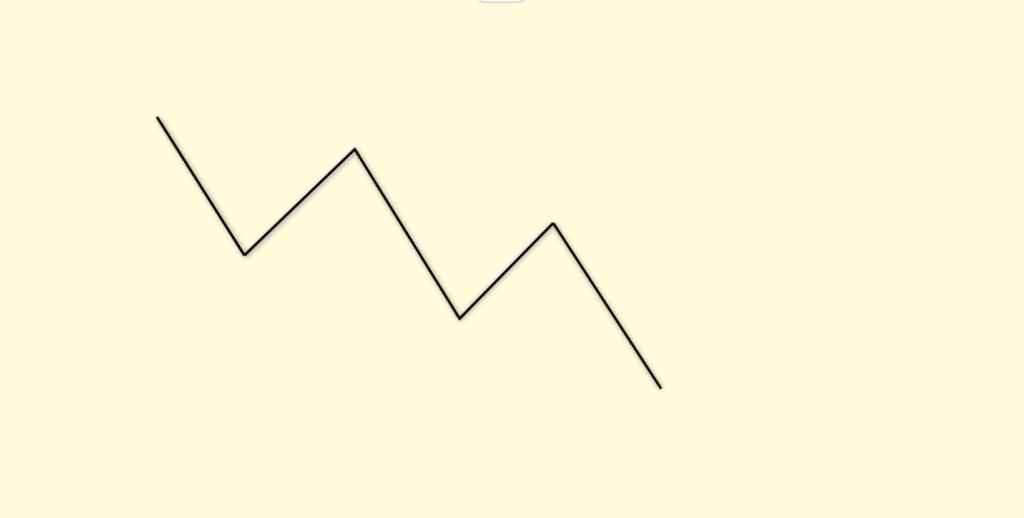
- Downtrend: both highs and lows are moving lower.
- Uptrend: both highs and lows are moving higher.
The key point is the word “both.” A trend is not recognized if only one side moves.
The trap of the “no-trend”
Many people mistake the state in the diagram above as a trend reversal.
The moment the price breaks above the last swing high after making a swing low, many people judge it as “upward bias.”
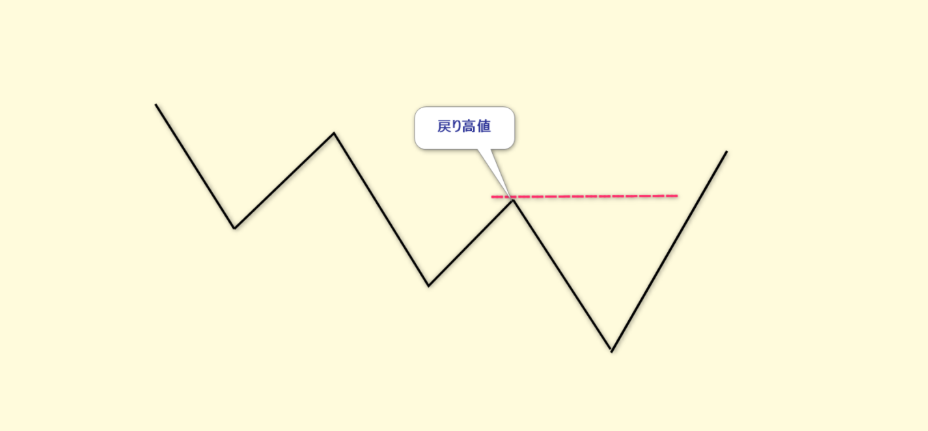
However, at this point the lows have not yet turned up.
This is simply a “no-trend (no directional bias)” state where the downtrend has not actually broken.
The correct view is to see the perspective as “flat,” not up.
How to identify the true “trend reversal”
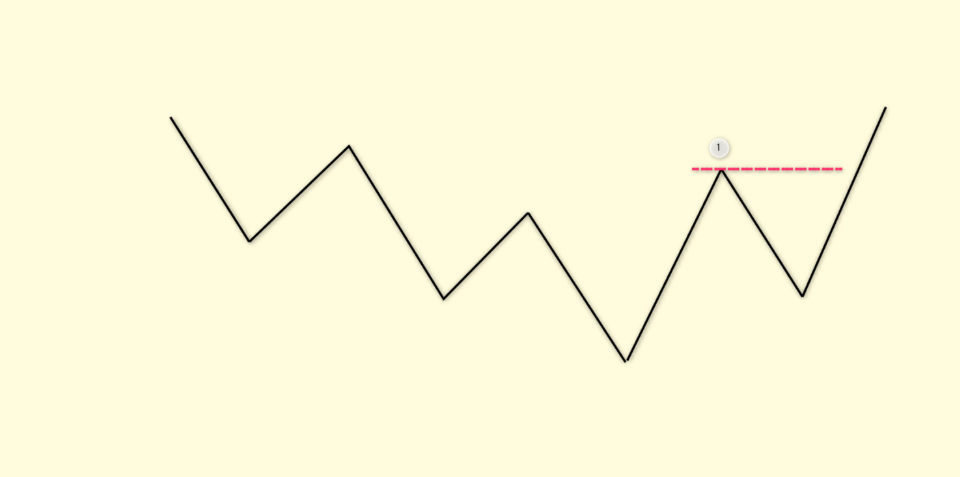
As in the diagram above, after updating the swing high (①) and then forming a pullback and updating the high again (or when the update is confirmed),both the highs and lows are moving higher, indicating a reversal to an uptrend.
That is why the so-called “inverse head and shoulders” pattern is watched—it visualizes the Dow Theory trend reversal process.
Why do false signals occur? The perspective of “complex waves”
If you “follow the rules and confirm the trend reversal but still lose,” the cause lies in the size of the waves (time frames).
Waves are formed by complex waves of different sizes
The market moves as a combination of waves of different sizes: red (large waves), blue (medium waves), and yellow (small waves).
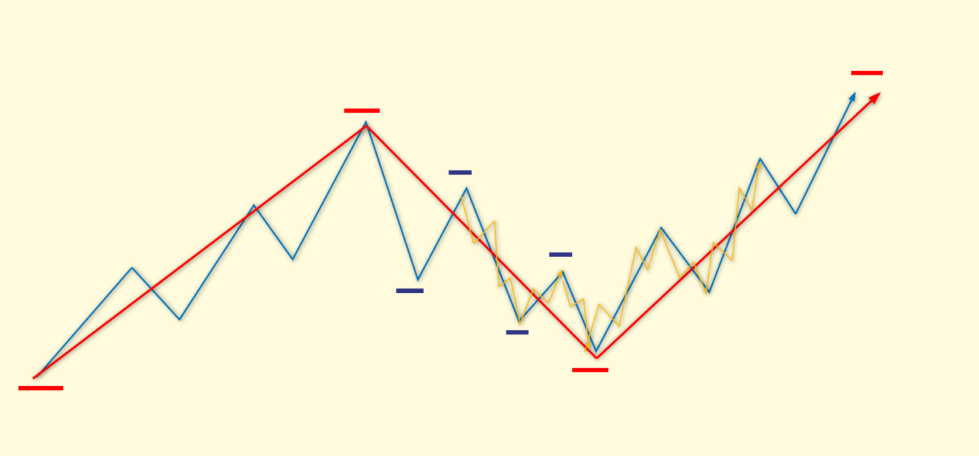
- If you only look at the blue wave and go short on a trend reversal,the red wave may be in the middle of a strong uptrend, and it will simply represent a temporary pullback in a large downward move and soon be absorbed.
The essence of false signals is the continuation on the higher timeframe
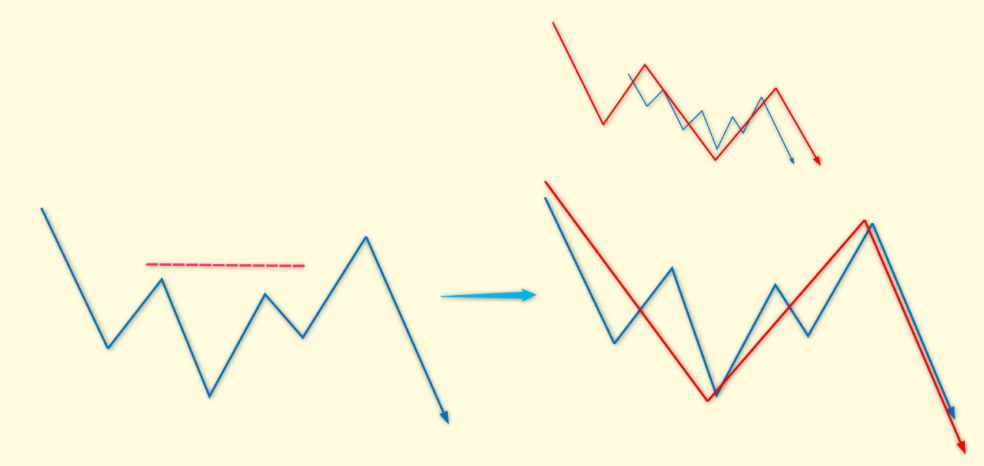
Look at the diagram above. A small wave (blue) may appear to have reversed, but when viewed in a larger wave (red), it is often only a part of a process where highs are being lowered and the price declines.
This is the essence of false signals. To avoid them, you must constantly understand where the wave you are watching sits in relation to the next higher-size wave.
Trading strategies to avoid false signals and increase edge
Practical points to determine perspective and improve win rate are as follows.
Use MA (moving average) as a filter: In addition to the Dow Theory perspective, using MA (20MA, etc.) helps judge wave momentum and convergence/divergence more accurately.
Capture waves in three sizes: Look at correlations across higher-timeframe (large wave), current timeframe (mid wave), and lower-timeframe (small wave), not just a single timeframe.
Do not go against the direction of the higher timeframe: If the larger wave is in a downtrend, even if the mid-wave turns up, avoid long positions or aim for short-term exits. Conversely, targeting reversals near the pullbacks and swing lows of the large wave offers the greatest edge.
Summary: steady perspective yields stable profits
Some say you can win with only Dow Theory, but that presupposes you understand the sizes of multiple waves.
- Merely breaking the swing high does not constitute a trend reversal
- Only when highs and lows align does a trend reversal occur
- Always be aware of the next higher-size wave
By thoroughly following these three points, unnecessary stop-outs will dramatically decrease. Once your perspective is clear, FX results will reliably stabilize.
For more concrete methods for price range trading and practical entry using three wave sizes, MA, and channels, see GoGoJian where they are on sale. If you’re interested, please check it out.
High-probability, simple price-range method, FX trading method using three wave sizes, MA, and channels