

[Third] The reason why averaging down EAs fail is not the entry but the “chasing method.”
Hello, this is Tsumo.
Today as well, I will talk about a topic that won’t collapse before winning.
This article is the third part of the MTP Operation Design Notes.
This time, I will write about the Averaging Down EA.
Averaging Down EA.
When you hear this word, you’ll probably have very different impressions.
“Dangerous”
“Will eventually collapse”
“A typical scattergun crash”
“Carrying unrealized losses and finally blowing up”
This is what people often say.
Indeed, sloppy averaging-down EAs are dangerous.
Rather, they are quite dangerous.
But I don’t think averaging down itself is absolutely evil.
The problem isn’t the act of averaging down.
Where, how much, and under what conditions you chase.
Here is the point.
The reason Averaging Down EA collapses isn’t because the entry was slightly off.
What’s really scary is how you chase afterward.
Today I’ll talk about that.
Averaging down is not a tool to hide losses
First of all, I want to make this clear.
Averaging down is not a magic spell that makes losses disappear.
The initial position moved against you.
Add the next position.
The average entry price moves closer.
If it returns, it becomes easier to recover.
I understand how this mechanism works.
But it’s dangerous to misinterpret it here.
Averaging down does not erase unrealized losses.
It just increases the number of positions and shifts the average entry price.
In other words, the account risk increases.
Visually, it might look like a small pullback could save you.
But in reality, you’ve increased the number of lots and the load on the account.
If you forget this, it’s dangerous.
Averaging down is not a tool to hide losses.
If you use it, you need a plan to recover.
Where to add more.
How large a lot size to add.
How many levels to tolerate.
Where to recover.
Where to stop.
A planless averaging down is just postponement.
Postponement may seem gentle at first.
But later it comes back with interest.
The market is quite demanding in this regard.
A collapsing averaging down EA is more dangerous in the chase than at the entry
When an EA collapses, people tend to blame the entry.
Entering there was wrong.
Direction was wrong.
Timing was early.
Misreading the reversal.
Of course, the entry is important.
But what truly breaks the account with an averaging-down EA isn’t only the entry.
Rather, it’s what happens after the entry.
The first leg moves against you.
Add the second leg.
Moves against you again.
Add the third leg.
Moves against you again.
The lots increase.
unrealized losses grow.
Maintenance margin falls.
Yet you don’t stop.
This flow is dangerous.
If the first entry was only a little bad, you may still recover.
But if the chasing afterward is sloppy, the account will quickly become strained.
When Averaging Down EA collapses,
it’s not so much “dying on the first bar”
as
“continuing to chase until it becomes so heavy you realize it”
often the case.
Therefore, what to look at isn’t entry precision alone.
Follow-up interval.
Increasing lots.
Maximum number of steps.
Account buffer.
Stopping conditions.
Recovery position.
Here it is.
Averaging-down EAs are defined more by how you chase than by the entry itself.
A too-close averaging down quickly burdens the account
What makes averaging down dangerous is when the intervals are too close.
Add after a slight move against you.
Add again after a little more move against you.
Add again.
In that case, the position count increases in a short time.
As positions increase, total lots increase.
Total lots rising accelerates unrealized losses.
You also use margin.
Available margin decreases.
At first it may seem nothing much.
But as it piles up, it becomes heavy suddenly.
The fear of Averaging Down EA lies in this “initially light, later suddenly heavy” part.
The first level is fine.
The second level is still fine.
The third level starts to worry.
The fourth level is heavy.
The fifth level begins to pray.
This pattern is not good.
When averaging-down intervals are too close, the number of levels advances even with a small market move.
Normally you should observe, but the EA calmly picks up the move.
And before waiting for a rebound, the account becomes heavy.
Therefore, interval is important in averaging down.
Rather than just adding,
you must consider whether there is truly enough price gap to add
for a meaningful recovery.
If you increase lots too much, the account will break before it can return
A common idea with averaging down EA is to increase lots to speed up recovery.
Make the second bar larger than the first.
Make the third bar larger than the second.
Close the average entry price earlier.
If it slightly retraces, it becomes profitable.
I understand the logic.
But this is quite dangerous.
If you increase lots, the recovery seems faster.
However, losses when moving against you also grow faster.
If it slightly retraces, you’ll be saved.
But if it doesn’t, you’ll suffer all at once.
This is the scary part.
Increasing lots in averaging down raises both recovery speed and collapse speed at the same time.
Not only the profits speed up.
The losses also speed up.
Therefore, increasing lots should be considered carefully.
Especially, people who struggle with cut losses should not increase lots too much.
Cannot cut.
But the lots are increasing.
Not returning.
Margin decreases.
This is a very dangerous combination.
What’s important in averaging down isn’t only to recover quickly.
It’s to survive the account until it returns.
It is dangerous to operate with a “return expectation”
Averaging down EA looks strong in a returning market.
Even if it moves against you, eventually you’ll return.
The average entry price gets closer.
If it retraces a little, you can recover.
And it becomes profitable.
If this flow continues, you’ll feel quite relieved.
But there is a trap here.
The market may not always return.
It can run further before returning.
The retrace can be shallow.
It can take a long time to return.
News and interest rate differentials can keep moving in one direction.
So it’s dangerous to base your plan on the assumption of a return.
What’s needed is not the expectation of a return.
It’s a plan for what happens if it does not return.
How far should you endure the adverse move.
How many levels to chase.
Where to stop beyond that.
What to do if the account health deteriorates.
Do you stop during news?
If you use hedging as recovery, how do you exit?
Think to this point.
Averaging down looks strong when it returns.
But what matters in operation design is what happens if it doesn’t return.
The market that breaks an account isn’t the expected market.
It’s an unexpected market.
Averaging down reduces escape routes the more you chase
The more you chase, the fewer escape routes remain.
Position count increases.
Lots increase.
unrealized losses increase.
Margin decreases.
Account health deteriorates.
Then, decision-making becomes difficult.
I actually want to stop it.
But stopping here would incur large losses.
I actually want to tidy things up.
But if it returns, there might be relief.
I actually want to reduce the lot sizes.
But recovery becomes distant.
Thus, you become unable to move forward.
What’s scary about averaging-down EA isn’t only the unrealized losses.
It’s the reduction of options.
When there is available margin, you can do many things.
Wait.
Close a portion.
Stop follow-up.
Aim for favorable closes.
Create time with hedging.
Adjust lots.
But when there is no more margin, options decrease.
And in the end, you’re left with praying.
Therefore, with averaging down, it’s important to leave escape routes.
Don’t chase everything.
Don’t make lots too heavy.
Have stopping conditions.
Recover where possible.
Chasing more does not make you stronger.
If you chase too much, escape routes disappear.
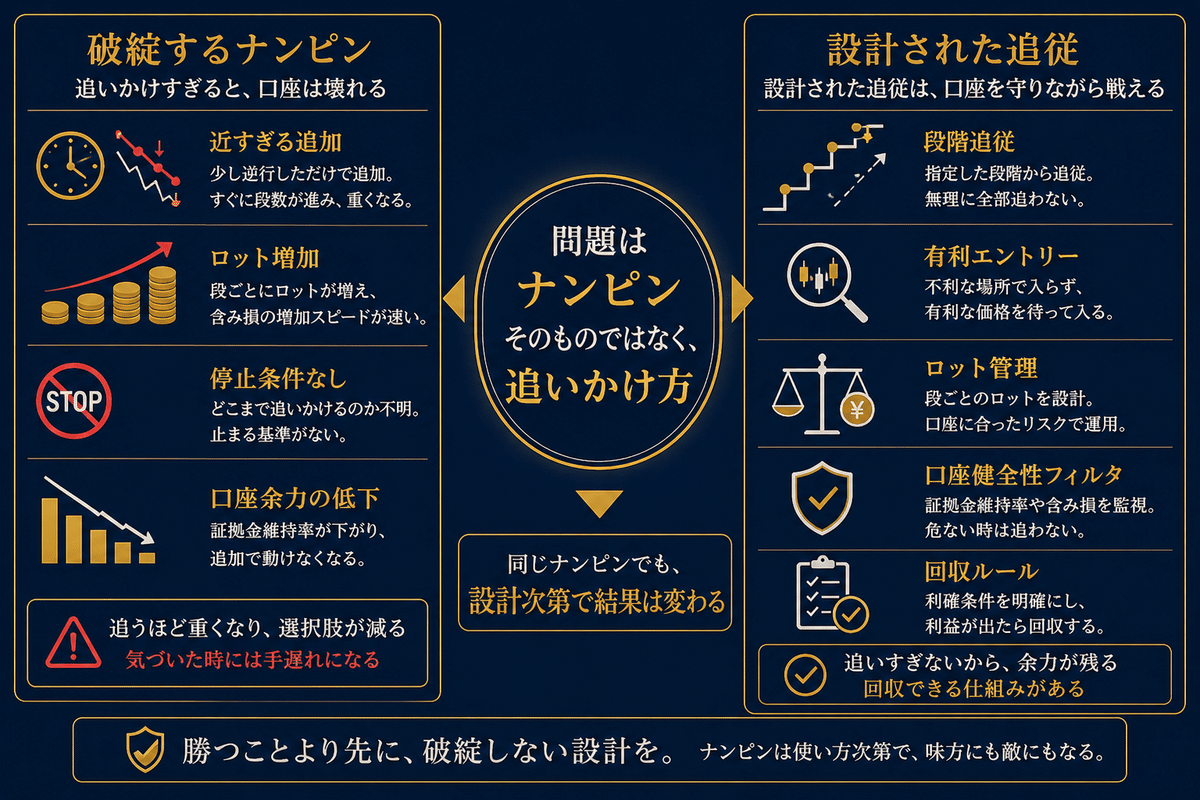
In MTP, it’s important not to chase everything
In MTP, following the Master with all positions isn’t considered the correct approach.
Master holds the first level.
Slave also holds immediately.
Master holds the second level.
Slave holds immediately.
Master holds the third level.
Slave holds immediately.
This isn’t always correct.
Because Master and Slave are not the same account.
Funds differ.
Leverage differs.
Lots differ.
Filled price differs.
Spreads differ.
Even if Master can endure a chase, it doesn’t mean Slave can endure it.
Therefore, in MTP we consider staged follow-up.
Skip the first level.
Think from the second level.
Enter conditionally from the third level.
Wait for a favorable price.
Don’t follow everything.
This isn’t about discarding profits.
It’s about protecting the account.
Favorable entries exist to shallow the wounds of averaging down
What matters in averaging down and follow-up is where you add.
If the position you add is at a bad point, it becomes very heavy later.
Add SELL during a sharp rise.
Add BUY during a sharp drop.
Jump on at an unfavorable price.
Enter when spreads are wide.
This kind of chasing is dangerous.
Therefore favorable entries are necessary.
A favorable entry isn’t to hit the top or bottom.
It’s to avoid chasing at an unfavorable price.
In averaging down, added positions pay off later.
If you add at a good position, recovery becomes easier.
If you add at a bad position, the average price worsens and recovery becomes heavier.
So, don’t rush to enter.
Wait for a slightly more favorable condition.
This is very important for averaging-down EA.
Don’t make profit-taking too distant
A common failure with averaging-down EA is wanting to take profits too greedily.
Endured the unrealized losses.
Finally returned.
If you endured this long, you want more.
I understand the feeling.
But in averaging-down operation, first priority is recovery.
If profit-taking is too far, you’ll miss the market that came back.
It went a little positive.
But you still wait.
It could extend further.
But it reverses.
Then unrealized losses appear again.
This is painful.
Averaging-down operation tends to involve unrealized losses for longer periods.
Therefore, when you see profits, first return the funds.
Prioritize lightening the account over big wins.
This is also the idea behind MTP favorable closes.
Don’t be slow to escape.
Don’t be greedy.
Recover where possible.
With Averaging-Down EA, if the exit is too far, you miss the recovery opportunity you worked for.
Account health filter acts as a brake for averaging-down EA
What averaging-down EA needs isn’t only entry logic.
It needs a brake.
Low available margin.
Large unrealized losses.
Increasing number of positions.
Heavy total lots.
Falling margin maintenance ratio.
Chasing further in this state is dangerous.
Therefore, an account health filter is necessary.
The account health filter isn’t to miss profits.
It’s to stop before the account breaks.
A averaging-down EA is dangerous without stopping conditions.
If conditions are met, you keep adding.
Even if the account is tight, you keep following calmly.
“Today is a bit risky, so I’ll stop.”
It won’t think that way.
Therefore, set stopping conditions from the start.
This is important.
In news and overheated markets, you need the courage not to chase
Averaging-down EA may clash with news markets and overheated markets.
Economic indicators.
Speeches by leaders.
Sharp rises.
Sharp falls.
Spread widening.
Order execution slippage.
Add after a slight move against you.
Add if it moves further.
Lots increase rapidly.
This is dangerous.
Also, be careful when RSI shows strong overheating.
Buy when oversold, sell when overbought.
Buy when oversold and price continues to fall.
This simple counter-trend strategy can be dangerous in strong markets.
It continues to climb when overbought.
It continues to fall when oversold.
This can happen.
Hence news filters and RSI filters are necessary.
Make the courage not to chase a rule.
This is the MTP philosophy.
Before denying averaging down, doubt design insufficiency
Averaging down is dangerous.
This is partly true.
But the other half is this.
A non-design Averaging Down EA is dangerous.
You don’t know where to add.
How much to increase is vague.
It isn’t decided how many levels to endure.
You aren’t watching available margin.
There’s no stopping condition.
Exit is too far.
Such averaging-down is dangerous.
But I don’t think you need to reject the concept of averaging down itself entirely.
The problem is how you chase.
If you use averaging down, design it.
Design the lots.
Design the number of steps.
Design the entry point.
Design the exit.
Design the stopping conditions.
Only after doing these, will it become a real operation.
Finally
The reason Averaging-Down EA collapses isn’t only the entry.
What’s truly scary is the chasing method.
Too-rapid additions.
Too-heavy lots.
Unstopped follow-up.
Too-distant profit-taking.
Not watching account margin during operation.
Jumping into news and overheated markets.
Hedging with no exit.
When these stack up, the account becomes strained.
Averaging down isn’t a magic to erase losses.
If you use it, you need design.
Today’s conclusion is simple.
Averaging down isn’t dangerous by itself.
Dangerous are the chasing methods used with averaging down.
Don’t chase everything.
Don’t make lots too heavy.
Wait for favorable conditions.
Recover when profits appear.
Stop when it’s dangerous.
Before winning, first avoid collapse.
Let’s consider Averaging-Down EA with that premise.
※This article is based on the author’s personal trading philosophy and does not guarantee profits.
※FX, automated trading, and following-trend trading carry substantial risks. Depending on settings, lots, and market conditions, large losses may occur. Please trade at your own risk.