

[Second Article] An article for people who don’t want to cut losses when trading FX.
Hello, it’s Tsumo.
Today as well, I’ll talk about the things that don’t lead to ruin before winning.
This article is the second installment of the MTP operation design notes.
This time, I will write about a topic that probably many traders actually don’t want to speak aloud.
I don’t want to cut losses.
I understand this feeling quite a bit.
In my head, I know it.
Cutting losses is important.
You should reduce losses.
Leaving a losing position abandoned is dangerous.
There is no guarantee it will come back.
You should cut before you lose big.
I understand all of that.
But when the loss is in front of you, you can’t cut it so easily.
If you cut, you’re certain to lose.
If you hold on, it might come back.
If you wait a little, you might be saved.
If you cut here, it might reverse exactly there.
This “might be” is what repeatedly erodes your account.
Still, I think this.
Just because you’re bad at cutting losses doesn’t mean you have to give up on the market right away.
However, there is a condition.
If you won’t cut losses, you must have a design that doesn’t blow up.
Today I’ll talk about that.
Not cutting losses itself is not a bad thing
This is often said.
People who can’t cut losses can’t win.
If you can’t cut losses, you should quit the market.
People who endure drawdown will eventually be expelled.
I think that’s true.
It’s quite true.
At least, if you stack lots, leave it as is during a drawdown, and only pray for a rebound, you’ll eventually break.
But I have a slightly different perspective.
Not cutting losses itself isn’t inherently bad.
What’s bad is,
not cutting losses and not having a design to prevent ruin.
I want to separate these ideas.
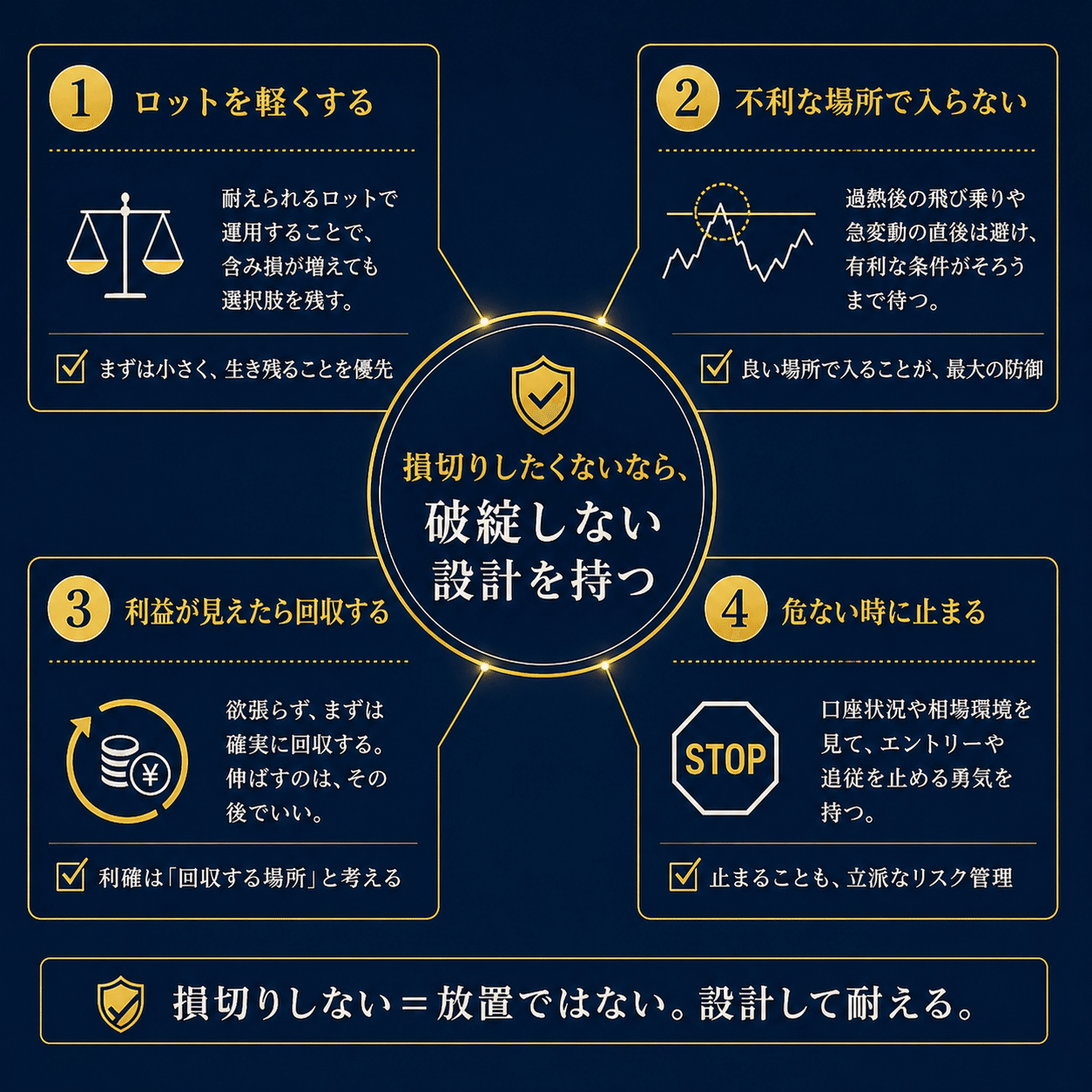
Not cutting losses.
But the lot size is light.
Starting to follow is late.
Not entering at unfavorable places.
When profits appear, take them.
Stop when it’s dangerous.
Look at available account margin.
Avoid around news times.
If you have this kind of design, it’s different from simply “not cutting losses.”
Conversely,
Not cutting losses.
Lot size is heavy.
Layering (averaging) is quick.
Follow-through captures everything.
Take profits is far away.
Even if the drawdown increases, you won’t stop.
You don’t look at account health either.
This is dangerous.
This is not a style.
It’s a prayer.
Moreover, if you leave the praying to the EA, you’ll pray quite diligently.
Until the account runs out.
Being too serious is also troublesome.
People who struggle with cutting losses should reduce lot sizes
What people who struggle with cutting losses should do first.
Is not to improve entry precision.
It’s to reduce the lot size.
This is quite important.
If you’re bad at cutting losses but heavy on lots.
This is quite dangerous.
Because you’ll accumulate drawdown without cutting.
With a lighter lot, you still have time to think.
Wait.
Aim to recover.
Wait for favorable closes.
Protect with trailing.
Consider hedging recovery.
Organize part of it.
Revisit settings.
Options remain.
But when the lot is heavy, options reduce sharply.
It’s hard even with a small retracement.
Maintaining margin drops.
Cannot move further.
Worried about the drawdown amount and lose calm.
And eventually it becomes this.
You can’t cut.
But you can’t endure either.
But you can’t cut.
But the account is in danger.
This state is quite harsh.
So, if you’re bad at cutting losses, first lighten the lot size.
Profitability becomes smaller, which is true.
But it’s much better than being expelled.
Staying small is not running away.
It’s a design to fight again next time.
A "survival-first" approach is dangerous
There are things that people who are bad at cutting losses tend to do.
That is, assuming they’ll be saved.
It will come back eventually.
Now is a temporary drawdown.
If it comes back from here, it will rebound.
It has returned before.
It will be fine this time too.
I understand.
I truly understand.
But what’s important in MTP operation isn’t there.
Whether it will come back or not is not the question,
Whether the account remains intact even if it doesn’t come back.
This is where it is.
The market may return.
It may not return.
It may go deeper than you think.
It may not return as quickly as expected.
Therefore, building around the assumption that it will recover is dangerous.
What’s needed is not a story of recovery.
What’s needed is a design that can endure.
Where is the point at which drawdown becomes painful?
Up to what lot size can you endure?
From which step should you follow through?
Where should you recover from?
Where should you stop?
Decide these first.
"If it returns, you’ll be saved" is weak.
Think that even if it doesn’t return, it won’t break immediately.
I believe this is the minimum condition for a loss-cutting-non-centric operation.
What MTP values most is not to win, but not to break
When building MTP, the first thing considered isn’t big wins.
First, not breaking.
Of course, I want to win.
I want to profit.
As a creator of an EA, I aim for that.
But I don’t want to reverse the order.
Before winning, not breaking is the baseline.
This is the foundation.
In MTP, we don’t just follow Master; we consider various safety designs.
Tiered following.
Favored entries.
Favored closes.
Trailing.
Account health filters.
News filters.
RSI filters.
Hedging recovery.
Rather, they’re a way to reduce reckless entries, create exits, and protect the account.
Seeing EA as a “box that makes money on its own” is dangerous.
EA is a tool designed to be used with a plan.
And especially for those who struggle with cutting losses, the design of the tool becomes crucial.
If you won’t cut losses, you must not make the entry sloppy
If loss-cutting isn’t the core, entry is still very important.
Because you can’t easily cut a poor entry.
If you can cut losses, you can end a bad entry.
But those who struggle with cutting losses are different.
Enter at a bad place.
It becomes a drawdown.
Cannot cut.
Endure more.
Takes time to recover.
So, if you’re bad at cutting losses, you need to devise ways not to enter unfavorable places.
Sell right after a sharp rise.
Buy right after a sharp fall.
Jumping in right after news.
Entering when spread is wide.
Adding when margins are weak.
Counter-trending in overheated markets.
Reduce these kinds of entries.
Don’t try to take every single opportunity.
MTP’s favored entries follow this principle as well.
Not to predict a top or bottom.
To avoid needless wounds at unfavorable prices.
If you don’t cut, decide your exit first
Exit is as important as entry.
People who struggle with cutting losses tend to have vague exits.
If it returns, consider it.
If it’s in profit, consider it.
Wait for Master TP.
If it seems to extend further, wait.
After enduring drawdown, you finally see profit.
That moment, desire arises.
Since you’ve endured this far, you want more.
Since it has returned, you want to push a little more.
It would be a waste to exit near the cost price.
This feeling is natural.
But with that desire you’ll return to drawdown.
Therefore, for a loss-cutting-non-dominant operation, you must decide your exit first.
Where to recover.
Where to have favorable closes.
How much to leave at minimum.
Including fees and swaps, is it positive?
Where to protect profits with trailing.
Decide this.
Take-profit is not a place to dream.
It’s a place to recover.
If you struggle with cutting losses, exits should be practical.
Don’t let unrealized gains become illusion
People who struggle with cutting losses also struggle with handling unrealized gains.
Unrealized losses cannot be cut.
Unrealized gains should be extended.
This combination is quite dangerous.
Unrealized losses endure.
Unrealized gains are greedy.
Then, funds don’t return to the account easily.
Even if the screen shows plus, they haven’t returned to the account yet.
If it reverses from there, the profit disappears.
In the worst cases, it becomes unrealized losses again.
Therefore, trailing is important.
However, trailing isn’t only for maximizing profits from the start.
First, use it to protect profits.
When a certain amount of profit is reached, never let it turn into a loss again.
Leave the minimum profit.
If it grows, chase it.
If it stalls, recover it.
This order.
Protect first, then extend.
I think this is especially important for loss-cutting-difficult operations.
Hedging is not a magic that saves you
For those who don’t want to cut losses, hedging appears attractive.
The unrealized loss is growing.
Hold a position in the opposite direction.
The loss expansion temporarily stops.
A little relief.
I understand.
But hedging is not magic.
Unrealized losses do not disappear.
The problem isn’t solved.
It’s only a temporary pause in movement.
Hedging without an exit is just a延命 (life extension).
If you use it, decide where to start.
What to reduce.
Where to close the recovery side.
How to organize the loss side.
When to end hedging.
You need to decide up to this point.
In MTP, hedging recovery is not to hide drawdown.
It’s to create exits.
Doing hedging because you’re bad at cutting losses.
That alone is dangerous.
That’s why, because you’re bad at cutting losses, hedging also needs exit design.
Reasons for visualizing on a smartphone
People who are bad at cutting losses must not lose sight of account status.
EA runs on a computer.
But humans cannot stay in front of the computer forever.
While working.
While outside.
Time with family.
While traveling.
Before bed.
Constantly watching MT4 isn’t realistic.
But the EA is running.
New entries have occurred.
Positions have increased.
Unrealized losses have grown.
Risks overlap across multiple accounts.
If you notice this late, your judgment will also be late.
That’s why in MTP we are considering making it possible to see the status of multiple accounts on a smartphone.
View status with Google Sheets.
Receive a notification when automatic entries occur.
Even when you’re outside, you can quickly check account status.
This may seem like a convenient feature.
But the goal is risk management rather than convenience.
Unseen risks cannot be stopped.
Even when busy, you’ll know what’s happening now.
That alone greatly changes the safety of operations.
If you’re bad at cutting losses, create stopping conditions
People who struggle with cutting losses should create stopping conditions.
Stop new entries.
Stop following.
Lower the lot size.
Don’t move around around news times.
Don’t enter when account health is poor.
Don’t counter-trend when RSI is overheated.
This is how you stop.
In markets, stopping is sometimes harder than entering.
It looks like a chance.
I want to regain what I lost.
I want to extend more.
Not entering here would be a waste.
I think so.
But for someone who’s bad at cutting losses, operating without stopping is dangerous.
Entering conditions alone aren’t enough.
Conditions not to enter.
Conditions not to chase.
Conditions to stop.
Conditions to recover.
You need these.
All of MTP’s filters aren’t to hinder winning.
They’re to stop you at dangerous times.
Rather than aiming to produce someone who can cut losses, first build a non-breaking system
Of course, becoming someone who can cut losses is important.
Acknowledge the losses.
Cut them into smaller pieces.
Move on to the next.
That is strong.
But if you could do that from the start, you wouldn’t have much trouble.
That’s why I want to build the system first.
A system to restrain lot sizes.
A system that avoids entering in disadvantageous places.
A system that stops when it’s dangerous.
A system that protects unrealized gains.
A system that alerts you to account status on your smartphone.
Not relying too much on human psychology.
This is important.
Saying you’ll cut losses with strong mental fortitude every time is a bit unrealistic.
Strengthening the mental aspect is also important.
But designing a system that is hard to break is even more important in some situations.
MTP aims to be such a tool.
Finally
I don’t want to cut losses.
I don’t deny this feeling.
Rather, I understand it well.
But if you don’t want to cut losses, there are things you need instead.
Lot-size management.
Tiered following.
Favored entries.
Favored closes.
Trailing.
Account health filters.
News filters.
RSI filters.
Hedging recovery exit design.
Smartphone visibility.
These are not excuses to not cut losses.
They are designs to prevent ruin.
Today’s conclusion is simple.
If you don’t want to cut losses, endure through design rather than neglect.
Not just by holding on forever.
Not just by praying.
Not just by waiting for a return.
From the start, build a form that’s hard to break.
Before winning, first not breaking.
I believe those who struggle with cutting losses should start there.
※This article is based on the author’s personal operating philosophy and does not guarantee profit.
※FX, automated trading, and following-trading carry significant risks. Depending on settings, lot size, and market conditions, substantial losses may occur. Please operate at your own risk.