
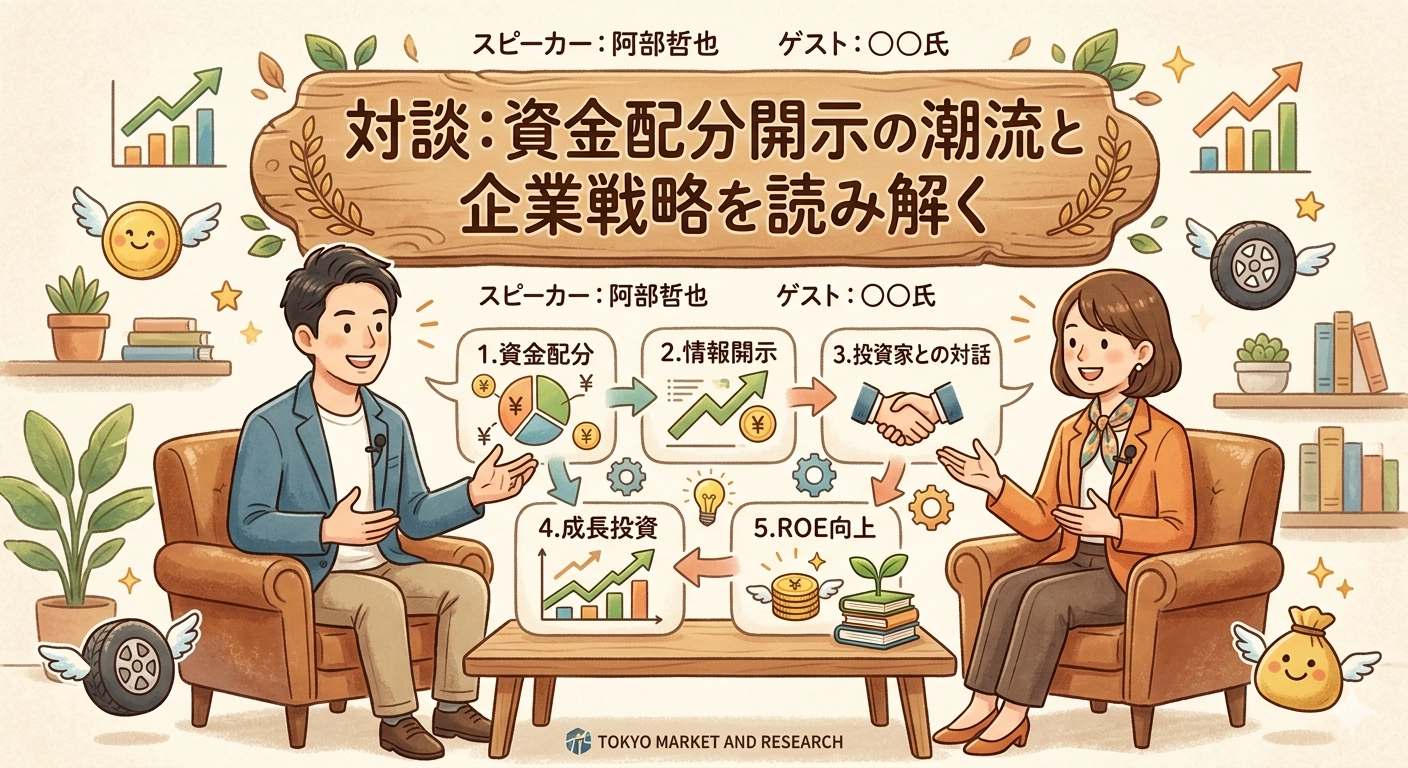
対談:資金配分開示の潮流と企業戦略を
A:Recently, there has been unprecedented attention on how listed companies disclose information about how they use money.
In fiscal year 2025, 476 companies published their capital allocation plans, up 60% from the previous year and the highest ever.
B:Yes, it was widely covered in Nikkei as well.
Until now, companies only stated profit targets in their medium-term management plans,
but now they are explicitly outlining “how much will be used for what, and how much will be returned.”
What is driving this change?
A:First and foremost, there is strong pressure from the market and the government.
In the revision draft of the Corporate Governance Code published by the Financial Services Agency and the Tokyo Stock Exchange,
the phrase “continual verification of effective use of funds for growth investments such as deposits” was included.
Investors are also setting strict standards, such as opposing appointments of CEOs of companies with low capital efficiency and no clear use of cash, like Mitsubishi UFJ Asset Management.
B:Indeed, the era of hoarding cash is over.
Specifically, how do you view the cases of companies that decided to disclose for the first time this time?
A:For example,Toho.
They plan for 2025–27 to allocate 160 billion yen to growth investments and 40–50 billion yen to shareholder return.
The breakdown of investments is concrete, including M&A to strengthen in-house content (IP) and real estate development.
Through dialogue with overseas investors, they felt the need to communicate their strategy more clearly.
B: Keio Corporationwas also surprised.
For the 2025–30 period, they present a huge growth investment of 1.14 trillion yen.
Not only updating railroad facilities, but also investing over 500 billion yen in urban development, and clearly signaling they will expand their hotel business as well.
A:Additionally,Casio Computer,
is taking a bold approach, directing about 30 billion yen deemed surplus toward growth investments and returns.
Some companies are making such decisive judgments.
This movement, following the lead of a precedent likeAjinomoto,
is expected to push growth by clarifying investment priorities.
B:As investors, will views differ greatly between companies with plans and those without?
A:It will clearly change.
According to OAKS or Okamura? (Note: translation may refer to Okamura Securities) Okasan Securities’ research shows that companies that disclose capital allocation policies in their mid-term plans tend to see stock price increases outperform the TOPIX after the announcement.
Showing a stance of not hoarding cash but distributing it appropriately leads to an improvement in ROE (return on equity) and, as a result, higher corporate value.
B:I see.
However, looking at the materials, only about 10% of companies nationwide have disclosed so far.
A:That’s right.
That’s why, at this very moment, it is crucial to earnestly engage with the market and
whether one can present a convincing capital allocation is the dividing line to become a company chosen by investors.
for investors.