
The provided HTML snippet translates to: Are you able to see it clearly?
I am a Candlestick FX trader.
How are you spending your weekend?
This time, I would like to explain what it concretely means to read “supply and demand.”
I will explain.
What is supply and demand? It means who among buyers and sellers is larger right now?
That is, which side is stronger right now.
And you take a position on the stronger side.
To trade advantageously in the markets,
you need to look at this.
Conversely, if you do not look at this, you will not be able to win consistently.
For example, in the stock market,
no matter how wonderful a company is,
if nobody pays attention, its stock will not be bought.
Therefore, among people investing in stocks,
even if you bought stock in a company with good performance and a wonderful business,
if the stock price doesn’t rise,
or it falls,
you may wonder, why?
This is exactly evidence that you are not reading supply and demand.
Conversely, even companies posting large losses can be bought massively.
Last year, for example, space stocks and uranium-related stocks were bought heavily.
These companies often posted significant losses for years, but
they were bought for future prospects, hype, etc.,
Being profitable and being bought are not equivalent.
Stock buys happen only when there are many buyers.
If you don’t understand this, you may focus only on a company’s earnings
and wonder why its stock isn’t rising,
ending up holding unrealized losses.
Nowadays, semiconductor stocks, and more specifically
optical semiconductors and optoelectronic fusion-related stocks, are being bought across the board.
However, especially for small-cap stocks, there are companies that have posted losses for years,
but are being bought with great expectations for future necessity of the technology.
Thus, looking only at earnings, you cannot tell which stocks will rise.
Where is the money heading now?
What is the state of supply and demand?
You need to look at these.
When you discuss this, some people bring up the margin loan ratio,
but this has nothing to do with it at all.
It is not at all informative.
Regardless of the margin loan ratio, if the number of buyers exceeds that, prices will rise.
Now, putting stock talk aside,
I will talk about the currency market.
Taking USD/JPY as an example,
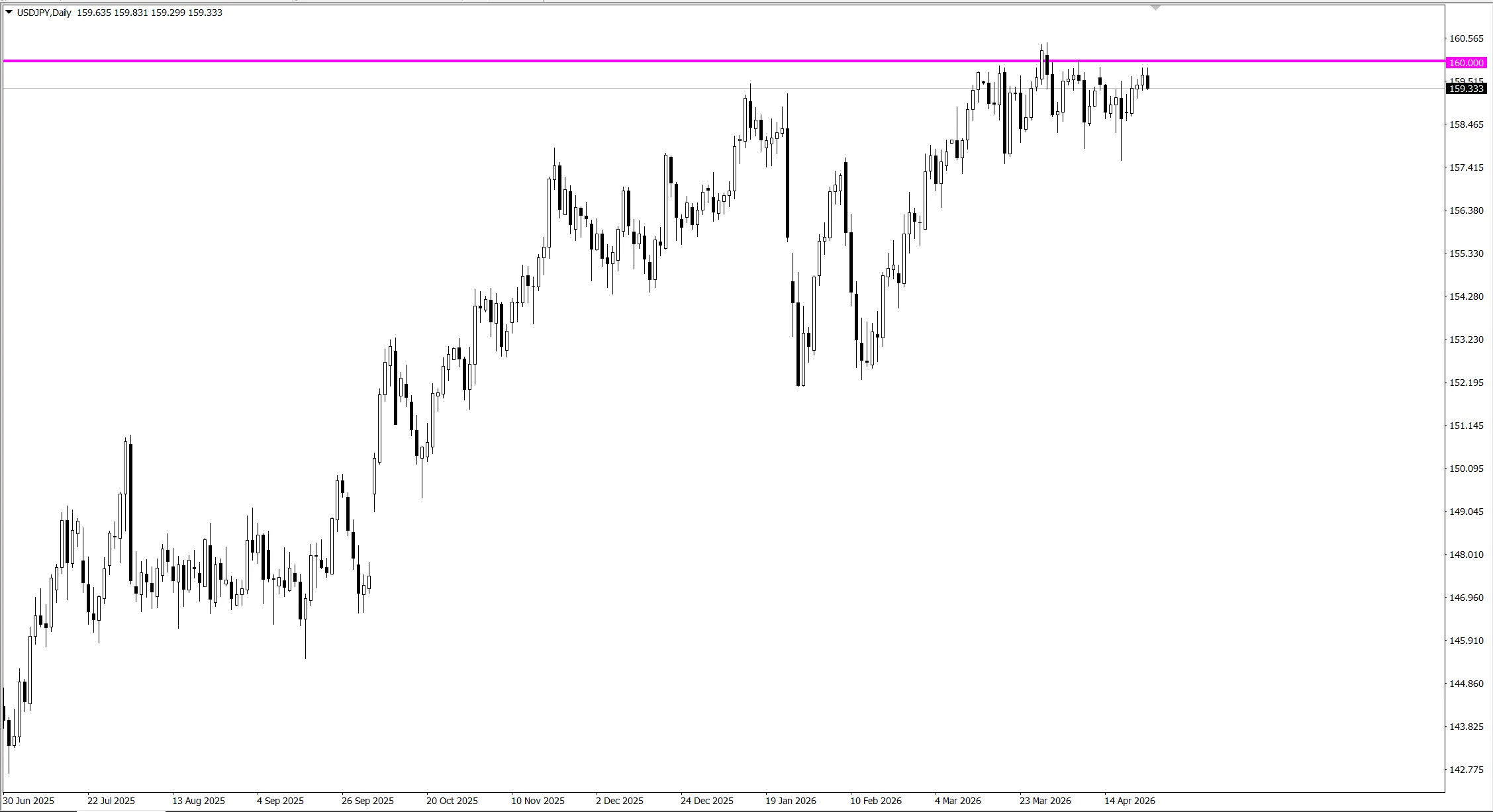
currently the price is at a ceiling of around 160 yen, forming a sideways market.
The pink line marks the 160 yen level.
Fundamentally, the situation is clearly yen-selling now.
Even though Japan’s inflation rate exceeds 3%,
the policy rate is 0.75%.
And there seems to be no rate hike in April.
Real interest rates are clearly expected to stay negative for the time being, and
as Governor Ueda has stated, the current situation is effectively accommodative,
now in Japan, despite this level of inflation,
the policy remains accommodative.
Furthermore, due to soaring gasoline prices,
gasoline subsidies and price-rise countermeasures
are being provided with unprecedented subsidies.
And because tax increases are not easily feasible,
the government must rely on issuing government bonds.
Considering these factors, it is clearly a case of yen-selling.
However, in reality, the market has remained largely sideways recently.
Why is that?
Because traders fear intervention,
institutional investors and large players are not aggressively selling the yen.
There have been remarks from Finance Minister Shun To Kaney:
and last month, from Senior Financial Counselor Jun Mizuta
“If this situation continues, decisive measures will be necessary.”
As indicated, if the rate surpasses 160 yen, currency intervention may occur.
Under such circumstances, you cannot boldly sell the yen at current prices.
Rather, the public waits for intervention to occur, to unleash a sharp yen sell-off.
If you do not understand this background,
you may wonder, why isn’t there more yen depreciation?
and end up buying USD/JPY.
And you may be wrecked by intervention.
Moreover, in technical analysis,
you might think, since price moved a bit higher,
it's a breakout, so you long-entry!
Let’s not do that (laugh).
If you trade without reading supply and demand, merely by technical analysis and looking only at the surface of the chart,
you will end up making such trades.
The reason I usually deny technical analysis and insist on watching supply and demand is
for these reasons.
What are market participants thinking now?
What positions do they hold,
or what positions are they considering taking,
what would trigger what actions?
If you do not grasp these and trade, you will merely be swayed by the market.
And even if you are swayed, you won’t understand why the price moved,
and you will dismiss it as a trap.
Everything important is supply and demand.
Whether in stocks or in foreign exchange, it is all supply and demand.
Supply and demand determine prices.
And what makes it possible to judge these without discretion is
“Ten-Ten FX Logic”.
It is all about following the market,
a logic focused on that,
making consistently advantageous trades possible.
So, this time
I explained concretely what “supply and demand” is, which I often talk about.
Well then, please have a good weekend.
If you wish to trade using a non-discretionary logic by reading supply and demand,
please take a look here.