

[Realistic] A strategy to capture 5 pips daily with USD/JPY — thinking to accumulate 100 pips per month
“I want to win steadily, even if it’s just 5 pips a day.”
I think many people feel this way.
You don’t need to take 50 pips every day. Just 5 pips a day will do. 100 pips a month for 20 trading days. 100,000 yen per month with 1 lot (100,000 currency units). Even with 0.5 lot, 50,000 yen per month.
There’s no flashiness. But what if you continued this for 12 months? 1.2 million yen a year. With compounding, it would grow even more.
“5 pips a day” may look plain, but it’s actually an incredibly powerful strategy.
However, very few people can actually sustain it.
Why?
The true reason why daily 5 pips is hard
5 pips isn’t hard. USD/JPY has a spread of 0.2 pips. There are dozens of opportunities to move 5 pips in a day.
That’s true. Earning a 5-pip range isn’t difficult in itself.
What’s hard is “taking 5 pips and stopping for the day.”
Have you ever had such experiences?
・You take 5 pips. But you think “I could take a bit more,” so you enter again. You lose. Break-even overall.
・You take 5 pips. Feeling confident, you increase the lot size. In the next trade you lose 10 pips.
・On a day you didn’t take 5 pips, you panic, thinking “I have to make up for it,” and enter repeatedly. You big-loser.
In the end, it’s not the skill of taking 5 pips that matters, but the mental discipline to be satisfied with 5 pips and stop.
“One more trade” breaks everything
The pattern that collapses the daily 5-pips strategy is almost always this.
“Just one more trade.”
With this single phrase, the accumulated profits vanish.
If you continue 5 pips for four days in a row for +20 pips, on the fifth day with “one more,” you lose -15 pips. Weekly profits shrink to +5 pips.
That is the true nature of “you should be able to take 5 pips every day, yet end of month you’re flat.”
So what should you do?
There are two solutions.
① Set a daily number of trades and don’t exceed it
Decide “up to 2 trades per day.” If you’ve entered twice, close the chart. Whether you win or lose.
Simple, but this is the most effective.
② Tighten your entry criteria
Don’t enter just because it seems like price will move. Enter only when clear conditions are met.
The stricter the criteria, the fewer entries. If the number of entries decreases, the temptation to take “one more trade” also decreases.
Best time window for the daily 5 pips
If you want to take 5 pips with USD/JPY, choosing the right time window is important.
Tokyo session (9:00–15:00) is optimal.
Reason is simple. In the Tokyo session, technical analysis works best. Price moves are gentle, MA touches function straightforwardly. Fakes are fewer.
You don’t need $30 movement to take 5 pips. If volatility is too large, your SL can be taken in an instant.
Aim only at moments when price touches the MA during the Tokyo session’s calm moves. This is the basic 5-pips strategy.
In particular, around the settlement time (9:55) patterns tend to form. On specific days like the 5th and 10th, currency selling toward the settlement can occur, and you can take 5 pips just from that.
Three elements needed for the 5-pips strategy
To take 5 pips steadily every day, three minimum elements are required.
① Clear entry conditions
Not “somehow,” but “When these conditions are met, I enter.” If conditions aren’t met, don’t enter. It’s okay to have days with 0 trades.
② Predefined TP/SL
If TP/SL isn’t decided before entry, you’ll end up deciding with emotions. If you decide to take 5 pips, set TP to 5–8 pips and SL to 3–5 pips in advance.
③ TP/SL suited to volatility
This is the point most overlooked.
Even if you fix “TP 5 pips,” in low-volatility periods you might not reach 5 pips. Conversely, in high-volatility periods, 5 pips can be hit instantly, but so can the SL.
TP/SL should be adjusted to the current volatility. But calculating it manually every time isn’t practical.
Where many people stumble
The daily 5-pips strategy is theoretically simple.
・Enter on MA touch in Tokyo time
・TP 5–8 pips, SL 3–5 pips; up to 2 trades per day
・Don’t enter unless conditions are met
But in practice, trying to do this every day leads to:
・Judging whether an MA touch actually occurred is subtle and confusing
・Calculating TP/SL each time is tedious
・Getting ahead of yourself, entering thinking it might touch soon
・Feeling pressured because you haven’t entered yet today, even when conditions aren’t met
Ultimately, as long as a human is involved, emotions enter. Once emotions enter, rules break. When rules break, the 5-pips strategy stops working.
A solution: KURAMA USDJPY SIGNAL
I developed KURAMA USDJPY SIGNAL (KUS) precisely to solve this problem.
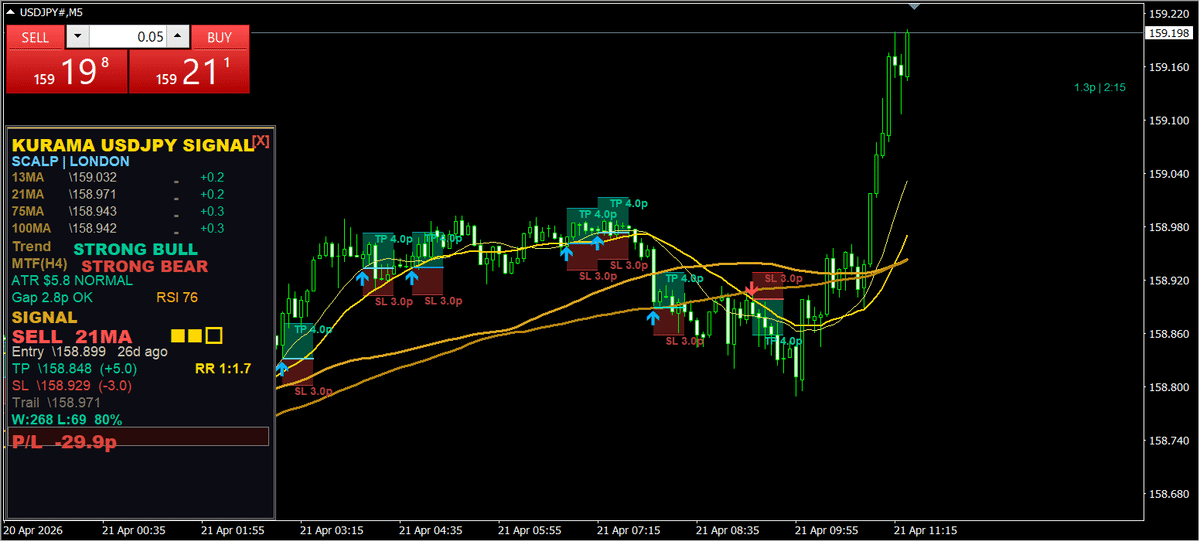
Whether the MA was touched → KUS automatically judges and issues a signal
No need to worry about “was the touch real?” KUS analyzes the market environment with seven filters and only signals when the conditions are met.
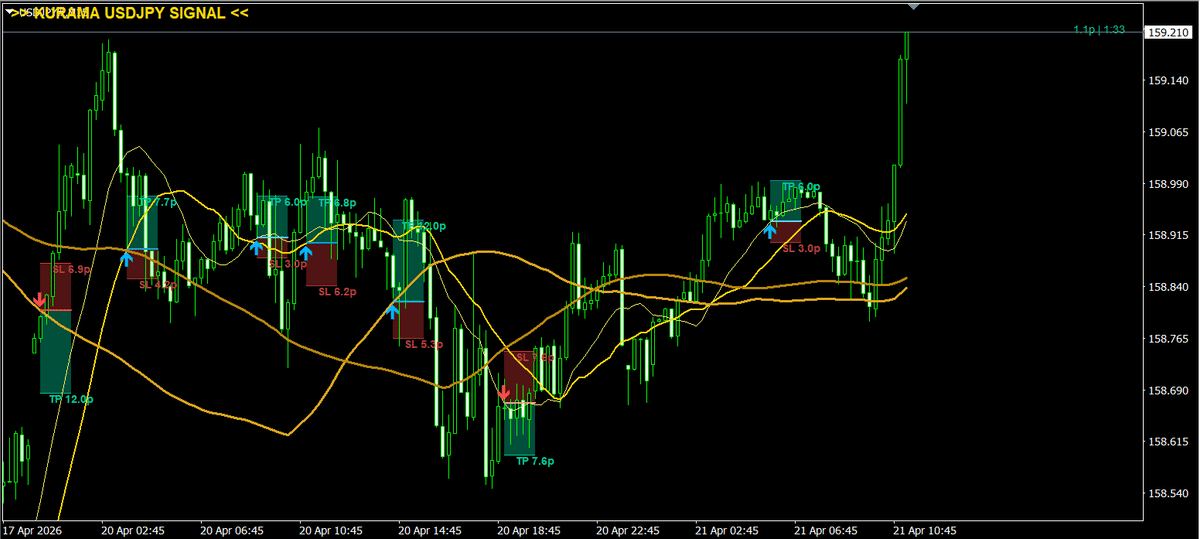
TP/SL calculation → displayed automatically based on ATR
At the entry signal, TP/SL is shown on the chart. The green zone is take-profit, the red zone is stop-loss. Place your order using the displayed numbers.
Moreover, TP/SL is not fixed. It dynamically recalculates based on ATR, automatically generating tight settings aligned with Tokyo session volatility.
Quality scoring for selection
All signals carry a quality score from ★ to ★★★. Limiting to ★★★ allows trading only in high-probability moments.
What’s important in the 5-pips strategy is entering only in high-win-rate situations. The quality score visualizes that.
How to use the 5-pips strategy with KUS
Concretely, here’s how it works.
① Display KUS on the M5 chart
② Wait for signals during Tokyo time (9:00–15:00)
③ If a signal of ★★ or higher appears, place the order with the shown TP/SL
④ Trade up to 2 times per day, then close the chart
That’s all.
If no signal appears, don’t enter. Skip signals with ★1. If you enter twice, you’re done.
“I couldn’t enter today” is perfectly fine. It’s 100 times better not to enter and lose than to force-entry and lose.
What lies beyond daily 5 pips
Daily 5 pips. 100 pips a month. 1,200 pips a year.
With 1 lot, that’s 1.2 million yen a year. With 2 lots, 2.4 million yen.
And as your capital grows, you can increase lot size, accelerating compounding.
Flashy trading isn’t necessary. Do it steadily every day, repeating the same thing.
What matters is not whether you took 5 pips today, but whether you followed the rules. If you keep following the rules, the results will come later.
Details of KURAMA USDJPY SIGNAL here
https://www.gogojungle.co.jp/tools/indicators/77817