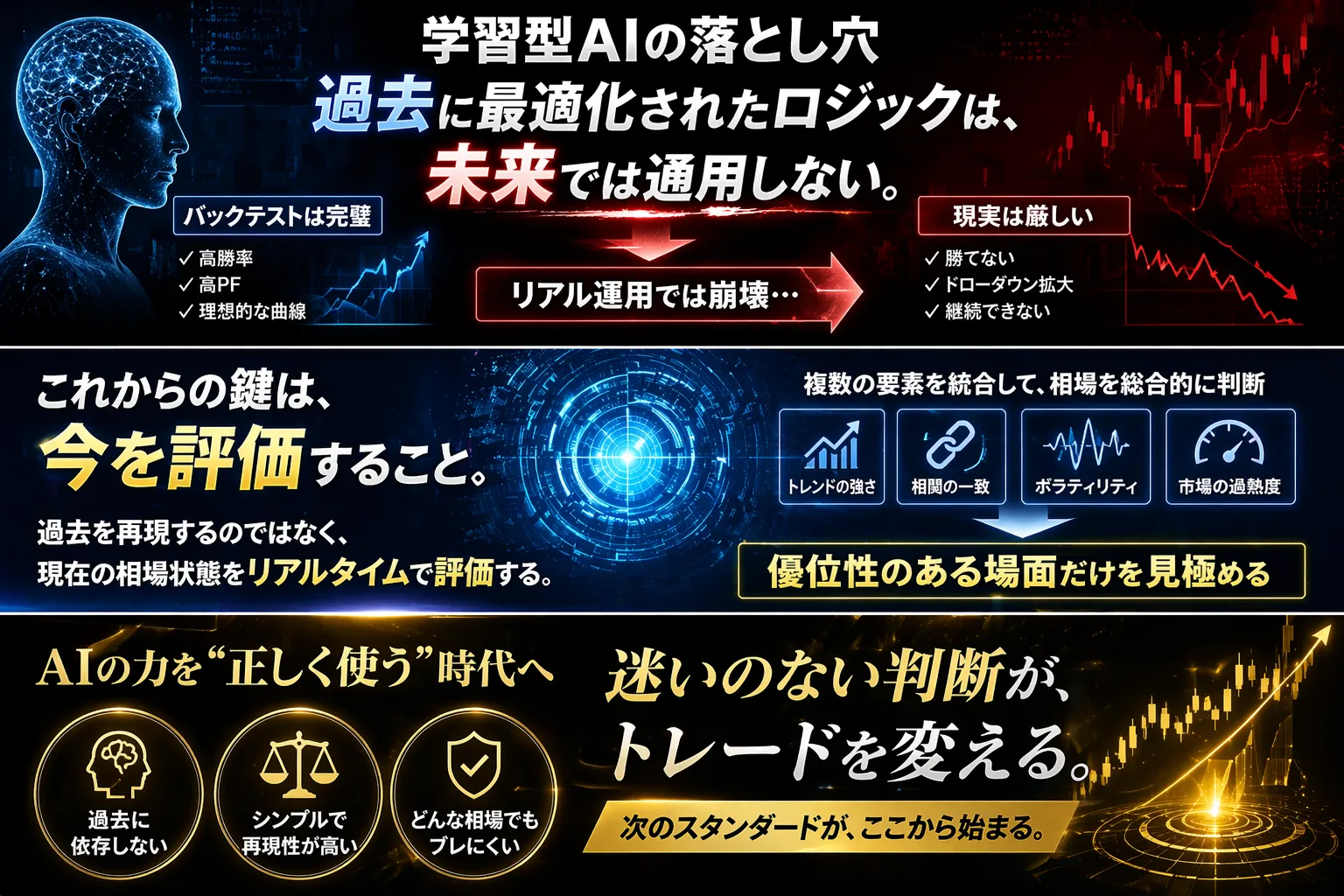

Are AI tools dangerous? The reason you lose in trading because they are “too smart”
“Learning AI vs Non-Learning AI”
What is the logic we should truly choose from now on?
In recent years, the word “AI” has become commonplace in the world of FX.
On sales pages for EAs (automatic trading) and indicators,
words like
“machine learning,” “self-optimization,” “deep learning”
and so on line up.
At a glance, it looks extremely advanced and capable of predicting the future
as the “strongest mechanism.”
However, many traders who have actually used them notice a common unease.“Why can’t AI consistently win, even though it’s AI?”
■ That’s the trap of overfitting
The main cause is
“overfitting”.
In simple terms, being tuned too closely to the past.
Backtests show astonishingly clean results, but
they fail to work in actual markets.
This isn’t rare;
it’s more like a common pattern.
Why? Because markets are inherently “full of noise,”
and they keep changing.
In other words,
the more parameters and timeframes you optimize,
the more fragile the logic becomes for the future
and there is a structure to that effect.
■ Why does AI lose even though it’s AI?
Now, let’s calmly think about one thing.
Where does the image that “AI = winning” come from?
From what source does it originate?
Automatically learns
Makes optimal decisions
Is smarter than humans
It is indeed appealing.
But to what is that “intelligence” applied?
The answer is simple.
It is applied to “past data.”
■ Is the premise off?
There is a big misalignment here.
Many AI logics are
trained on past price movements and analyzed
extract the most efficient patterns (and the reverse)
and try to apply them to the present and future
This is the structure.
It seems reasonable at first glance, but
there is a fatal problem in trading.
That is,
“the market does not repeat the same moves.”
This is the reality.
■ What’s happening
In real-world practice,
backtests are perfect
forward testing starts to fail
it breaks in real trading
And then new “AI” tools appear again. This cycle has been repeating.
What happens next is the same.
■ Can AI not be used?
Here lies one misunderstanding.
“So is AI not good?”
This isn’t the question.
On the contrary.
The AI-like way of thinking itself is very effective
in trading.
The issue is
“how you use it” is off.
That is the point.
■ A noticeable change now underway
some say
there is a movement in a completely different direction.
Instead of trying to
perfectly reproduce the past
maximize numerical results
we are steering in a completely different direction.
It’s a move in a direction that cannot be namedyet.yet.
■ The hint is “now”
The hint for this way of thinking is very simple.
Not the past,
how we view “the market right now, in this moment”
Is it a trend
Is it ranging
Or neither
Is there volatility
Is volume increasing
Or is it,is it dangerous now
We evaluate this information in real time, without relying on the past,
and make decisions “on the spot.”
■ The decisive difference from the past
Traditional logic
“looks for the answer in the past”If so,
the new approach
“evaluates the current situation correctly”
This is the key.
Because even if the future cannot be predicted,
the present can be evaluated accurately.
■ And one more change
Even more importantly, the evaluation method itself is changing.
Previously,
look at indicators individually
check conditions one by one
was common.
But now,
a mindset that treats them collectively is beginning to spread.
■ What is happening?
Multiple market elements are not scattered, but
consolidated into a single standard.
And that standard becomes the basis for judgment itself.
Once you arrive here,
traditional indicators and EAs start to enter a different realm.
They are no longer the same as before.
■ What happens next
As this flow progresses, how will trading change?
Decision-making becomes more straightforward
Unnecessary entries decrease
Reproducibility increases
And above all,
there will be no more hesitation.
■ Areas still not widely known
However, this way of thinking is not mainstream.
Many people are still focused on
backtest numbers and the abundance of features
the impact of the term learning AI
and overlook other considerations.
But behind the scenes, gradually and surely,
a different standard is becoming widespread.
It is spreading as the new standard.
■ Summary
AI isn’t inherently bad, and learning isn’t inherently bad.
The issue is
“where you are looking.”
Are you looking at the past
This difference is increasingly separating outcomes.
There is a movement to change even the way you view things.