

Reasons why day trading and swing trading are better than scalping

▼Details page for Sanjo Nopo FX
https://www.gogojungle.co.jp/tools/indicators/65204?via=users_products
I am SEI from Trading Labo+.
Thank you always for visiting.
Today’s topic is “Why day trading and swing trading are better than scalping.”
◆ The allure and traps of scalping
“Trade dozens of times a day, steadily accumulate small profits.”
There is such an appealing image of scalping.
Results appear in a short time. High turnover of funds. Profit is visible quickly.
That’s why many beginners are drawn to scalping.
However, there is actually a big trap here.
Scalping is the most difficult trading style.
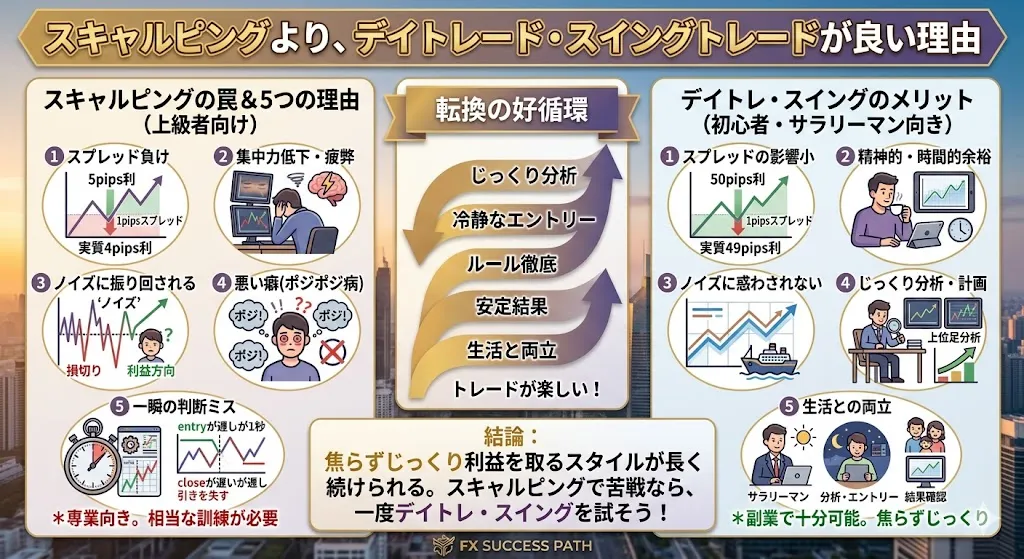
Five reasons scalping is difficult
1. Easy to lose to spread
Scalping aims for a few pips of profit.
For example, aiming for 5 pips of profit, but with a 1 pip spread, you effectively need to move 6 pips to be profitable.
Profit can be reduced by about 20% due to the spread.
If you repeat this dozens of times a day, the spread alone can cause substantial losses.
2. Concentration wanes and you tire
Scalping requires staying glued to the chart at all times.
Never miss a second, judge instantly, and repeat entries and exits.
This level of concentration doesn’t last for hours.
Fatigue lowers judgment, increases mistakes, and losses snowball.
3. Noise causes misdirection
1-minute or 5-minute charts are full of noise.
You get pulled by temporary fluctuations rather than genuine price movement.
You get stopped out by noise, only to move in profit shortly after.
This frustration is experienced repeatedly.
4. Bad habits form easily
Continuing scalping tends to form bad habits such as:
Position-Positivity Disease: You must always hold a position. Enter even when there’s no real opportunity.
Impatience: Rapid price moves lead to hurried entries without calm judgment.
Inability to extend profits: You quickly take profits at the first sign of profit.
Once these habits set in, they affect other timeframes too.
5. A single moment of misjudgment can be fatal
In scalping, a single moment of misjudgment can be deadly.
A one-second delay in entry can trigger a stop-out.
A one-second delay in taking profits can erase gains.
Trading under this tension makes it extremely difficult to avoid mistakes.
Advantages of day trading and swing trading
So, what are the advantages of day trading or swing trading?
1. Smaller impact from spreads
Day trading and swing trading target tens to hundreds of pips.
For example, aiming for 50 pips of profit, even with a 1-pip spread, the impact is about 2%.
Spread impact is overwhelmingly small.
2. Time and mental energy are preserved
With day trading, after entering you can wait for several hours to half a day for the exit.
With swing trading, you hold for days to weeks.
You don’t need to stay glued to the chart constantly.
Once you enter, set stop loss and take profit, then leave it to the market.
This margin allows calm judgment.
3. Not easily swayed by noise
Timeframes like 15-minute, 1-hour, 4-hour, and daily charts help reduce noise.
It becomes easier to capture the essential trends and waves.
You can ride the larger trend without being pulled by temporary fluctuations.
4. Thorough analysis possible
Scalping requires instant decisions.
But day trading or swing trading allows careful pre-entry analysis.
Review multiple timeframes, identify support/resistance, and calculate risk-reward.
Trade calmly and methodically.
5. Easier to balance with life
Scalping is difficult unless you trade full-time.
However, day trading or swing trading can fit a typical work schedule.
Analyze before work in the morning, trade, and review results after returning home at night.
You can balance life and trading without strain.
Difference in capital efficiency
“Isn’t scalping more capital-efficient due to higher turnover?”
You might think so, but the reality is different.
Scalping: high turnover, small profit per trade
You can place dozens of trades per day.
But profit per trade is only a few pips.
Moreover, spread and fees greatly reduce actual profit.
Day trading and swing: larger profit per trade
Day trading or swing involves fewer trades.
However, profit per trade targets tens to hundreds of pips.
Even with fewer trades, total profit can be large.
Which has better risk-reward?
Scalping often has around 1:1 risk-reward.
But day trading and swing trading can aim for 1:2 or 1:3 risk-reward.
If risk-reward is good, you can win in total even with 50% win rate.
From a capital-efficiency standpoint, day trading and swing trading are more favorable.
Mental strain differences
Trading is a mental game.
And mental burden varies greatly by trading style.
Scalping: constant tension, excessive stress
Scalping requires nonstop chart watching.
Every second counts. You cannot afford to let your guard down.
This tension lasts for hours.
Stress accumulates, fatigue sets in, and judgment falters.
Mistakes increase, losses cascade.
Day trading and swing: calm judgment with margin
With day trading or swing, after entering you don’t need to constantly watch the chart.
Set stop loss and take profit, then wait.
Mental burden is significantly lighter.
Having margin allows calm judgment. Being calm helps you follow the rules.
This virtuous cycle yields stable results.
What’s suitable for beginners and office workers?
So, which trading style is best for beginners and office workers?
Scalping: suited to full-time traders; requires considerable training
Scalping is for advanced traders.
A dedicated environment for trading full-time and substantial training are required.
• Instant decision making
• Long periods of concentration
• Mental resilience to stress
• Skills that exceed spreads
For a beginner, taking on scalping is an excessively high hurdle.
Day trading and swing: feasible as a side business
Day trading or swing trading can be done as a side job.
• Analyze before work and enter
• Focus on your job during the day
• Check results after returning home
You can balance life and trading without strain.
Gentle on beginners, ideal for office workers.
My own experience: moved away from scalping and started winning
I, too, started with scalping in the beginning.
I was drawn to the appeal of earning in a short time.
I became exhausted, developed Position-Positivity Disease, and kept losing.
Still, the results were terrible.
Sticking to charts continuously led to fatigue and poor judgment.
I entered even when there was no real opportunity due to impatience.
I repeatedly traded ignoring the rules out of haste.
Losing streak continued, funds dwindled.
After changing to day trading or swing trading, stability returned
So I boldly changed my trading style.
Day trading on 15-minute or 1-hour charts, and swing trading on 4-hour charts.
The results changed dramatically.
Careful analysis improved entry accuracy
Mental margin allowed me to follow rules
Not having to glued to the charts reduced fatigue
Larger profit per trade meant fewer trades could still be profitable
Gradually, I started to win consistently.
Mental ease made trading enjoyable
And more than anything, trading became enjoyable.
During scalping, trading felt painful.
Constant tension, fatigue, and stress were present.
However, after switching to day trading or swing trading, trading became enjoyable.
Having margin allowed you to analyze calmly. Trade according to plan.
This change made me a successful trader.
Summary: A slow, steady profits approach is sustainable long-term
There is certainly appeal in scalping.
However, for beginners and office workers, day trading and swing trading are overwhelmingly more suitable.
Scalping is for advanced users
• Easy to lose to spreads
• Concentration cannot be sustained
• Easily swayed by noise
• Bad habits form easily
• Difficult unless trading full-time
Benefits of day trading and swing
• Less impact from spreads
• Time and mental margin
• Not swayed by noise
• Thorough analysis possible
• Easier to balance with life
• Better risk-reward ratio
• Lower mental burden
A style that can slowly and steadily build profits lasts longer.
If you are struggling with scalping now, try day trading or swing trading once.
Like me, your results might dramatically change.
Trading is not a short-term battle.
What matters is to continue for a long time and earn stable profits.
To do that, choose a trading style that is not overbearing.
That is the first step toward success.
◆ “Sanjo Nopo FX” is perfect for these people.
・Those whose trading time is limited due to night shifts or irregular work
・Parents raising children and cannot stay glued to charts
・Office workers doing FX as a side business
・Those who are not good at complex analysis and want simple trading
・Those who find it bothersome to look at dozens of indicators
・Those who lack confidence in chart pattern judgments
・Those who want to aim for large pips efficiently with little time
・Those who prefer swing trading to scalping
・
・Those who worry about where to cut losses and end up in salt positions
・Those who have become a nosy information gatherer
・Those who are troubled by not winning even after buying signal tools

◆ How to join Sanjo Nobo FX is here ↓ ↓ ↓
https://www.gogojungle.co.jp/tools/indicators/65204?via=users_products

◆ How to join Sanjo Nobo FX is here ↓ ↓ ↓
https://www.gogojungle.co.jp/tools/indicators/65204?via=users_products