

【FX】Explain gently why it reverses in London time|Causes and countermeasures when going backwards from Tokyo time
【FX】簡単に解説する理由 why prices reverse in London time|原因と対処法 from Tokyo time
This is Shirou!
When London time begins, do you have these concerns?

Entering London time and getting stopped out

Before London time, it was fine, but once London time started, you were stopped out
In this article,
we will thoroughly explain the reasons why prices temporarily reverse during London time.
I will explain in a way that even beginners can understand.
【FX】Thorough explanation of why prices reverse in London time

In Tokyo time,
the trend-following by higher timeframes succeeded! Will you take profits as is?
and yet once London time arrives, it reverses,and you get stopped out!
Have you had that experience?
The reasons and causes are
orders and stop-loss accumulateandmake it easy to be huntedbecause
it's easier to hunt during these times.
Let me explain clearly.
For example, at the start of Tokyo time, sell positions start piling up.
This means many orders have accumulated.
Stop-losses accumulate as well.
There will be a lot of orders and stop-losses piling up.
The market is of course selling, so it gradually declines.
(In the image, for nowplease only look at Japan time)
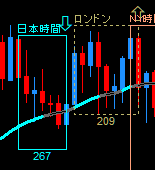
London time arrives.
London traders firstpay attention to cross currencies.
In Tokyo time, cross currencieshave many orders and stop-losses from Japanese traders and institutions, so
the London players will hunt down the areas that dropped in Tokyo time
and target the Japanese session.
For London players, it is a very easy market to hunt in.
Especially when, as in the image, it drops cleanly, be careful..
Image explanations
Let's dig a little deeper.
I made an image.
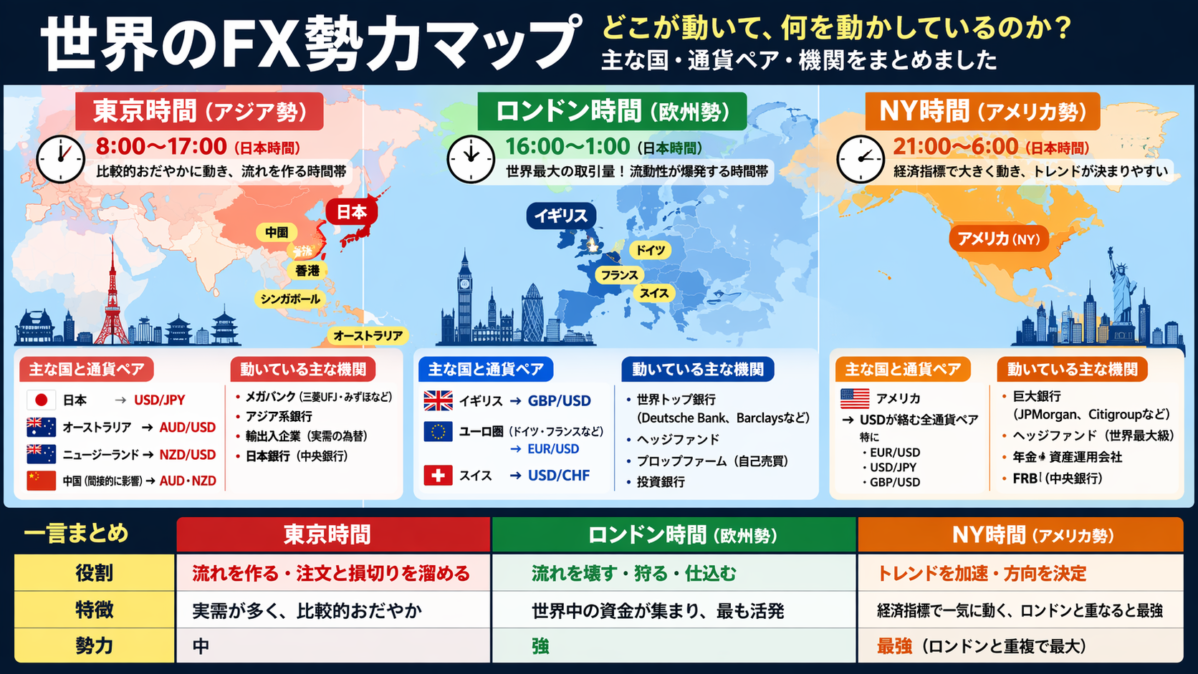
Volatility
Tokyo time (Asia) < London time
and volatility becomes especially large from London time.

Looking at only the map, actuallyAsia is bigger, so why is London time more volatile?
There are two reasons for this.
First, geographicallylocated between Asia and NY,where money concentrates from both sidesis one reason.
The world's top banks are in Europe as well (such as Barclays Bank).
Another reason is that
FX trading volume is about 8 times Tokyo's. Moreoverit is only in Britain’s London.
As for FX liquidity, roughly speaking,
- Europe (London-centric):40~45%
- North America (New York-centric):25%
- Asia (Tokyo, Singapore, etc.):20%
- Others (Middle East, Oceania, etc.):10%
That was the data.
Trading in Europe-led regions is among the world's top, and when London time comes, the market becomes active.

Summary

So, this was an explanation of why a favorable Tokyo-time market gets hunted by London players.
Again, the scale of trading and volume is completely different...
In actual markets, you will not always be hunted, such as
- a pattern where it rises slightly in Tokyo time and continues to rise
- a pattern where Tokyo time is range-bound and a trend emerges in London time
There are various possibilities.
When Tokyo time shows clean rises or falls, be especially careful of London time approaching.