
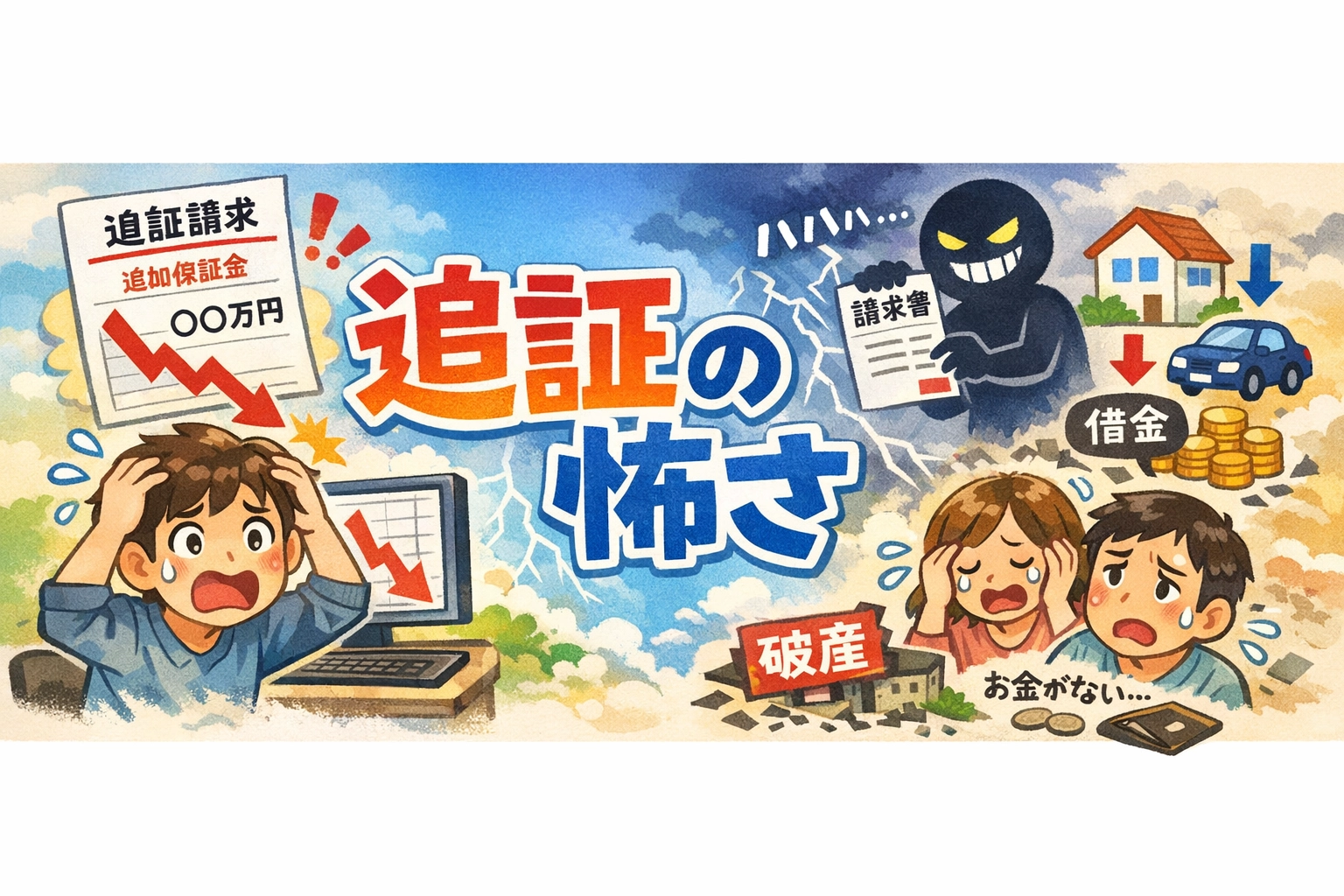
The Fear of a Margin Call
Just hearing the word "margin call" still makes my stomach churn. I’ll never forget—that was about ten years after I started investing. One morning, when I had a sizable position in a margin account, I received a message from my securities company on my smartphone: "The deposit maintenance ratio fell below the minimum maintenance margin, so please deposit additional margin by noon on the next business day."
The moment I read it, my mind went completely blank. I understood there was a risk of a margin call in theory, but when it actually happened, the fear was completely unimaginable. That morning, I realized that intellectual understanding and bodily sensation are two totally different things.
A margin call, officially called additional margin, is a system that requires investors who are using margin trading and have suffered losses due to rapid market changes to deposit additional collateral when the value of the collateral they have deposited falls below the minimum maintenance ratio set by the securities company.
Why does such a system exist? It is to protect the money and shares loaned by the securities company. In margin trading, the securities company lends money or stocks to the investor. If the investor incurs losses and those losses surpass the margin, the securities company suffers a loss. To prevent that, a mechanism is in place that requires additional margin once losses reach a certain level.
Let me explain the mechanism of the margin maintenance ratio with concrete numbers. For example, if you deposit 1,000,000 yen as margin and buy 3,000,000 yen worth of stocks with leverage, the margin ratio is 1,000,000 divided by 3,000,000, i.e., 33.3%. If the securities company's minimum maintenance rate is 20%, then for a 3,000,000 yen position, at least 600,000 yen of margin is required.
Suppose the stock price then falls by 10%. The 3,000,000 yen position becomes 2,700,000 yen, and the 300,000 yen loss is deducted from the margin. The margin becomes 1,000,000 minus 300,000, i.e., 700,000 yen. At this point, the margin ratio is 700,000 divided by 2,700,000, which is 25.9%. Since it still remains above the minimum maintenance rate of 20%, no margin call is issued.
But if the stock price falls further and the position becomes 2,500,000 yen, the total loss is 500,000 yen. The margin would be 500,000 yen. The margin ratio would be 500,000 divided by 2,500,000, i.e., 20%. It has just reached the minimum maintenance rate.
If it falls a little more and the position becomes 2,450,000 yen, the loss would be 550,000 yen and the margin would be 450,000 yen. The margin ratio would be 450,000 divided by 2,450,000, which is 18.4%. Because it falls below the 20% minimum maintenance rate, this is where you would receive a margin call notification.
When a margin call arrives, investors basically have two options. One is to deposit additional funds and replenish the margin. The other is to partially or fully close the position to reduce its size. If neither is possible or you cannot respond by the deadline, the securities company will forcibly close the position. This is called forced liquidation.
When forced liquidation is executed, market conditions are often at their worst. That is because a margin call indicates the market is moving sharply. In such situations, you may find you cannot sell even if you want to, or your position may be liquidated at the worst possible moment.
I’ll tell you more about the day I experienced a margin call. The American stock market had fallen sharply the previous night. I couldn’t sleep worrying about the impact on the Japanese market the next morning, and when I checked my phone before the market opened, I saw the margin call notification.
What I felt first was denial: "This can’t be happening." Next came panic: "What should I do?" My mind started spinning. And finally, regret: "Why did I take such a large position?"
That morning, after the market opened, price movements were brutal. Following the drop in the previous day’s U.S. market, the Japanese market opened sharply lower, and my position’s losses expanded further. The amount of the margin call kept increasing. Even if I wanted to top up, there was only so much cash I could quickly arrange.
In the end, I cut part of the position to manage it. But the timing of that cut was terrible, and when the stock price later rebounded, the losses turned out to be much larger than the actual bottom. I still remember the exact amount of loss from that day. It’s etched in my memory with striking clarity.
There are several reasons why a margin call is frightening. First, the psychological damage is enormous. A margin call means a large loss has already occurred. The decision to add more funds in that situation is an extremely difficult mental task. The reluctance to add funds to a losing position, and the fear that losses could grow further if you don’t, come at you simultaneously.
Second, there is time pressure. Margin calls have deadlines. The next business day at noon is common, but sometimes deadlines can be even shorter. Under this time pressure, it is very hard to make a calm decision.
Third, there is the risk of a chain reaction of margin calls. Even if you add cash to meet a margin call, if the market falls further, another margin call can come. Repeatedly adding funds can eventually exhaust all your available capital. This is known as the chain reaction of margin calls.
Throughout history, there have been many cases where the chain reaction of margin calls caused substantial damage to individual investors. During the Lehman Shock, the Japanese stock market fell for months. Many investors with large margin positions were swept up in the chain reaction of margin calls, losing all their cash and incurring heavy debts. People who describe that period call it a hellish experience.
The COVID-19 shock was similar. In March 2020, Japan’s stock market fell more than 30% in just a few weeks. Investors who held long positions on margin were overwhelmed by margin calls in no time. Many investors who couldn’t meet them were forcibly liquidated at the worst times.
What is the worst response when a margin call arrives? To borrow money to meet it. Some investors borrow from consumer finance companies or card loans to cover their margin calls, but this must be avoided at all costs. You should never cover losses with borrowed money. If the market falls again, you’ll face the double hardship of investment losses plus debt repayment.
The most important step to avoid margin calls is not to use excessive leverage from the start. Using full leverage in margin trading carries the risk of margin calls from even small market movements. Markets will move unpredictably if you trade for a long time, and holding a fully leveraged position makes it very hard to respond when that happens.
One rule I impose on myself when taking positions in margin trading is to keep leverage within a range that I can handle calmly even if a margin call comes. Specifically, I set it so that even a 30% drop would not trigger a margin call. The 30% figure is based on the maximum drawdown observed in past large declines.
Another important point is to keep a separate pool of funds for margin trading, available to respond immediately if a margin call occurs. Having this contingency cash apart from the margin collateral makes a huge difference to mental composure when margin calls happen.
The fear of margin trading lies in the possibility that losses can snowball. When the market plunges, many investors rush to sell. That selling pressure further pushes prices down, causing forced liquidations of margin-call investors and creating a vicious circle of falling stock prices. This is called a chain of declines.
In such market panics, it is extremely hard for individual investors to think calmly. When losses mount, there is a strong psychological resistance to admitting it. Hope that the market will recover if you wait a bit longer delays the decision to cut, and losses grow during that period. This is the most typical failure pattern in margin trading.
After experiencing a margin call, I drastically reduced my margin trading positions and spent about a year engaging only in cash trading. What I felt during that period was the psychological stability of cash trading. Even if the market falls, at worst you only stand to lose the invested amount. There is no fear of a margin call or forced liquidation. That sense of security more than compensates for the lower profit potential of cash trading.
What I learned from experience with margin calls: first, there will be moments when the market moves opposite to your expectation. No matter how confident your analysis, markets can move against you. It is important to humbly accept that reality and always prepare for the worst-case scenario.
Next, when a margin call arrives, decisions should be made by rules rather than emotions. A margin-call situation is an emotionally crushing state, and to make a calm decision you must mechanically follow pre-set rules. It is crucial to have a clear rule like: if a margin call comes, cut losses on a portion without hesitation.
And most importantly, you should only trade on margin within a range that does not affect your daily life. Margin trading is just one investment tool. You should not take risks that could destroy your living. Clearly separate living expenses, emergency funds, and investment capital.
I have a acquaintance who lost all his assets due to a chain of margin calls. He worked as a company employee while holding a large margin position. During the Lehman Shock, margin calls hit him repeatedly, and even spending all his cash was not enough; at one point he even had to consider selling his house. Fortunately he did not have to sell the house, but all the wealth built from investing disappeared.
What he told me afterward remains memorable: "The hardest thing at the time was having to decide, every time a margin-call notification arrived, whether to trust my own judgment or to give up. If I cut, the loss would be locked in and perhaps unrecoverable. But if I held on, the loss might expand further. Repeating that choice many times pushed me to my mental limit."
The margin-call system is not designed to protect investors. It is a system for risk management by securities companies. Understanding that, investors must think about measures to protect themselves.
Investing is most important when it lasts a long time. If you drop out after one failure, it’s over. I believe the only path to long-term investment success is properly managing the risk of margin calls and surviving through any market environment without exiting.
Margin trading is an attractive mechanism. But behind that charm lies a very harsh reality called margin calls. Facing this reality head-on and engaging with margin trading as an investor is an important step toward maturity. After learning the fear of margin calls, ask yourself again whether you still need to use margin trading. The answer will solidify your investment style.