
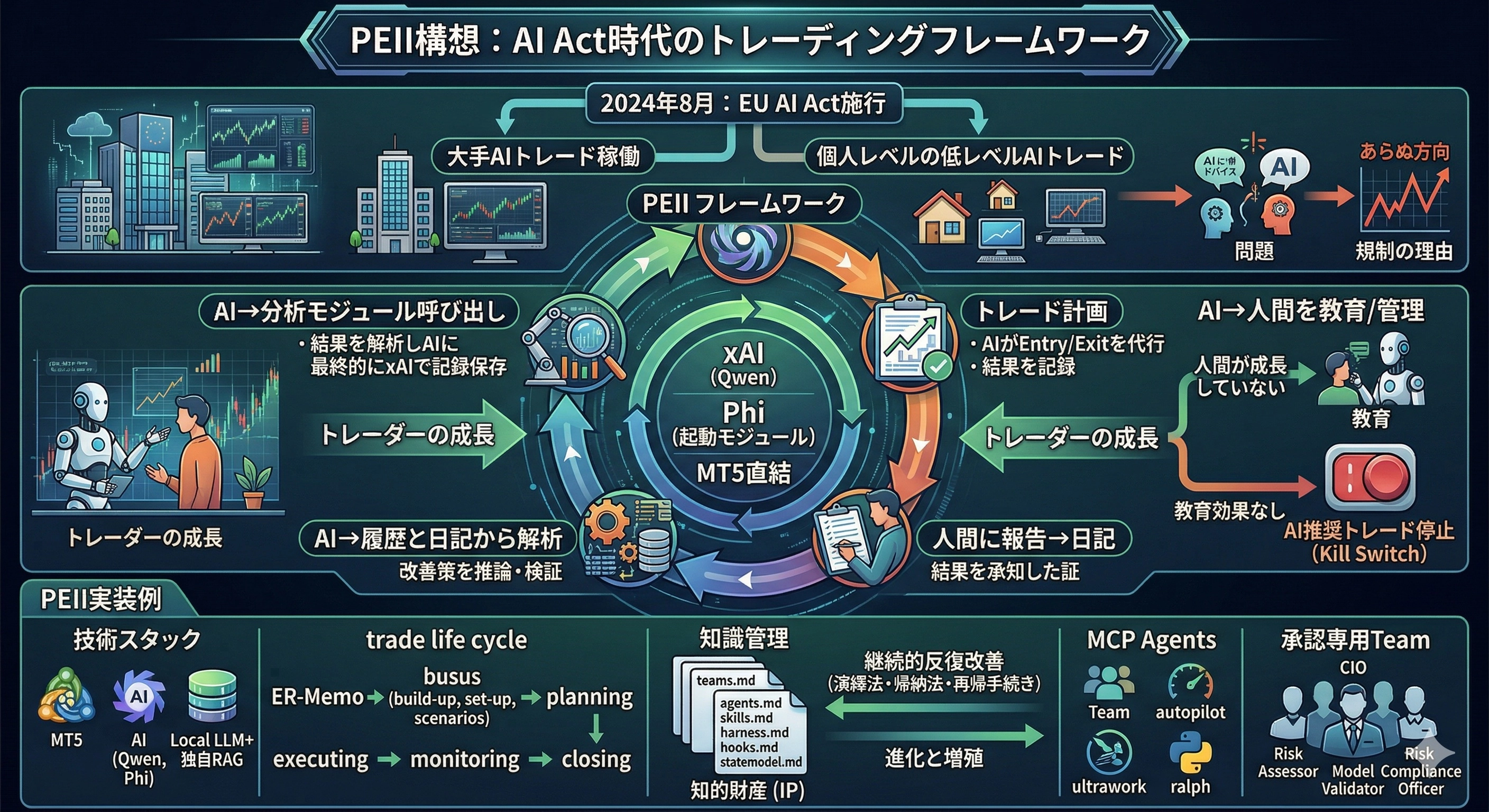
EU AI Act and its impact on trade - detailed explanation
EU AI Act and Its Impact on Trading - Detailed Explanation
Implementation of the EU AI Act
Starting this August, the EU AI Act (EU Regulation on Artificial Intelligence) will take effect, and AI is expected to directly influence market positions. Progress and levels differ among the UK/Ireland/Europe, the US, and Japan, but the commencement in the UK and EU has a significant impact.
In simple terms, the nature of market Price Action (price movements) is expected to change.
Two Major Changes
1. Serious AI Trading by Large Firms
Large financial institutions will start operating AI trading that has been thoroughly researched and developed.
2. AI Trading at the Individual Level
The issue is that individuals will engage in lower-level AI trading. When small contributions accumulate, AI responses may become biased, and if there are many of them, the chart could move in unintended directions due to overwhelming volume.
This is already studied and falls under the category of “AI risk usage.”
Foundational Premise of the EU AI Act
The core premise of this AI Act (regulation) is as follows.
The ultimate responsibility for trading lies with humans (organizations), and the goal is to prevent any escape by claiming “AI traded on its own.” Therefore, relying on AI to justify black-boxing is not acceptable.
Requirements for xAI (Explainable AI)
Technically, the concept of “xAI” (Explainable AI) becomes important.
| Requirements | Contents |
|---|---|
| Accountability | AI must output explanations in a way humans can understand |
| Consistency | The explanations and actions must not contradict |
| Attribution of Responsibility | The responsibility should be placed with humans (the organization) |
However, legally and scientifically, industry consensus is that this boundary is still gray.
Recommendations for Individual Traders
Individual traders should acquire mastery of AI-driven trading as soon as possible and lead the new era forward.