

How to avoid low-win-rate trades in day trading? How to create reproducibility to identify buying opportunities in the pre-market
Stock day trading is difficult.
A lot of individual investors may feel that way.
In fact, day trading targets short-term profits, but it requires rapid judgment and is easily swayed by emotions. In particular, the morning session of Japanese stocks is a time when trading volume expands quickly from the open and price movements accelerate rapidly.
What makes many individual investors prone to losses is not a lack of knowledge, but“where to buy, what to buy, and how to buy it” remains vague when entering the market.
When you see a rising stock, you jump in in a hurry.
When you see a stock that's falling, you naively bet on a rebound, assuming it will bounce back soon.
Profit-taking and stop-loss decisions are made based on the mood of the moment.
With this approach, even if some days happen to go well by chance, over the long term the earnings and losses won’t be stable.
What’s important in day trading is not chasing big movers on impulse, butavoiding low-probability battles and narrowing down to situations where you have an edge.
To achieve this, you first need to organize what kind of stocks to pick and what patterns you regard as buy opportunities.
【Example】Advantest (6857)
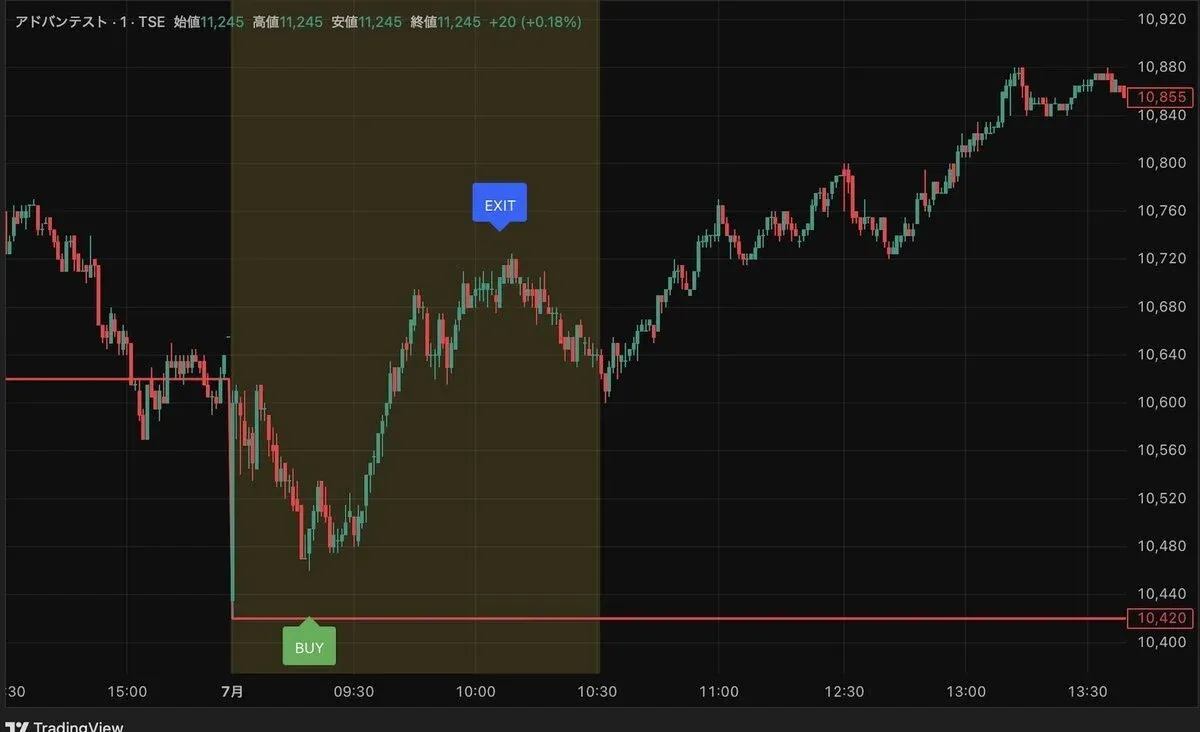
Common “vague buying and selling” among people who tend to lose in day trading
There are several common traits among people who struggle with day trading.
One is rushing into rising stocks.
If you join after buying has already moved once, you are easily swept up by the subsequent pullback and may end up selling out of fear.
Another is picking fallen stocks simply because they’re cheap, hoping for a rebound.
Entering without confirming a bottom makes it more likely to stray into a trading pattern that fights against the downtrend instead of aiming for a rebound.
Furthermore, if your criteria for taking profits and stopping losses are vague, your entry becomes vague as well, and the exit becomes even more vague.
Small profits get realized quickly, while losses are held out with the idea that “it might come back someday.” This is a common pitfall in day trading.
In short, people who lose more often trade with a vague sense of things.
Therefore, to avoid low-win-rate trades in day trading, you need, not a feeling, buta reproducible framework.
In day trading, the important thing is not “price range” but “reproducibility”
When people think of day trading, they tend to focus on which stock will move the most today. Of course, price movement is important. However, having price range and being able to extract profits are not the same thing.
What truly matters isbeing able to repeatedly pick under similar conditions.
Even if you happen to catch a big move once by chance, if you can’t reproduce it, you’ll hesitate in the next trade.
Conversely, if you only enter when the same conditions line up, you can verify your results whether you win or lose.
Which time frame to emphasize.
What to regard as a buy zone.
Where to consider taking profits or withdrawing.
Only when these four are organized does day trading shift from “luck” to “strategy.”
【Example】Kobelco (5801)
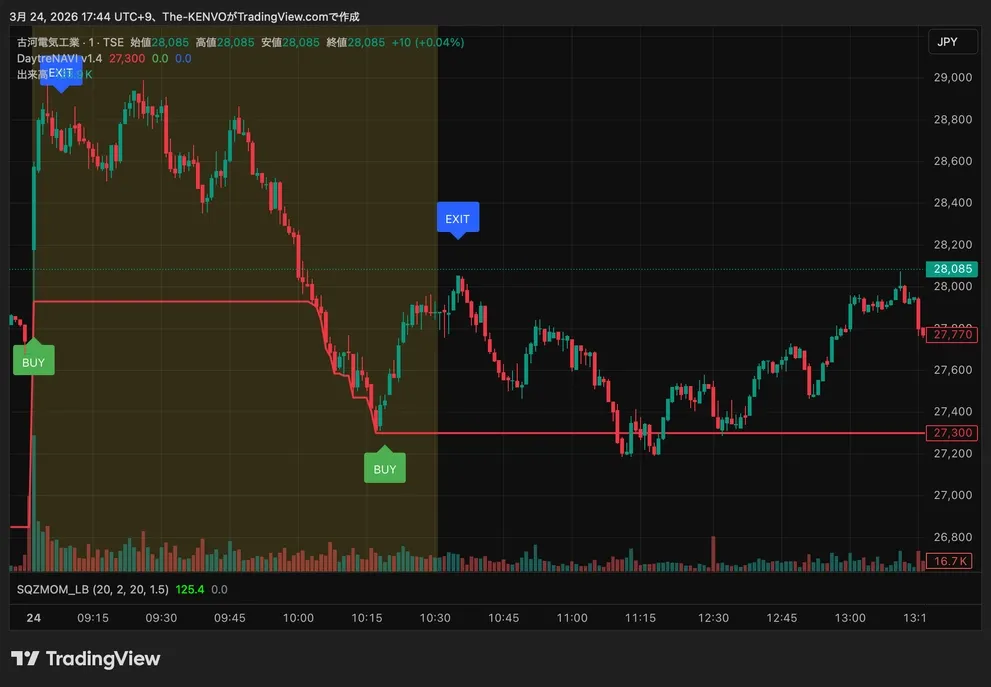
What kind of stocks should you day-trade—not just trading volume
What is often overlooked in day trading iswhich stocks should be the targets for buying and selling.
No matter how you optimize timing, if stock selection is poor, your ease of trading drops significantly.
First, and most importantly, you want to focus onstocks with high trading value.
Stocks with high trading value have many players, thicker order books, and tend to attract short-term liquidity.
In day trading, it’s important to enter when you want and exit when you want. For low-liquidity stocks, even with good signals, actual trading can be unfavorable. Therefore, focusing on high trading value stocks is a very practical approach.
However, high trading value alone is not enough.
Even if large-cap stocks have high trading value, if their market capitalization is enormous, the daily capital concentration may not be as high as expected.
What to pay attention to istrading value relative to market cap.
This is calculated as
Trading value ÷ Market capitalization
and essentially indicates how much capital rotates that day relative to market cap.
In other words, it measures how much short-term liquidity concentrates on that stockthat day.
Stocks that rank high in trading value and also have a high trading value-to-market cap ratio are not only well traded but are likely to be closer to the market’s center that day..
Such stocks attract short-term liquidity and exhibit clearer price movements, making them easier to consider for day trading.
Of course, high ratios alone do not guarantee good trades. There are cases of stock-specific volatility and excessive volatility.
Nevertheless, at least having both trading value and trading value-to-market cap ratio helps quantify where capital is flowing, improving day-trade stock selection.
Why the morning session matters
There is a reason why the morning session is emphasized in Japanese stock day trading.
From the open through the morning session, the day’s supply and demand, overseas markets, morning news, pre-market expectations, and individual and short-term funds clash, leading to high volume and the strongest sense of direction for the day.
Among these, the most significant isthe morning low.
The morning low is the price range where the day’s bears and bulls first diverge.
Whether price breaks below and cannot recover, or is held and rebounds, the subsequent price action quality changes.
Short-term funds do not buy everywhere.
Usually they bet in price bands where participants’ attention focuses.
In that sense, the morning low is a level that tends to mark the day’s supply and demand split.
If you want to reduce wasteful entries in day trading, don’t just chase price movements, butthink in terms of a reference point that market participants notice.
The meaning of the pattern “Morning Low × RSI rebound”
Just because the morning low is important doesn’t mean you should buy just on that.
A price reference alone cannot reveal the quality of the rebound.
So, an oscillator like RSI provides a supplementary meaning.
RSI is a representative indicator that visualizes the strength of price movement over a period. Of course, relying on RSI alone to make buy/sell decisions can be risky. However, when combined with price references, it helps condition the decision toward a more objective assessment of potential rebound.
Morning low is a price reference.
RSI rebound is a supplementary confirmation of the early movement as price turns from oversold conditions.
The essence of combining these two ideas is not intuitive buying on dips, butonly targeting situations where the conditions align.
For example, if price stops falling near the morning low and RSI shows signs of rebound,
then at least it becomes clear what you are looking at.
Conversely, if the conditions do not align, it is also a valid decision to pass.
In day trading, the skill to avoid entering is as important as the skill to enter.
The pattern that combines the morning low and RSI rebound supports both entering and avoiding entry.
DaytreNAVI as a supplementary line to fill the weakness of discretion
In the market, everyone hesitates at times.
Looking at the same chart, one person feels weakness and another sees a buy opportunity. Judgment by discretion inevitably wavers.
Therefore, to improve reproducibility, it is important to organize the points to watch in advance.
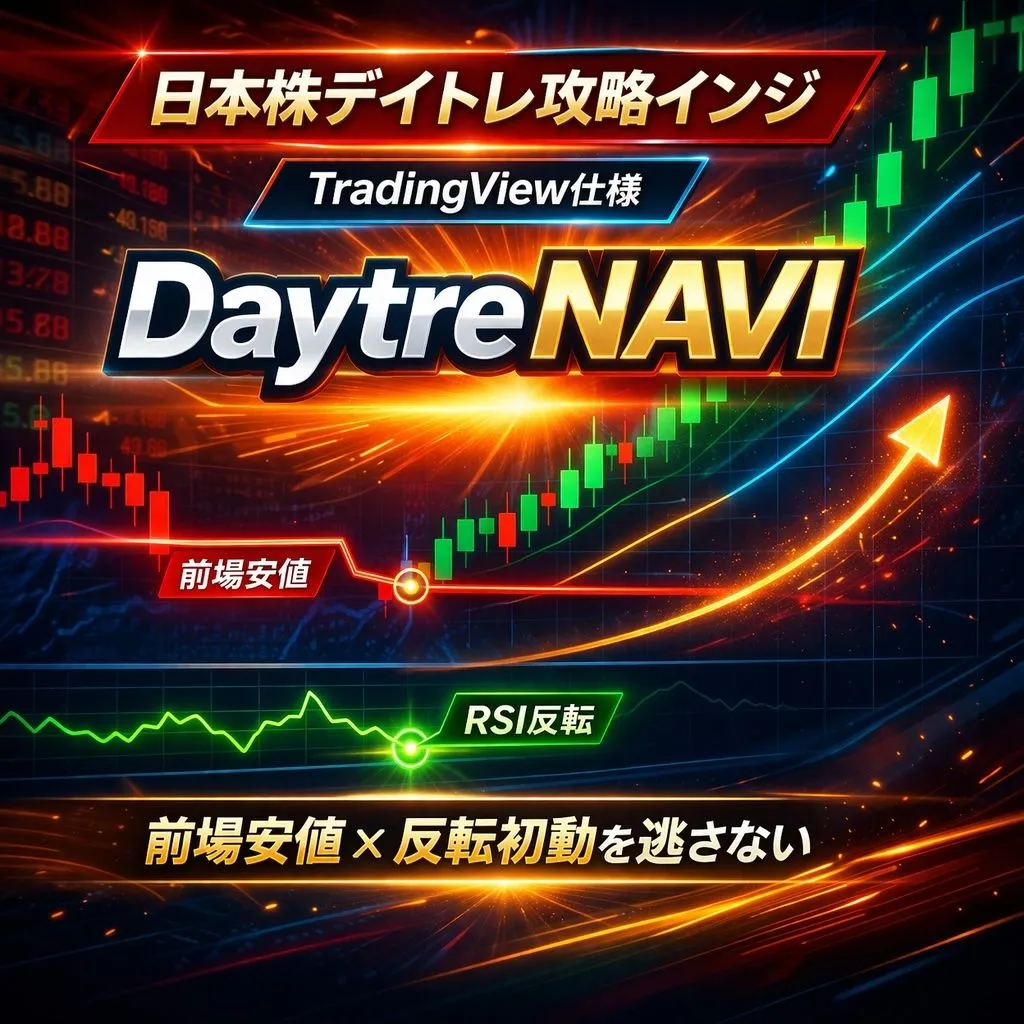
The TradingView Japanese stock day-trading indicator “DaytreNAVI” is positioned as a tool to support such organization.
Visualizing the morning low line makes the day’s supply/demand baseline easier to see.
Detecting RSI rebound as a BUY signal makes the rebound phase easier to identify under certain conditions.
Furthermore, auxiliary EXIT judgments and alert notifications help reduce monitoring burden and judgment variance.
The key is not to use this as a tool to hand over all buying and selling decisions, butto use it as an auxiliary line to organize your own trading rules.
Especially suitable for
those who want to systematize Japanese stock day trading
those who want to view morning pullbacks and rebounds more objectively
those who want to reduce intuitive trading
those seeking a simple auxiliary tool usable in TradingView
Summary
To avoid low-win-rate trades in day trading, you first need to rethink what to trade before considering where to buy.
Trade in high-volume stocks.
Additionally, look for a high trading value relative to market cap with short-term funds gathering that day.
These stocks provide a solid foundation for day-trading consideration.
Then focus on the most information-rich time in Japan, the morning session, and narrow buy opportunities by combining a reference point like the morning low with conditions such as RSI rebound.
Thus, thinking about “stock selection” and “entry patterns” in an integrated way is important to improve reproducibility.
In day trading, the important thing is the pattern, not talent.
If you can define which stocks to watch and where to look for buy opportunities, unnecessary trading decreases.
If you want to organize morning buy opportunities more and judge based on conditions rather than intuition, using supplementary tools like DaytreNAVI is one option.
Please check the product page for details?
Disclaimer
This article is for information purposes only and does not guarantee profits or specific stock performance. Please make investment decisions based on your own responsibility and judgment.