
[Even if you go with the flow, it becomes hard if you enter late] The idea of reducing “jumping on board” with Prime ACE
Good morning.
I am Trader A (Ace), the developer of the \"Prime ACE Strategy\".
Up to this article,
the discretionary aspect of Prime ACE is not about doing everything difficult from the start,
but about starting with small steps and gradually proceeding.
Also, when looking at the flow,
by confirming higher highs and higher lows,
the way the arrows appear can change.
As a continuation of that,
it is not enough to just follow the trend
I would like to write about this point.
Prime ACE is a classic trend-following approach.
Therefore, it is important to see whether you are following the flow.
However, there is one more important thing in practice.
That is,
whether the entry point is not late
in terms of timing.
Even with the same buy arrow,
there is a big difference between arrows that appear after a pullback within the flow,
and arrows that appear in a high-price zone after a substantial run,
in terms of how easy it is to trade after entering.
First, please look at the first image.
This isan easy-entry scenario.
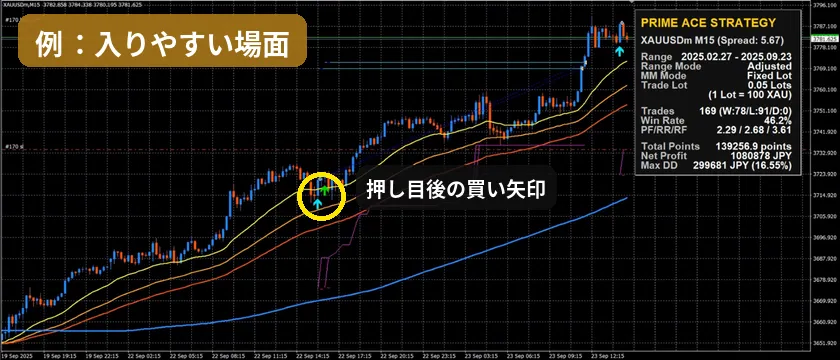
Within a continuing upward trend,
after a brief pullback, a buy arrow appears.
This kind of pattern not only follows the flow but also
is easy to enter with little pressure
as an entry point.
The reason is that arrows appearing after a pullback often leave room for further upside.
Of course this is not absolute.
However, at least
compared to patterns like “chasing after a long run,”
it is easier to manage risk-reward.
In other words, it is easier to plan the exit and profit targets after entering.
On the other hand, the second image isa scene to avoid.
Here too, a buy arrow appears.
And visually, it looks strong.
There is upward momentum.
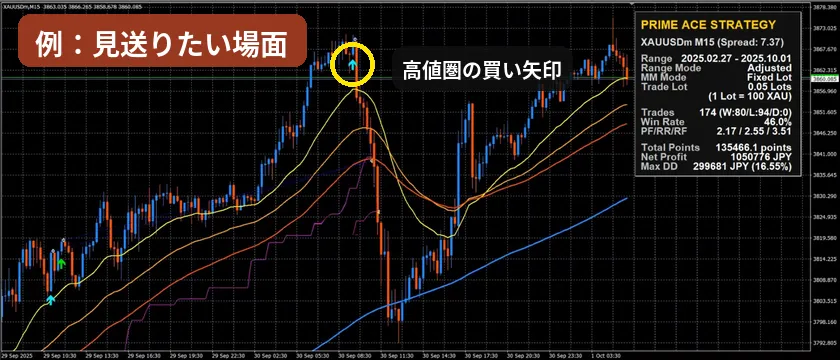
But looking at the location,
it is already in a high-price zone after a substantial move.
In such a situation,
even if it follows the flow,
the entry point can be late
in terms of timing.
When people hear “trend following,”
they tend to think of buying rising assets and selling falling ones.
But in practice,
following the flow and entering at a good location are not the same thing.
In zones where the price has already risen considerably,
despite apparent momentum,
you can get pulled back soon after entering.
In other words, even if the direction is correct,
the timing can become painful.
I regard Prime ACE’s discretionary approach as
more of a
“technique to avoid late entries”
That is why,
instead of reacting immediately when an arrow appears,
first look at the location.
Is it in line with the flow?
Are the highs and lows still in the uptrend?
And is it not already quite stretched?
In terms of the theme this time,
by focusing on these three axes,
you can greatly reduce impulsive entries.
Then, by looking at nearby highs and lows, horizontal lines, and key price levels (milestones),
and the walls ahead,
your accuracy will improve further.
Just by adopting this view,
Prime ACE’s arrows become
not “things to take because they appeared,”
but
material to select the most favorable scenes among candidates
for trading.
Prime ACE is not merely a tool to line up arrows.
First, look for the main battlefield on the panel.
Next, evaluate arrows as candidates.
Then, with discretionary judgment, narrow down to even more favorable situations.
This flow makes it easier to build your own trading approach.
This time,
even if you are following the flow, late entries can be painful
as a theme,
and I have organized a way of thinking to reduce “jumping in.”
If you are interested, please also take a look at the product page.
▼Product page here
『Prime ACE Strategy』
https://www.gogojungle.co.jp/tools/indicators/77315?via=users