|
Hello! This is Tanaka from GogoJungle.
A hugely popular series: conversations between our CEO, Hayakawa, and developers!
This time, we are joined bynao.
|
|
|
| A unique trader: former business owner and former monk |
|
nao
A trader with an unusual background, having run a construction company and then temporarily entered Buddhist monastic life for training. He has been seriously involved in the markets since 2015 and now mainly trades Gold. Proficient in programming, he developed the unique ‘tundere’ series of tools that embody SMC (Smart Money Concepts) to decode the order flows of large investors. He fuses a bird’s-eye managerial perspective with the mindset cultivated through monastic training in his trading.
|
|
| Table of Contents |
| Efficient position management with a semi-automated MT5 EA |
| Visualizing SMC “high-rebound zones” in TradingView |
| Scoring rebounds where MTF confluences align |
| Merging tools and scenarios: learning in an online community |
| Breaking free from “overtrading”: how evidence-based trades change outcomes |
|
Efficient position management with a semi-automated MT5 EA
|
| The MT5 tool currently shown at the center of the screen is what you’d call a “semi-automated EA,” correct? |
|

|
| Hayakawa |
|

|
| nao |
|
| Yes, that’s right. I handle the entries myself, and then leave the subsequent position management to the EA. |
|
You’ve built up quite a number of positions now, and unrealized profits have exceeded 200,000 yen.
There’s an appeal to stacking multiple positions like this, but how do you determine the timing of the initial entry? |
|
|
|
| Hayakawa |
|
|
|
| nao |
|
| For the initial entry, I narrow down SMC (Smart Money Concepts) zones and enter there. |
|
| I see. So you strategically build positions from points refined through your own analysis. |
|
|
|
| Hayakawa |
|
|
Visualizing SMC “high-rebound zones” in TradingView
|
| And the tool you’re introducing in TradingView takes this a step further, right? |
|
|
|
| Hayakawa |
|
|
|
| nao |
|
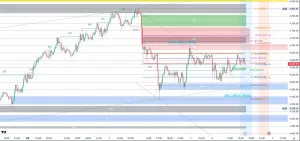
| Yes. This is an upgraded version of what I’ve provided so far, making it easier to visually judge among many zones “where price will bounce” and “where pullbacks will form.” |
|
| On the screen, the “green zones”, for example, suggest an assumption that large investors (smart money) are present there, correct? |
|
|
|
| Hayakawa |
|
|
|
| nao |
|
| These green and red zones highlight areas where zones overlap across MTF (multi-timeframe). |
|
| So it automatically finds stronger points where higher-timeframe confluences align. |
|
|
|
| Hayakawa |
|
|
Scoring rebounds where MTF confluences align
|
|
|
| nao |
|
| On the 15-minute, 1-hour, and 4-hour charts, where FVG (Fair Value Gaps) overlap, the confluence is very strong. Therefore, I judge a high probability of a rebound and aim for pullbacks. |
|
| The screen shows probabilities as percentages—are those calculated automatically as well? |
|
|
|
| Hayakawa |
|
|
|
| nao |
|
| Yes. The score factors in higher-timeframe overlaps, the strength of OBs (Order Blocks) and FVGs, zone width via ATR, and trade direction, among other elements. |
|
| So you’re essentially quantifying where large players are positioning. That’s very compelling. |
|
|
|
| Hayakawa |
|
|
|
| nao |
|
Gaps where unfilled limit orders from large players remain tend to attract price and are prone to rebounds.
By confirming this across multiple timeframes, you can make trades with stronger justification. |
|
|
Merging tools and scenarios: learning in an online community
|
| You actively share information in online communities as well—what kind of activities do you do there? |
|
|
|
| Hayakawa |
|
|
|
| nao |
|
I share potential developments like “Here’s a possible scenario for this week.”
I want people not just to use the tools, but to master SMC. |
|
| By learning the actual analysis steps, users will be able to build scenarios on their own. |
|
|
|
| Hayakawa |
|
|
|
| nao |
|
| Exactly. Even with past market action, by reviewing “why that scenario played out,” the steps should stick. |
|
| If you set the first position as a pending order, you can then leave it entirely to the EA, right? That seems extremely beneficial for busy people. |
|
|
|
| Hayakawa |
|
|
How evidence-based trades change outcomes
|
| SMC has been gaining traction in Japan—how do you see the current state, nao? |
|
|
|
| Hayakawa |
|
|
|
| nao |
|
I get the impression that many materials still end at explaining concepts.
“Even if you know the zones, where exactly do you enter?” Few people actually share that. |
|
| If the rationale becomes clear and win rates are visualized, even those with “overtrading syndrome” who take positions needlessly should see different results. |
|
|
|
| Hayakawa |
|
|
|
| nao |
|
| In fact, I’ve received feedback from someone who was about to quit trading, but discovered SMC through my articles and said, “My chart perspective changed dramatically,” “It became fun.” |
|
Identify areas where confluences stack up, and enter with confidence.
That becomes the greatest weapon for a trader. |
|
|
|
| Hayakawa |
|
| Thank you for sharing such valuable insights across two sessions! SMC/ICT tools are what I’d first recommend to those who want to trade with these methods. |
|
|
|
| Hayakawa |
|
|
|
| nao |
|
Thank you very much as well!
Please take a look at the product page first! |
|
| Part 1 |
SMC/ICT
A former monk and former CEO speaks!
Secrets to riding with the market’s big players and compounding profits |
|
|
| Part 2 |
Quantify “where to enter?” and automate exits
This is winning SMC! |
|
|
|
|
| [Free] Exclusive for video viewers |
|
All-in-one SMC indicator for TradingView
As a token of our gratitude, we’re giving away an original indicator that bundles the main SMC features into one. The password is in the Part 1 video.
|
|
|