

[Buy/Sell Signal Logic Explanation] Three-Currency Parity Analysis Tool "Intervention Aftershock PRO" Entry Strategy
RE/BO Signals of the Three-Currency Parity Analysis Tool "Intervention Aftershocks PRO":
What is the underlying thinking that generates them
Last time,Why three-currency parity analysis can become a weapon for general traderswas written. This time, as a sequel,we will整理 (organize) how the RE and BO signals are generated from their underlying ideas. Note that the first half (Part 1) focuses on detailed logic and is aimed at intermediate/advanced readers. A more approachable explanation is provided in the latter half (Part 2), so if you want to grasp the big picture first, you can start with Part 2.
※In this article, only publicly shareable concepts are used. Implementation-specific coefficients, threshold optimizations, and internal processing details are intentionally omitted.
To summarize the main points upfront
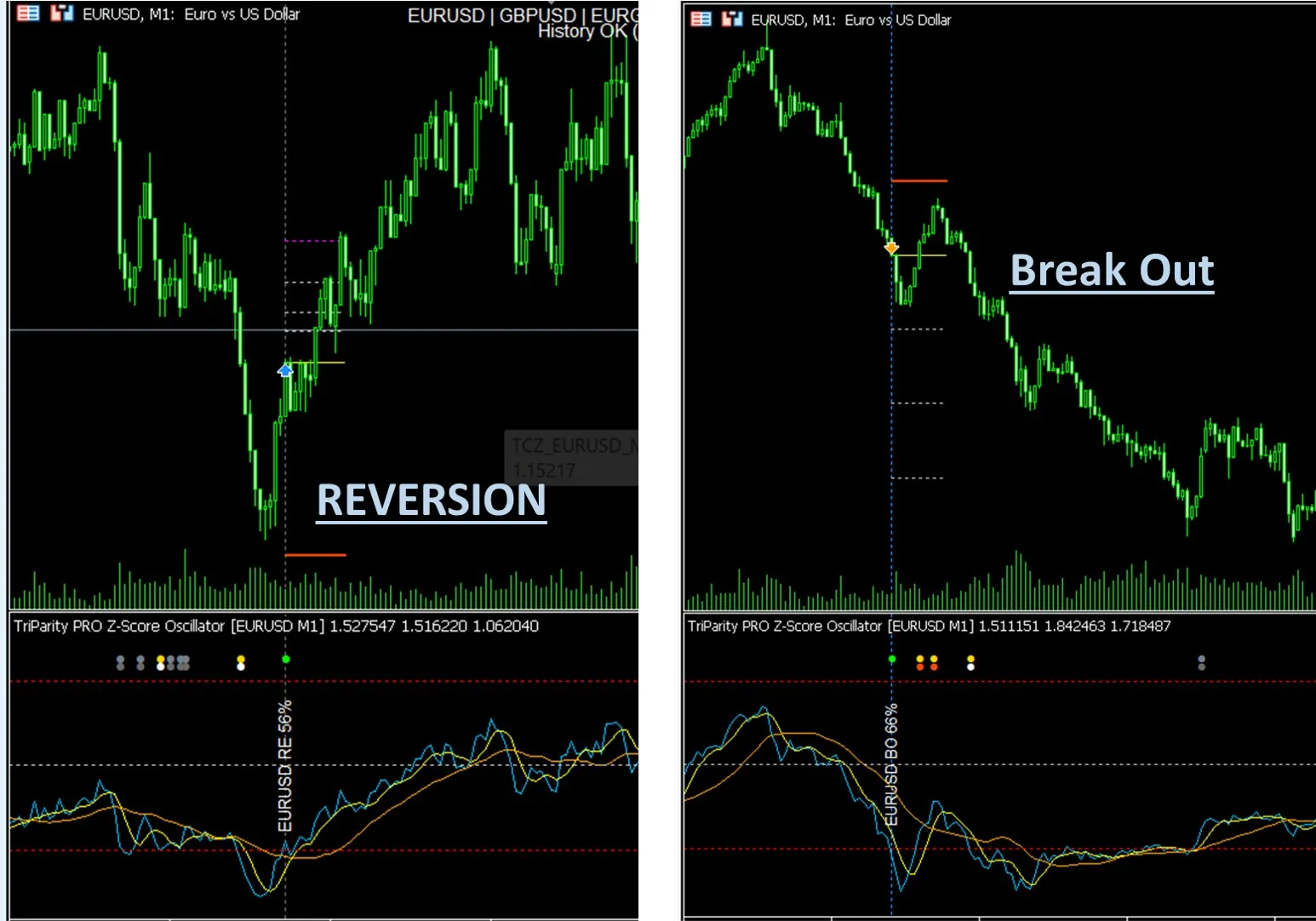
RE (Reversion)is the side that seeks the phase where after the distortion has spread outward,it begins to return inward.
BO (BreakOut)is the side that seeks a phase where the distortion moves away from the neutral band andtends to expand further.
Both signals are driven not only by the appearance on a single chart, but also bythe distortion of the three currencies and the overall market context.
The "Entry-A / B / C" dealt with in this article and the "A / B / C rank" that appear in Scanner and Nowcast are different things.
Entry-A / B / C are types of entry logic on the RE side. The ranks on Scanner and Nowcast are an overall assessment that includes the distortion's position, phase, and alignment with higher timeframes.

Detailed: How are RE and BO assembled?
1. Both RE and BO originate from the same "distortion among the three currencies"
Intervention Aftershocks PRO does not start from the price of a single pair. It starts from asynthetic spreadconstructed from three related instruments.
zt= ( St- μt) / σt
What I want to convey here is that RE and BO are not inherently different indicators from the start; they both read the same "distortion Z" behavior using different market hypotheses.They interpret the same distortion Z under different market assumptions.
RE treats this distortion as a"returning one", while BO treats it as.
In other words, the difference between RE and BO is not the shape of the signal, buthow to interpret the current distortion in terms of the phase.
2. RE and BO differ in which phase they aim to take
After the distortion has spread outward,they aim to take the phase where it starts to return inward.
The distortion moves away from the neutral band andaim to take a phase where it can expand further.
Therefore, at a glance, RE looks like the reverse side and BO looks like the forward side. However, the essence is not there; it is aboutwhether the distortion should be treated as mean-reverting or as a continuation/expansion type.
3. RE has effectively three entry points
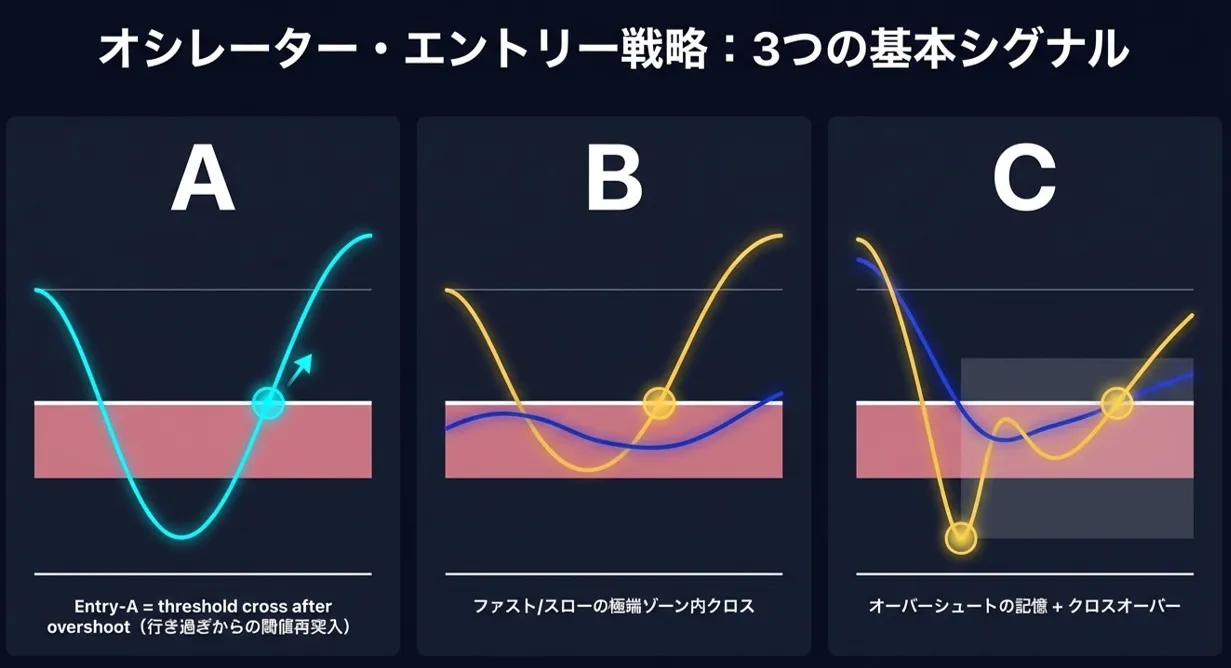
In the settings screen,Entry-A: Threshold Cross,Entry-B: ZMA extreme value region cross,Entry-C: ZMA over-shoot memory-type cross are all entry points on the RE side.
Entry-A: Threshold cross (basic)
After the distortion reaches a certain outer extent, the moment it begins to move back inward is the RE candidate.
Entry-B: ZMA extreme value region cross
Here, the ZMA used is not a moving average of price, butthe moving average of the distortion Z itself.
When the distortion is still in its extreme region, the fast-side ZMA crossing over the slow side in the reversal direction signals aphase change in the return.
Entry-C: ZMA over-shoot memory-type cross
Similar to B using ZMA cross, but additionally assumes thata recent sufficient over-shoot occurred.
In other words, C is not merely a small reversal, but a“high-quality return that appears after a large distortion” type of entry that is easier to target.
As a mental image: A = "returned", B = "began returning", C = "began returning after a large distortion"
4. RE does not display immediately when triggered
Even if Entry-A / B / C is satisfied, that alone does not become the final signal.
After a RE candidate appears, several additional confirmations are required.
- Was there truly a sufficient over-shoot?
- Is there momentum in the return?
- Does the Scanner / Nowcast overall assessment meet the minimum standard?
- In the current higher-timeframe regime, is it permissible to aim for mean reversion?
In other words, RE signals are not simply “a reversal-looking pattern appeared,” but are issued after confirming that there is value in taking the return.
5. The most crucial for RE: whether mean reversion is admissible in the market
This is the most important part for RE.
RE only acts seriously when the regime permits mean reversion.
On the higher timeframe, it looks at elements like residual stationarity, half-life, trend versus mean reversion, whether the mean itself is moving, and whether the triangle relationships are intact.
To put it simply here
- “Is this distortion prone to return?”
- “Is the observed return genuine?”
- “Are the triangle relationships themselves intact?”
This is where it differs greatly from ordinary reversal oscillators. Intervention Aftershocks PRO does not wait for extreme values to appear and then aim for a return; it first evaluateswhether the return premise is likely to be satisfied.
6. BO is not merely a band breakout
If you only think of BO as the opposite side of RE, you miss the point.
Intervention Aftershocks PRO's BO is not just a breakout, but a logic that aims to take advantage of distortion expansion in a regime where mean reversion is not allowed, via a trend-following approach.
BO’s live trigger is straightforward: while RE looks at "outside→inside," BO looks at "inside→outside."
However, that alone does not guarantee a BO signal.
What BO emphasizes
- Is the regime where mean reversion not allowed?
- Is there enough momentum in the distortion's slope?
- Is the amplitude expansion not too weak?
- Is it not contradictory with the direction of the higher timeframe?
- Is the continuation phase not inherently unnatural?
In short, BO looks for when it has 'broken through' and then still has engine power to run further.
Therefore, even though the visual may be just a simple breakout arrow, inside it is quite multi-layered.
7. In the end, the arrows that appear on the chart are intersections of conditions
Briefly, the actual flow is
- Create distortion Z from the three currencies
- RE or BO live trigger appears
- Check depth and slope
- See if Scanner / Nowcast minimum standard is met
- Pass the higher timeframe regime assessment
- If BO, pass a continuation filter
So even if charts look similar on the surface, there is a difference: today RE will appear, today it won’t, today only BO will appeartoday RE will appear, today it won’t, today only BO will appear.
This is not instability; rather, it is the opposite—the differences arise because you are examining context.
Dedicated Tool for Triangle Currency Parity Analysis
"Intervention Aftershocks PRO Catcher & Scanner"
If you want to incorporate the core RE/BO logic into actual discretionary decisions, this is for you.
Based on triangle currency parity concepts, it helps organize distortion expansion and return phases, serving as a primary tool.
Explanation: In plain terms for beginners, what does it mean
1. In short
Intervention Aftershocks PROseparates RE and BO by asking whether this misalignment will revert or still expand.
Typical oscillators often imply “it will revert soon” when a misalignment goes extreme. But in actual markets, there are misalignments that really revert, and misalignments that briefly widen further. Intervention Aftershocks PRO attempts to organize these differences as much as possible.
2. RE takes the moment when the return begins
It targets the moment when the rubber is stretched and tries to return toward the origin.
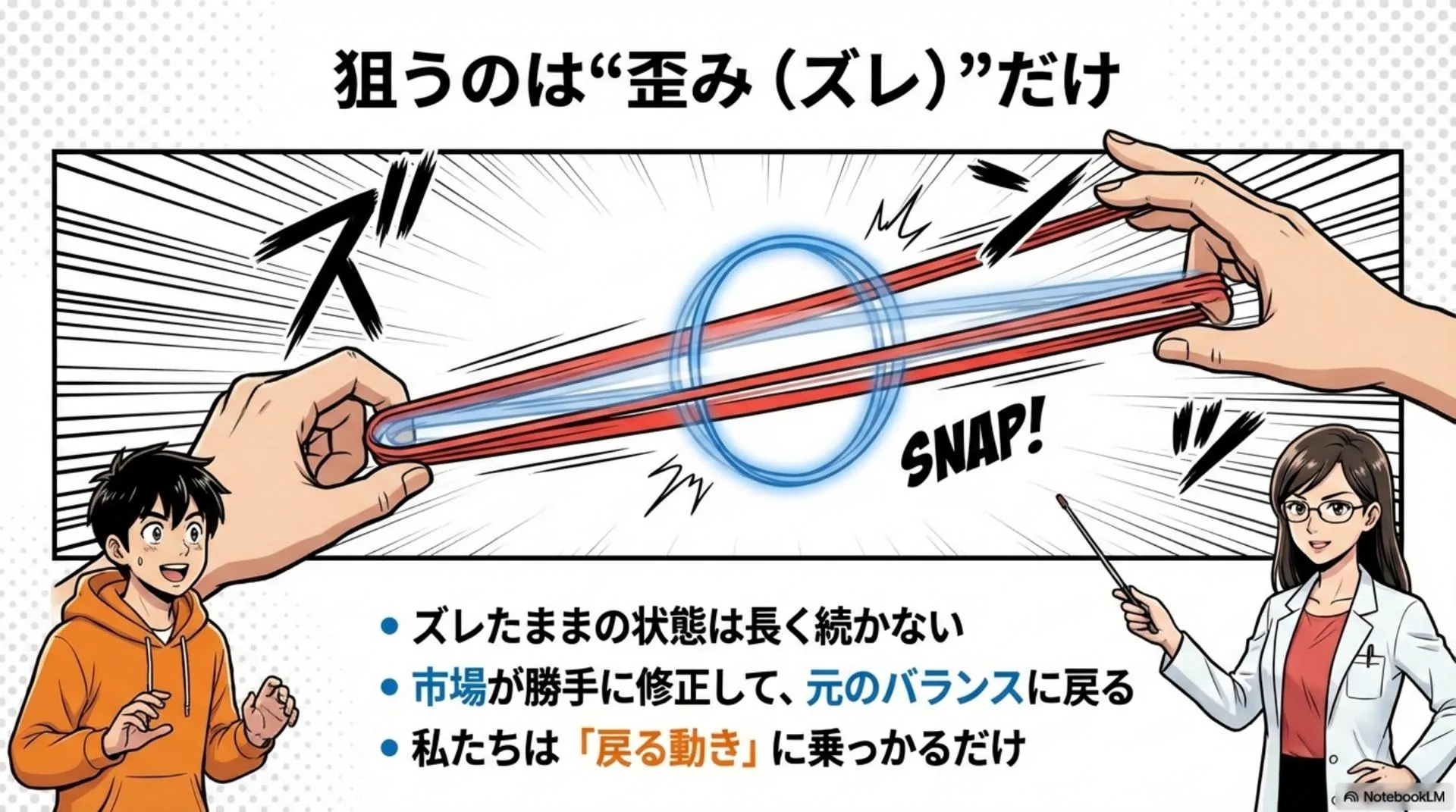
However, it will not fire just because it looked like a return was about to happen.
It checks whether it went too far, whether the return gain has emerged, and whether the current market is a favorable environment for a return.
Thus, RE is not a simple reversal signal but a signal emitted when there is a suitable environment for a return.
3. BO takes the moment when the distortion still has room to grow
This time it is not about overshooting, but about a signal when the market is moving in that direction.
In other words, BO is not “go long because it’s oversold” but a signal issued when it decides that“this time it will still extend”.
Therefore, Intervention Aftershocks PRO is not only a return-targeting tool but a structure that can detect both returns and expansions.
4. Entry-A / B / C are RE’s ways of confirming the return
Entry-A: A basic type that confirms a line has returned
Entry-B: A type that confirms momentum in the return direction has changed
Entry-C: A type that picks up only high-quality returns after a large distortion
A, B, C are not just different in difficulty but representdifferent angles of confirming a return.
Think of them as basic type, momentum-confirmation type, and stringent type after a large distortion.
5. Why are both RE and BO necessary
Traders who are prone to losses tend to favor one side.
- Always expect a return and counter-trade
- Always expect a continuation and jump in
But in reality, markets have misalignments that should revertand misalignments that should expand.
Based on this principle, Intervention Aftershocks PRO explicitly separates the return logic (RE) and the expansion logic (BO) from the start. (BO added in version 8.0)
6. In short, easily summarized
- Measure distortion from the three related instruments
- Decide if the distortion will revert or expand
- If revert, issue RE; if expand, issue BO
- Also filter out weak or dangerous situations in between
So, though it may appear as a simple signal indicator on the surface, it is actually a tool thatdistinguishes between returns and expansions based on market nature.
This is a major difference from ordinary oscillators or simple breakout displays.
Intervention Aftershocks PRO SPIDER
A crosswise tool that captures buy/sell signals across the triangle currency parity monitoring network
If you want to leverage triangle currency parity perspectives to monitor multiple assets across, SPIDER is also available.
If you want to reduce missed signals and improve monitoring efficiency, please also check this out.
Summary
RE and BO are not generated solely from single-chart appearances.
Based on distortions created by triangle currency parity,they determine whether the distortion will revert or expandin a staged manner before producing signals.
Therefore, it becomes easier to justify questions like
“Why isn’t this a reverse-trade entry but a wait-and-see one?”
“Why is this not a return but BO’s side?”
with reasons attached.
Visually similar, but internally quite different.
That is the core of the RE / BO logic of Intervention Aftershocks PRO.