

English translation: [Save Version] USD/JPY (Dollar-Yen) Time-of-Day Strategy Guide: Change your approach in Tokyo, London, and New York
"Tokyo time was going well, but London took everything away." "When I entered during New York night time, I got wiped out in an instant by the indicators."
Have you ever traded USD/JPY and had experiences like this?
Actually, this isn’t a problem with the method.You’re just not fighting in a way that suits the time of day.
USD/JPY isn’t as volatile as gold. But that’s exactly why, “when you trade” can massively affect your win rate. Knowing the price action tendencies for each time period directly ties to your profits and losses.
In this article, we’ll explain the characteristics of USD/JPY price movements by time of day and how to operate in each period.
I’ve traded USD/JPY as my main arena for 12 years, and I’ll write everything based on real experience.
The Three Sessions of USD/JPY
USD/JPY price movement is divided into three main time periods.
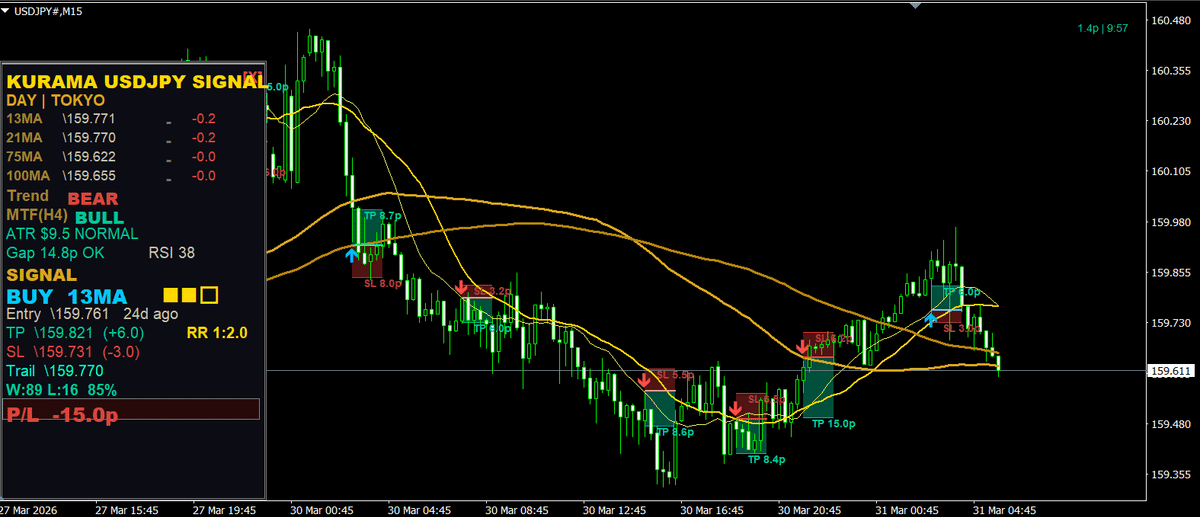
Tokyo Session(Japan time 9:00–15:00 approximately)
London Session(Japan time 16:00–1:00 the next day)
New York Session(Japan time 22:00–6:00 the next day)
Gold mainly trades in London–New York, but USD/JPY has opportunities in all three. In particular, Tokyo time has a strong presence that is unique to USD/JPY.
Tokyo Session (9:00–15:00): "USD/JPY's Main Battleground"
Characteristics: Technicals are most effective in this time
Gold during Tokyo time is “don’t touch because it doesn’t move.” For USD/JPY, it’s the exact opposite.
Tokyo time is when Japanese institutional investors and real demand players (exporters and importers) participate. Because USD/JPY involves the Japanese yen, liquidity is highest during Tokyo time.
Price action features are as follows:
Price range is relatively narrow (about 30–50 pips), but directional bias emerges easily
Touches of moving averages function straightforwardly
Few “false breaks,” making entries easier
Patterns of yen selling toward the fix (9:55) tend to form
USD/JPY in Tokyo time is the easiest environment for technical traders to trade.
Tokyo Time Tactics
Use price action around the fix (9:55).Particularly on the Go-To days (5th and 10th), there is a strong tendency for yen selling toward the fix (USD/JPY rising).
MA touch pullbacks and reversals work well.If a perfect order (price action alignment) is confirmed, simply follow the trend
Take profits/stop losses modestly.Volatility in Tokyo time is low, so a reasonable target is TP 5–8 pips, SL 3–5 pips.
Close positions before 15:00.The flow often changes at the London open
Common Mistakes
The main caution in Tokyo time is “overly greedy.” Because price movement is calm, dragging unrealized profits often ends up restoring to breakeven.
Tokyo time is about “taking small, certain profits.” Accumulate steadily here, then prepare for London onward.
London Session (16:00–翌1:00): "Where the Trend Changes"
Characteristics: Break the Tokyo range and a trend forms
From around 16:00 when the London open approaches, USD/JPY price action changes dramatically.
European participants break out of the range built during Tokyo time. It isn’t as violent as gold, but volatility clearly changes compared to Tokyo time.
Price action features:
Breaks the Tokyo time range in one direction or the other
A trend tends to develop in the break direction
Most of the daily price range concentrates in London–New York time
Moves can be influenced by euro and pound
Mind the "fake" at London early phase
As written in the gold version, right after the London open, fake breaks are common.
USD/JPY behaves the same. A fake break up at 16:00 that reverses by 16:30 is not unusual.
Wait 15–30 minutes after the London open to assess the market.It’s safer to ride the trend once the direction is confirmed.
London Time Tactics
Know the upper and lower limits of the Tokyo time range in advance.These become the basis for break confirmation
After a breakout, follow the trend.If MA is rising, buy on pullbacks; if falling, sell on rallies
TP/SL wider than Tokyo time.TP 8–15 pips, SL 5–8 pips, adjusting to volatility
Check euro zone economic indicators as well.ECB announcements also affect USD/JPY
New York Session (22:00–翌6:00): "Determined by the Indicators"
Characteristics: Economic indicators rule everything
During NY time, USD/JPY is governed by US economic indicators.
Employment stats, CPI, FOMC, retail sales — it’s normal for price to move dozens of pips around releases. The trend built in London can reverse in a single indicator release.
Price action features:
Spreads widen at release moments
After the release, direction is hard to discern (wicks up and down)
The trend often confirms 30 minutes to 1 hour after release
After 2:00 AM, liquidity declines and moves become sluggish
Pitfalls of NY Time
Gold during NY time had max volatility but also max risk. USD/JPY is a bit better, but indicators around releases remain dangerous.
Entering at the exact moment of an indicator release can cause a poor fill due to widened spreads
Jumping on the initial move right after a release can reverse and whip you
Staying up late can erode discipline and lead to rule-breaking entries
NY Time Tactics
Flat your position 30 minutes before an indicator release
Skip the initial move right after the release.Ride once the direction is confirmed
If the London trend continues, ride in that direction
After 2:00 AM, no trading in principle.Low liquidity and more false moves
Set wider SL than usual.Account for the spillover effect of indicators
Changing TP/SL by Time Zone Is Important—but Manual Adjustment Is Impossible
I think you’ve noticed by now.
The appropriate TP/SL width varies greatly by time zone.
Tokyo time: TP 5–8 pips / SL 3–5 pips
London time: TP 8–15 pips / SL 5–8 pips
NY time: TP 10–20 pips / SL 8–12 pips
"I know, but changing them manually every time is impossible."
Yes. That’s precisely the problem.
If you adjust entries by thinking, "Now it’s Tokyo, so TP is 5 pips, but after entering London, change to 8 pips…," you’ll hesitate and enter late. You’ll also make calculation mistakes.
As mentioned in the Gold article, the solution to this problem isAutomatic TP/SL adjustment based on ATR.
Solution: Auto-adjust TP/SL by Session × ATR
ATR (Average True Range) is an indicator that quantifies the average volatility of recent price movement.
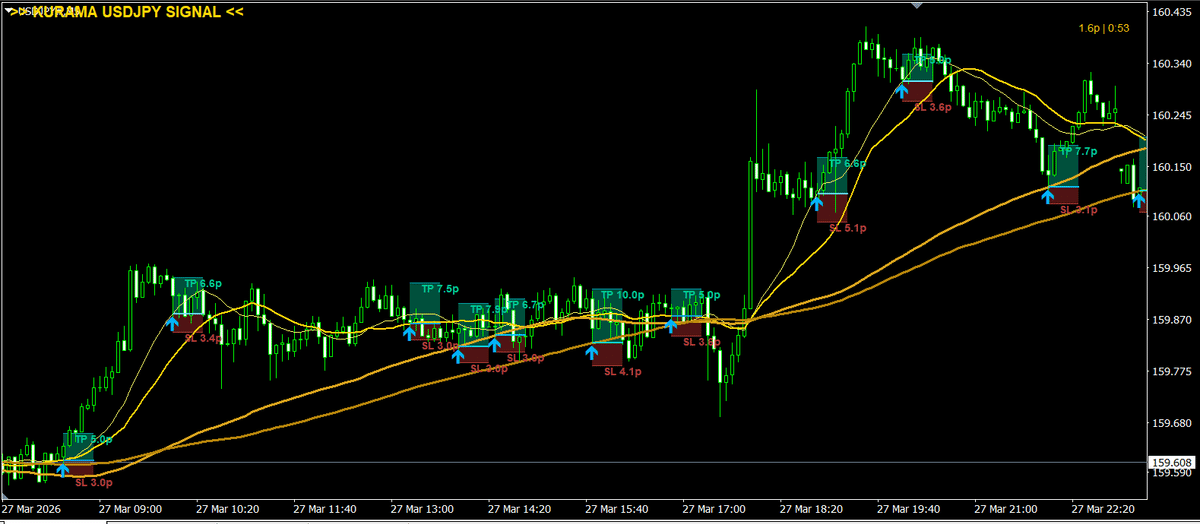
Tokyo time has lower ATR, while London–NY has higher ATR. If you automatically calculate TP/SL in line with ATR changes, you don’t need manual adjustments by time zone.
Furthermore, for USD/JPY you should also consider the price action tendencies of each session. Tokyo time has real demand toward the fix, London is breakout-driven, NY is indicator-driven — applying corrections tailored to each characteristic will further improve accuracy.
In other words,you should create an environment where you don’t have to think, "What time is it now, so TP/SL should be this much.".
KURAMA USDJPY SIGNAL: An Option
The USD/JPY indicator I developed, KURAMA USDJPY SIGNAL (KUS), is exactly this mechanism built for USD/JPY alone.
Main Features
USDJPY-specific— Zero-to-one tuning for USD/JPY volatility, spreads, and session characteristics
ATR × Automatic Session Detection— Automatically detects Tokyo, London, and NY sessions and reflects this in TP/SL calculation. No manual adjustment needed
M5 scalping / M15 day trading— Covers both Tokyo scalping and post-London day trading with one indicator
Quality score (★–★★★)— Signals’ reliability is visible at a glance. Focusing on ★★★ filters out noise
Three-level filters (SAFE / STANDARD / ACTIVE)— Adjust signal quantity and accuracy to your preference
Push notifications— Alerts go to your smartphone, so you don’t need to stay glued to charts
Supported by domestic MT4 brokers— Works with FXTF, Rakuten Securities, OANDA, Gaitame Finest, etc.
"I understand that you must change your trading method by time zone. But manual adjustment is impossible." If that sounds like you, please take a look.
The Best Strategy: Use Both Gold and USD/JPY
Gold and USD/JPY have different optimal time periods.
Tokyo Time→ USD/JPY is the main focus. Gold doesn’t move much
London–NY Time→ Gold is the main focus. USD/JPY moves too, but gold has more opportunities
In other words,Using KUS (USD/JPY) and KGS (Gold) side by side ensures opportunities do not dry up throughout the day.
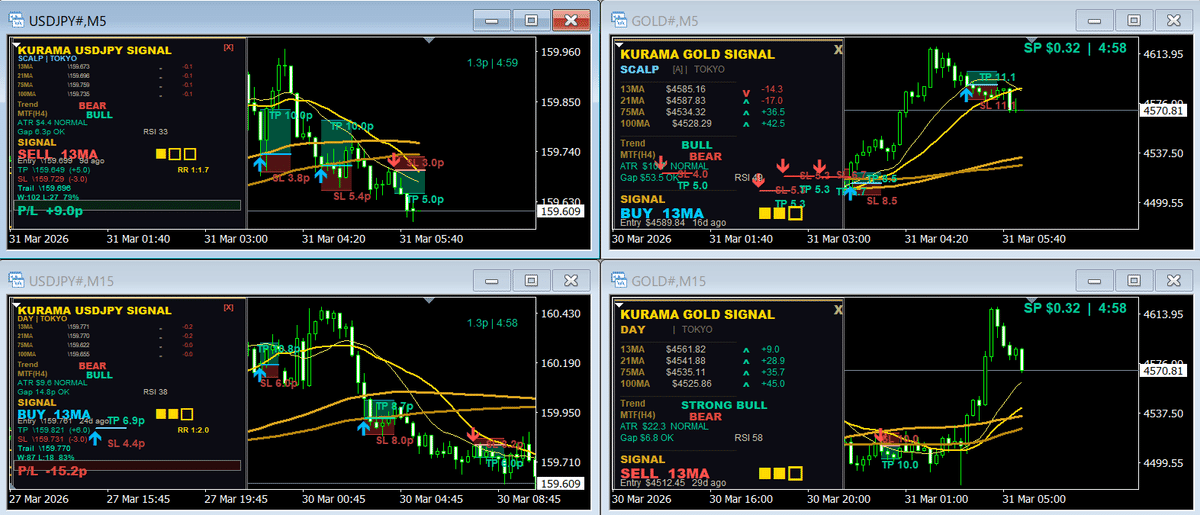
Time Zone Summary
Tokyo (9:00–15:00)→ USD/JPY main battleground. Technicals work best, MA touches respond naturally. Watch the fix. Keep TP/SL modest.
London (16:00–翌1:00)→ Break the Tokyo range and a trend forms. Watch out for early-session fakeouts. After breakout confirmation, follow the trend.
NY (22:00–翌6:00)→ Everything revolves around indicators. Be flat before releases. Avoid trading after 2:00 AM due to low liquidity.
All Time Zones In Common→ TP/SL should be adjusted according to volatility. Manual adjustment is unrealistic, so use ATR×Session automatic adjustment in KUS.