
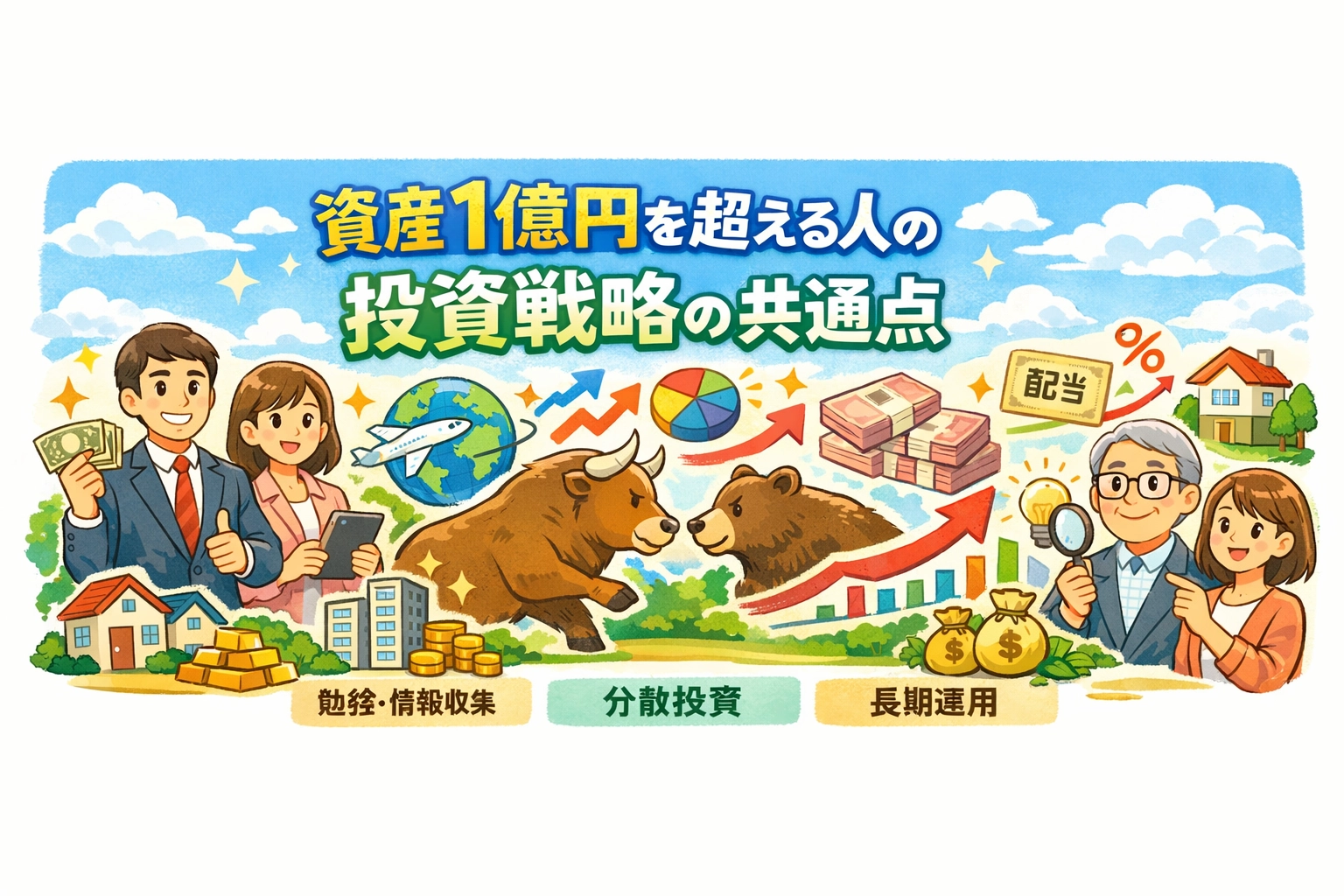
Common investment strategies of people with assets exceeding 100 million yen
Many people have at some point wondered, "What exactly am I working for?" Each month their salary is deposited, and it disappears into rent, food, and taxes, and the remaining money is left in a bank account. As years pass like that, before they know it they’ve entered their 40s. Only then does the question start to bubble up from the depths of their chest: “Is this really okay as it is?”
In Japan, it is said that more than 1.5 million households hold financial assets of 100 million yen or more, i.e., the so-called “wealthy class.” It accounts for only about 3% of the population, but the number is increasing year by year. Were they born into special families? Not necessarily. Some inherit billions in wealth from their parents, but many ordinary salaried workers have built assets of 100 million yen over 30 or 40 years while working.
So, do people who surpass 100 million yen in assets share any common way of thinking or patterns of behavior? The answer is yes. And it’s surprisingly simple, not requiring extraordinary talent or luck. It’s just that most people don’t know it, or know it but can’t put it into practice.
This article will describe, as concretely and honestly as possible, the investment philosophy and behavioral habits shared by those who have surpassed 100 million yen in assets. Rather than “the secret method to becoming rich,” I hope you read it as an honest answer to the question, “Why can’t most people become rich?”
First, there is something you should know. Almost everyone who has surpassed 100 million yen did not become wealthy “by hitting it big in investments.”
When many people imagine the rich, they picture those who made a fortune in stocks, became “crypto millionaires,” or earned millions overnight in forex. Such stories stand out on television or social media, so you might think that only those people can reach 100 million yen. In reality, those “one-shot-turnaround” wealthy individuals are a tiny fraction of the total.
Rather, the path most of the wealthy have walked is quiet and seemingly dull, because it’s simple. Regular monthly contributions, steadily maintained over a long period. That’s all. Yet few people were able to execute even that much consistently.
Let’s consider concrete numbers. If you invest 50,000 yen per month at 5% annual return, after 30 years you’ll have about 41.6 million yen. If you invest 100,000 yen per month, you’ll have about 83.2 million yen. And as salaries rise and you increase your contribution or add bonuses to your investments, reaching 100 million yen in 30 years becomes a realistic goal.
What’s important here is that the annual 5% return is not a “dream high return.” Over the past 30 years, the global stock index funds have averaged roughly 6–8% annually. In other words, you don’t need special skills or luck, or even connections with securities firms. You just need to keep your money in the right place, and such a return has been achieved in the past.
So why can’t most people do that? There lies the essential difference that separates the billion-yen earners from ordinary investors.
When you talk to people who have surpassed 100 million yen, there is almost always one phrase they repeat: “I didn’t let emotions move my money.”
In investing, emotions are the greatest enemy. When stock prices rise, you panic, thinking, “I should have bought more.” When prices fall, you fear, thinking, “I want to sell everything now.” Following these emotional swings leads to repeated bad patterns of buying high and selling low.
During the 2008 Lehman Brothers collapse, the Japanese stock market fell by about 60% in a little over six months. At that time, many individual investors were beaten by fear and sold all their stocks. But many of those who exceeded 100 million yen did almost nothing during that crash. Some even bought more because prices had become cheap.
Why could they do that? Because they had a conviction that crashes come, but recoveries come as well. This conviction comes from studying history. After crashes like Lehman, the IT bubble burst in 2000, and Black Monday in 1987, the market eventually hit new highs. Those who truly understand this can see crashes not as losses but as sales opportunities.
Conversely, emotional actions when the market is rising are dangerous too. After the Covid-19 crash and the subsequent rapid rebound, and the stock market boom in 2021, many chased high-risk assets and leveraged products, driven by the fear of missing out. The result was widespread losses in the downturn of 2022.
Those who surpassed 100 million yen fight these emotional traps with systems. They set up automatic monthly contributions on a fixed date, with a fixed amount, so there is no space for emotional decisions like “let’s skip this month because the market is scary” or “prices are high, buy more now.”
This concept of automation may seem mundane, but it’s actually a highly advanced self-control mechanism. Research shows that human willpower is finite, and when tired or anxious we tend to make emotional judgments. Smart investors therefore remove emotion by relying on mechanisms rather than willpower.
Next, we must discuss the unique “sense of time” held by those who’ve surpassed 100 million yen.
Ordinary investors judge success by “how much they earned this year.” A 5% annual return feels small, 20% feels large, and many chase high-risk investments to reach 20%. This is the thinking pattern for many people.
But those who surpassed 100 million yen move money with a view to “what will it be like after 10, 20, 30 years.” They have little interest in short-term returns. Rather, they feel it’s enough to achieve an average annual return of about 7% over ten years, without overreacting to yearly results.
This is called “a difference in time horizon.” With a longer horizon, the approach to risk changes.
The money you’ll need in ten years and the money you’ll need next year have completely different characteristics. Investing for next year when you might need the money is foolish, because there’s a chance prices drop by half next year. But investing for money you’ll need in ten years makes sense, because there’s enough time to recover from any downturn.
If you look at the portfolios of those who surpassed 100 million yen, you’ll see they clearly separate money by its purpose and time horizon. Money that might be used within five years is kept in cash or short-term bonds. Money not needed for ten years or more is actively invested in risk assets like stocks or real estate. This “bucket strategy” helps prevent emotional selling. When you feel like selling during a dip, you can calmly remind yourself, “This money will be used ten years from now, so there’s no need to sell now.”
Longer time horizons also maximize the power of compounding. It’s often said that compounding is the eighth wonder of the world (though the truth of this attribution is debated). Regardless, the power of compounding is mathematically astonishing.
If you invest 1,000,000 yen at 7% annually, after 10 years you’ll have about 1,970,000 yen; after 20 years about 3,870,000 yen; after 30 years about 7,610,000 yen. In 30 years you’re 7.6 times the principal. And this is without additional investments; with monthly contributions, the final figure is even larger.
To maximize this power of compounding, two principles are vital: "don’t withdraw along the way" and "invest as long as possible." Those who have surpassed 100 million yen fiercely guard these two. When you need a down payment for a house or education costs for your children, they seek other ways rather than tapping into long-term investment assets. They understand that this will make a big difference after ten or twenty years.
One concept that is absolutely essential when talking about the investment strategies of those who surpassed 100 million yen is cost.
Costs, which many individual investors hardly notice, are one of the factors that most affect long-term returns. In particular, the fees called management expense ratios (MERs) for mutual funds are problematic.
For example, compare an active fund with a 1.5% MER to an index fund with a 0.1% MER. If you invest 50,000 yen monthly for 30 years, the difference in final assets can be hundreds of thousands to over a million yen, under the same assumed return.
1.5% vs 0.1% may look like a 1.4% difference, but over 30 years, the compounding effect means you pay a substantial amount more in fees, dramatically widening the gap in final wealth.
Those who surpassed 100 million yen understand the compounding effect of costs well, so they choose products with the lowest costs. In recent years in Japan, ultra-low-cost index funds such as eMAXIS Slim and SBI・V series have become common, with MERs around 0.05–0.2%. Using such products gives you a clear long-term advantage in asset formation.
Moreover, tax costs are equally important. Nearly all those who surpassed 100 million yen maximize the tax-advantaged accounts like NISA and iDeCo (individual defined contribution pension plan).
The new NISA, starting in 2024, has expanded the lifetime investment limit to 18 million yen and annual investment limits to 3.6 million yen (1.2 million yen for the savings frame + 2.4 million yen for growth frame). Within these limits, investment gains and dividends are tax-free. Normally, investment profits are taxed at about 20%. If you earned 10 million yen in profit, 2 million would disappear as tax. But within the NISA frame, that 2 million remains with you.
iDeCo offers three-tier tax benefits: contributions are fully deductible from income, investment gains are tax-free, and withdrawals receive a fixed deduction. Particularly for people with high income tax rates, iDeCo’s tax savings are substantial, making it a no-brainer for those with higher earnings.
People who surpassed 100 million yen always consider not only what to do with the gains but also how to legally reduce taxes. This is not just tax avoidance; it’s about ensuring that the money that should be in their hands remains there.
When looking at the asset composition of Japan’s wealthy, many hold both real estate and financial assets. More of them combine both than those who built 100 million yen purely through stocks or real estate alone.
Why is real estate included in the assets of the wealthy? There are several reasons.
First, real estate is an “inflation-resistant asset.” When prices rise, rents tend to rise as well, and asset values generally increase. Stocks are also known to be inflation-resistant, but real estate more directly benefits from inflation.
Next, real estate is an asset that can use leverage. You don’t need to put down 100% of the property price. With a 20–30% down payment and a mortgage, you can purchase properties worth several times your own funds. If managed well, returns on your own funds can be very high.
Furthermore, real estate generates a steady monthly cash flow. While stock dividends vary with corporate performance, rental income is relatively stable. This is a major advantage for those pursuing FIRE (financial independence, retire early) or those who want to fund living expenses from assets after retirement.
However, real estate investing also carries risks. Vacancy risk, maintenance costs, rising interest rates, and illiquidity are intrinsic risks not found in stocks. Many who surpassed 100 million yen understand these risks well and diversify by combining real estate with highly liquid stocks and cash.
In stock investing, diversification is also deeply ingrained. Among those who surpassed 100 million yen, you won’t often see “putting all your assets into one stock.” Their portfolios are diversified across regions (Japanese stocks, US stocks, developed markets, emerging markets) and across asset classes (stocks, bonds, real estate, cash).
The essence of diversification is not to pick the best in every scenario, but to ensure you don’t collapse in any scenario. If one market crashes, other assets protect you. Deliberately designing this safety net is a characteristic of those who have surpassed 100 million yen.
Here is something many people overlook: before investing, solidifying your defense is essential.
A common trait among those who surpassed 100 million yen is that before starting to invest, they firmly structured their financial foundation. Specifically, they saved cash equivalent to 6 months to a year of living expenses as an emergency fund, they completely paid off high-interest debt (especially credit cards and consumer finance), and their monthly cash flow was positive. These are prerequisites for starting to invest.
There is a saying: “Before trying to grow your money, plug the holes in the bucket.” If you start investing without reviewing monthly expenses and still waste more than your investment returns, your wealth will not grow.
Almost all who surpassed 100 million yen had a clear grasp of their cash flow. They understood exactly how much they spent each month, what portion was fixed costs and what was variable, where waste existed, and how much they could invest with precision.
Budgeting may sound dull, but it is the backbone of investing strategy. Even if one can invest only 30,000 yen a month versus 200,000 yen a month, the difference in final wealth can be enormous for the same rate of return. To increase the amount you can invest, you have only two options: increase income or decrease expenses, or both.
Regarding increasing income, many who surpassed 100 million yen actively pursued side jobs, career changes, or career advancement in their main job. They did not rely solely on investing; they also worked to grow the capital that would fund their investments. In particular, the period up to their 40s often yielded higher returns from investing in themselves (skill improvement, certifications, networking) than from investing in markets.
If increasing your market value leads to a yearly income increase of 1,000,000 yen, that is like earning a guaranteed annual return of 1,000,000 yen. To reliably achieve 1,000,000 yen per year from investments, you would typically need around 20,000,000 yen in principal, so the value of investing in yourself is evident.
In discussing investment strategies, the psychological aspect cannot be ignored. One of the biggest differences of those who surpassed 100 million yen is how they feel about money.
For many, money is a source of anxiety. They constantly feel short, fear retirement, worry about illness—this anxiety triggers many financial scams and dubious investment offers, such as “10% monthly returns guaranteed.” People who fall for such promises often carry deep money anxiety.
Those who surpassed 100 million yen remain remarkably calm about money. This isn’t merely because they have abundance; it’s because they truly understand the essence of money and remain calm as a result.
They view money as something that replaces time and labor. Therefore, wasteful spending feels like “wasting time.” Conversely, they spend money willingly on valuable experiences, learning, or activities that increase personal productivity.
They also have a sense of “making money work for you.” They understand that wealth is not merely earned by working; it’s built by creating systems where money itself generates more money. Therefore, they feel strong discomfort in letting cash sit idle in a bank. Cash is “money that’s sleeping” and a “lost opportunity” because it could be earning returns.
Even more interesting is that almost all who surpassed 100 million yen share a refusal to spend money merely for status.
When income rises, many upgrade their standard of living: buying a new car, moving to a more expensive rental, or purchasing luxury brands. This is called lifestyle inflation, and it is one of the biggest barriers to wealth accumulation.
Even if income rises from 5 million to 8 million yen, if expenses rise in tandem, the amount that can be invested hardly changes. However, those who kept their living standards steady while increasing income and continued investing the increment have reached dramatically different wealth levels a few years later.
Many who surpassed 100 million yen, even with annual earnings over 10 million yen, lead a remarkably frugal life. They don’t buy luxury cars, eat at ordinary restaurants, and travel only 1–2 times a year. Some may think this is wasteful, but they don’t value consumption for appearances. They weigh the happiness gained from spending against the future freedom that comes from continued investing, and the latter tends to win out, guiding their behavior naturally.
Though it may seem abrupt in a discussion of investment strategies, many of those who surpassed 100 million yen place emphasis on reading habits and continuous learning.
They read not only about stock investment techniques but also economics, psychology, history, philosophy, management, and other fields. They believe broad learning expands their worldview and improves investment judgment.
For example, studying history reveals recurring patterns: bubbles and collapses, wars and subsequent recovery, technological revolutions and their impacts. History repeats the same patterns, albeit in different forms. Those who know history can calmly place what is happening now in context.
Studying psychology reveals “the biases in one’s own thinking.” Humans exhibit dozens of cognitive biases, such as loss aversion (feeling losses more than gains), recency bias (overvaluing recent events), and the familiarity bias (preference for familiar companies or brands). Knowing these helps you pause and consider whether your current judgment is biased.
People who surpassed 100 million yen have humility: they doubt themselves more than they are certain they are right. This leads them to diversify thoroughly and avoid concentrated bets based on absolute convictions. They understand that the danger is not in thinking a stock will surely rise, but in thinking it will.
Becoming and maintaining 100 million yen are two different things.
Many have heard the statistic that many lottery winners end up spending all their money within a few years. This is statistically supported: sudden windfalls often leave people financially worse off within a few years.
What distinguishes those who built 100 million yen gradually from those who gained it suddenly is a “philosophy of handling money.”
People who built wealth over time naturally acquire wisdom about money, investment principles, the relationship between risk and return, the importance of costs, and control of emotions. Because of this, even after reaching 100 million yen, they can continue to grow wealth by following the same principles.
In other words, “acquiring the right philosophy and behavioral habits” is the essence of wealth formation. Aiming for the number 100 million yen may be less effective than aiming to “think and act like the person who built 100 million yen,” which paradoxically brings you closer to it.
In wealth formation, “today’s daily actions” may seem small. Yet when accumulated over ten, twenty, or thirty years, these small daily actions become a huge wealth difference. If you can invest 10,000 yen more per month, it will amount to hundreds of thousands over thirty years. Reducing fees by 0.5% per year over thirty years yields hundreds of thousands in difference. If you don’t sell during a crash and keep holding, long-term returns will be markedly different.
Believing in this power of accumulation and continuing to act steadily is perhaps the path that only those who reach 100 million yen can take.
In Japan today, more people are starting to invest. With the new NISA, the number of securities accounts has reached an all-time high, and younger generations are increasingly viewing investing as a normal thing. This is very good.
However, starting to invest and continuing to invest correctly are two different things. Merely opening a securities account and casually buying stocks will not, by itself, allow you to build 100 million yen over decades.
What matters is clarifying the purpose of investing. Is it for retirement funds, for your children’s education, for early retirement, or to achieve financial freedom? When the goal is clear, you can maintain a long-term perspective without being swayed by short-term market fluctuations.
And the question of “what kind of life do you want to lead” cannot be separated from your investment strategy. Money is a means, not an end. Many who surpassed 100 million yen pursued not money itself but the freedom and choices money enables: to work because you want to, to rest when you want, to learn what you want to learn, to go where you want to go. They aimed to gain that kind of life freedom through money.
Toward that goal, they continued a steady monthly accumulation, endured crashes, kept costs low, stayed unemotional, and maintained a long-term view. This cumulative effort results, after many years, in a realization like “before I knew it, I had surpassed 100 million yen.”
Hundred million yen is not a place reachable only by exceptional talents. With the right knowledge, the will to act on it, and a long-term perspective, it is within reach for most people.
However, the path to get there is not dramatic. No need for sudden flashes of insight or lucky breaks. You simply persist with what is right, in a boringly steady way, for a long time.
Whether you can accept that quiet approach is perhaps the final dividing line between those who surpass 100 million yen and those who do not.