
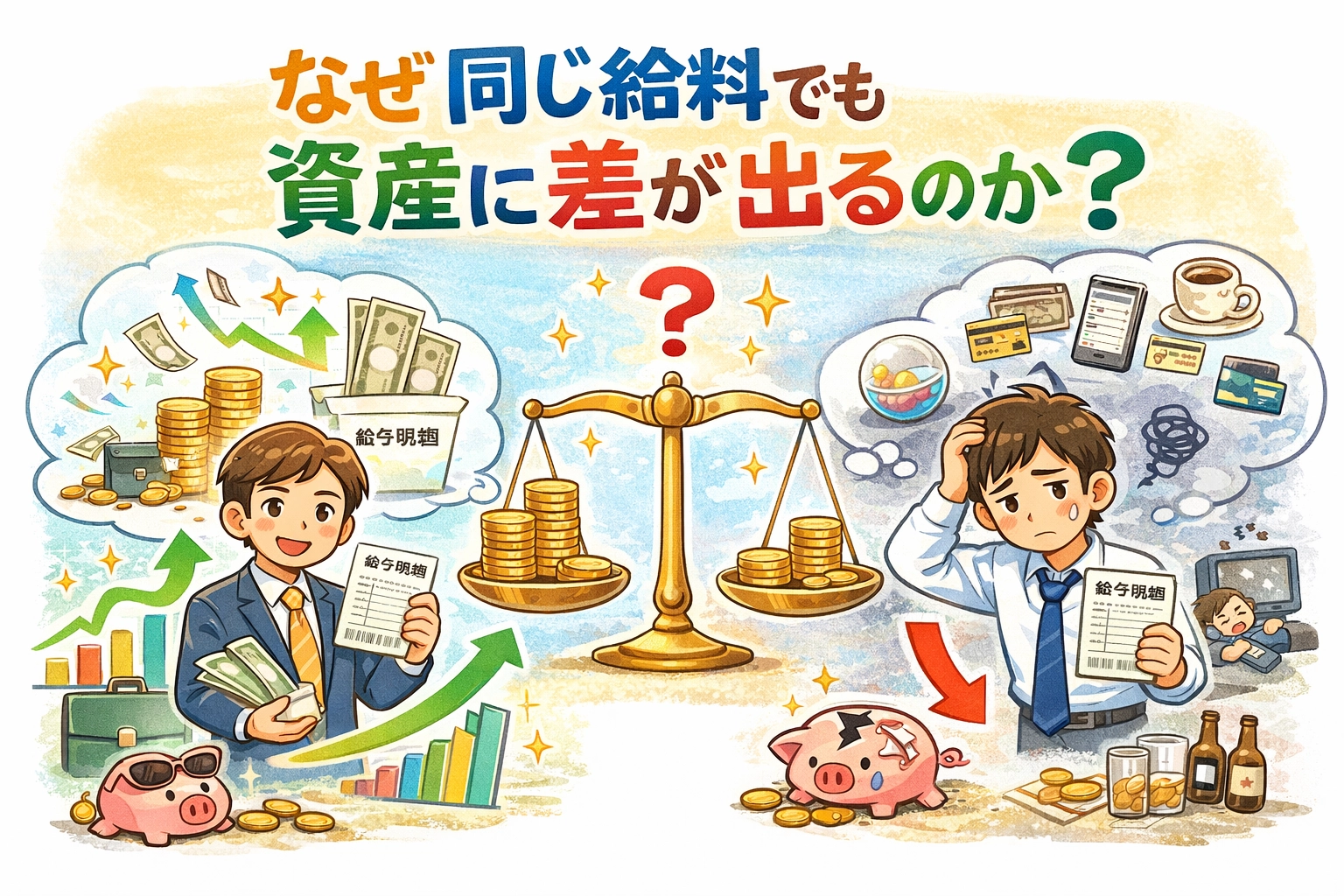
"Why does wealth differ even with the same salary?"
Joining the same company, doing the same job, and earning the same salary. The standard of living isn’t that different. From the outside, the two people who seemed to start life under almost identical conditions can be standing in completely different places after 10 years.10 years later, they can be in very different positions.
One side has almost no savings and a monthly salary that comes in and disappears. The other has quietly accumulated assets amounting to hundreds of millions, and in some cases over 10,000,0000 yen. Where does this gap come from?
It’s not about income. It’s not about talent. It’s not about education, nor luck. Even though they earn the same salary, why does such a vast difference arise? To be honest about the answer to this question, it is that three things—how you use money, how you think, and time—determine the result more than the income itself.
In this article, I will write the reasons why even with the same salary, assets can diverge greatly, as specifically and honestly as possible. This isn’t just information you already know; it’s written so that you can truly feel how much difference small daily choices can make. I would be happy if, after reading, you feel, “So that’s what it means.”
The gap has already begun in the unseen places
When you meet a classmate you haven’t seen in ten years, you may sense they seem to have more leeway. You might have started work in the same year and heard that their income isn’t much different. Yet something is different—the house they live in, what they wear, what they talk about. It’s hard to say exactly what’s different, but there are moments when you just feel, “This person has room to breathe.”
Or conversely, you might be earning more but a friend seems to have more ease in life. When you try to figure out why, the answer isn’t clear. If you’ve felt this kind of discomfort, what I write in this article will probably resonate.
The asset gap doesn’t appear overnight. Small daily choices accumulate month by month, year by year, until you realize a difference you can’t undo. Moreover, the gap is hard to notice from the outside, so you may notice it late. People rarely talk about their savings, and outward appearances don’t reveal whether someone is investing. The gap spreads quietly, without anyone noticing.
In the first few years, the gap is hardly visible. If you earn the same salary and live similarly, one year or two years apart, there isn’t a big difference. But after five years, after ten, the small daily differences accumulate like compound interest and start to show a big gap. By then, even if you wonder, “Why did the gap become this big?” you can’t reclaim the time that’s already passed.
How you spend money is the starting point of everything
The first reason why assets diver with the same income is the difference in how money is spent. This isn’t about whether you’re frugal. It’s about a deeper value system: what standards you use to spend money.
There are three main kinds of spending: consumption, waste, and investment. Consumption is necessary for living: food, housing, transportation, utilities. Waste is spending that doesn’t match the value or satisfaction you gain: things you buy on impulse, monthly charges for services you don’t use, etc. Investment is spending that brings value or returns in the future: acquiring qualifications, upskilling, health maintenance, and, of course, financial investments.
When you look at households whose assets aren’t increasing, you’ll often see a high ratio of consumption and waste and a very low ratio of investment. Monthly income is almost entirely spent on consumption and waste. You spend this month’s life away and there’s no money left for future actions. This is the essence of “not saving.”
On the other hand, people who are accumulating assets, when income comes in, first set aside a fixed amount for savings or investments. This method, called “paying yourself first,” means you don’t save the leftovers after spending, but secure the portion you can save before spending the rest on living. By restricting the amount of money you can use, your spending naturally stays within your income.
There is a formula that seems obvious: Income − Expenses = Assets. It seems obvious, but many people focus on “increasing income” and neglect “reducing expenses.” A person with income of 3,000,000 yen and expenses of 2,800,000 yen is in a more advantageous position for asset formation than someone with income of 4,000,000 yen and expenses of 4,000,000 yen. It’s not the amount of income that matters as much as how much you have left over.
Reviewing expenses is most effective with fixed costs. Rent, communications, insurance premiums, and monthly subscription services are costs that recur every month. Once you review them, their effects continue monthly. Trying to cut variable costs like groceries and entertainment every month requires willpower and effort, but reducing fixed costs once provides ongoing effects.
If you switch your smartphone plan from 8,000 yen to 2,000 yen, you save 72,000 yen per year. Canceling an unused gym membership of 5,000 yen per month saves 60,000 yen annually. Reworking insurance you’re enrolled in but don’t review can cut thousands to tens of thousands of yen per year. If you invest these savings, they make a big difference over the long term.
Reevaluating expenses isn’t about “self-denial.” It’s about confirming whether the money you spend actually gives you real satisfaction and value. Stopping money you’ve been spending out of habit and directing it toward more meaningful uses can improve your quality of life, not reduce it.
In savings and investing, the 10-year difference is completely different
When your spending changes and more money remains, the next question is how to handle that money. The choices here decisively widen asset gaps.
If you leave money in a bank’s ordinary deposit, current interest rates are almost zero. Even if you deposit 1,000,000 yen, the interest you receive after one year is only a few hundred yen. If inflation is 2% per year, the real value of your deposits falls every year. There is a sense of security in “saving,” but in real terms your assets are shrinking.
Meanwhile, if you invest that 1,000,000 yen in an index fund, the long-term historical expected return is around 5% to 7% per year. Of course it isn’t guaranteed to stay this way every year, and there are years it declines, but as a long-term average this is a useful reference. If 1,000,000 yen earns 5% annually, after 10 years it would be about 1,630,000 yen. If that 1,000,000 yen had sat in a bank deposit, after 10 years the amount would be almost unchanged.
From the perspective of monthly compounding, the difference grows even more. If you save 30,000 yen per month at 5% annual rate for 20 years, your final assets would be about 12,300,000 yen. The total principal saved would be 7,200,000 yen, but thanks to compounding, about 5,100,000 yen is added. If you kept 30,000 yen monthly in a cash stash for 20 years, your assets would remain 7,200,000 yen. The people who leveraged compounding will have more than 5,100,000 yen extra, compared to those who did not.
The effect of compounding accelerates with time. From the first 10 years after starting to save, to the period from 10 to 20 years, the increase becomes larger. This is because the principal grows, and at the same rate the absolute profits increase. To maximize this “snowball effect,” you should start as early as possible and continue for as long as possible.
Money has three states: use, save, and grow. If you use it, it disappears. If you save it, you maintain the status quo but its value gradually declines due to inflation. If you invest to grow, it accelerates over time. Even two people with the same salary and the same amount left each month, if one invests and the other leaves it as savings, after 10 years there will be hundreds of thousands, even millions, of difference. The nature of money itself doesn’t change, but the way you handle it can completely alter how it works for you.
Investment can seem difficult, but systematic investing in index funds is extremely simple. Open an account with a securities company, choose an index fund that tracks global stocks or the S&P 500, and set up automatic monthly contributions. That’s all. No need for complex analysis or daily monitoring. Once set, you can largely leave it alone.
Time differences create all other differences
Same salary, same standard of living, same investment method. If outcomes still differ, the only remaining difference is when you started.
Compare a person who started saving at age 25 with someone who started at 35. Both save 30,000 yen per month at 5% annual, for 60 years. The 25-year-old who started at 25 will, after continuing to age 60, have a final asset of about 34,000,000 yen. The 35-year-old who started at 35 will have about 17,000,000 yen. The only difference is a 10-year difference in when they started, but it results in roughly a 2x difference in final assets. The same 30,000 yen per month and the same rate of return produce a huge gap due to the time that compounding has to work.
Starting 10 years earlier yields benefits not merely equal to 10 years’ worth of contributions.Because each year you started earlier compounds longer, the base grows, and the later years’ growth accelerates. The 10-year earlier start grows across the following 25 years as compounding continues.
Saying that a one-year lead becomes a lifetime difference might sound like an exaggeration, but when you look at the numbers, it’s not far off. Whether you start this year or next year can change your assets at age 60 by tens of millions of yen. Imagine how much your current month’s 30,000-yen installment could grow by year 60 with compounding.
Time is the only resource that cannot be bought with money. Even with low income or incomplete knowledge, there are many things you can recover if you have time. But time itself cannot be bought back with any amount of money. In investing, youth itself is not talent but the greatest asset.
In your 30s, and40s, starting to invest is not late, but the earlier you start, the longer the compounding works. The present moment is the youngest point in your life. Regardless of your age, starting today is the best choice.
Knowledge without action yields zero
You may meet someone who says, “I’m interested in investing but I’ll start after I study a little more.” They read several investment books, study on YouTube, research which funds are best. But they haven’t opened an account yet. They haven’t started automatic contributions yet.
Having knowledge and actually growing wealth are two different things. Between someone who can explain index investing in detail and someone who saves 3,000 yen per month, the latter is overwhelmingly more advantageous in terms of assets. Knowledge yields zero percent return. Only the money actually invested grows with compounding.
The idea of “study more first” hides a trap. Investment knowledge is infinite. No amount of study will ever reach a state of complete understanding. Even economists cannot predict market movements perfectly. Even professional fund managers are not able to consistently beat the market. If you wait to begin until you’ve achieved perfect knowledge, you’ll wait forever.
The knowledge needed for long-term index investing isn’t that much. What index funds are, how compounding works, and why long-term holding is effective—the understanding of these three concepts allows you to begin basic long-term investing. The rest of the knowledge can be learned as you go.
The learning you gain from acting is different from knowledge you get from books or YouTube. Opening an actual account, setting up automatic contributions, and experiencing monthly price moves makes the numbers and concepts you knew into something you feel. Experiencing a market crash, for example, lets you know how you’ll feel during a crash. This experiential accumulation is the most important element for growing as a long-term investor.
Asset gaps are gaps in action, not gaps in knowledge. Two people with the same salary and who gather information similarly can create a clear asset difference years later if one opens an account and contributes monthly while the other remains “still studying.” The wall between knowing and doing may seem small but is actually large; only those who cross it can enjoy the benefits of asset formation.
Habits build wealth, and habits destroy wealth
Ultimately, the greatest difference in money comes from habits. How you handle monthly income, how you decide expenses based on standards, how you continue investing. These daily patterns accumulate over a long period and become the differences in wealth.
Many people who don’t see their assets grow have a pattern of spending based on current emotions. They go on impulse buys after stressful weeks at work, spend more when friends invite them out, buy things on sale and never use them. These up-front minor actions accumulate into large sums over time.
On the other hand, people who accumulate assets have rules for how they use money. Acting based on rules rather than emotions may sound cold or rational, but it’s actually the opposite. Rules liberate daily financial decisions from habit and allow you to focus money and energy on what you truly enjoy. If your monthly contributions are automated, you don’t need to worry about whether to invest or stop this month. Fewer decisions mean less stress.
The power of habits is often underestimated because its effects aren’t immediately visible. Even continuing a monthly 30,000-yen investment for 1 or 2 years doesn’t feel dramatic. But after 5, 10 years, you’ll realize a large asset has accumulated. Those who experience the feeling of “it just grew” understand the true meaning of habit power.
Similarly, bad habits accumulate. A habit of spending aimlessly every month, buying because it’s on sale, repeated spending to relieve stress. Each small item may seem trivial, but if you do it for 10 years, it becomes hundreds of thousands of yen in difference.
Changing habits is hard but not impossible. The key is not to rely on willpower alone but to change the system. Set up automatic contributions, so you don’t have to consciously act every month. Reassess fixed costs once, and that saving continues automatically each month. By creating a system, good habits can continue without willpower.
The illusion that “if income were higher”
Many people think, “If only I earned more, I could save more,” or “If my salary increases, I’ll start investing.” In reality, for most people this ends as a fantasy.
When income rises, expenses often rise with it. This is called lifestyle inflation. If your salary increases by 50,000 yen a month, your housing, car, and dining out levels rise, and you may find that you have less money left than before, even if your annual income exceeds 10,000,000 yen. If your living standards rise with your income, assets rarely accumulate.
There are people who have high income but little assets, and others with low income who accumulate assets. The difference comes not from income, but from the three elements described above: how you use money, how you increase it, and how you use time. A person earning 300,000 yen per month who invests 50,000 yen monthly may be in a more advantageous long-term position than someone earning 600,000 yen but investing only 30,000 yen per month.
There’s also a misconception that you can’t grow assets without a side job. Earning more via a side job isn’t bad, but starting a side job without proper expense management and investment basics often results in the increased income simply being absorbed by higher spending. The basics of asset formation lie in investing within your current income before considering a side job.
There’s also a belief that talent or special skills are required. You don’t need expert stock analysis or deep economics knowledge to grow assets through investing. Long-term, regular investing in index funds is a simple method anyone can do. What you need isn’t talent but the will to continue and a system.
From the same salary, a different future can emerge
From now, in 10 years, your assets may differ greatly from your colleagues. This difference arises from the accumulation of seemingly minor choices 10 years ago: how you managed monthly spending, whether you invested the money you had left, whether you started this month or postponed to next year.
These daily choices may seem unimportant at the time. Deciding, “This month I’ll stop the contributions because I’m a little short,” might seem minor. Yet if you repeat this every month, after 5 years, after 10 years, the difference between those who continued and those who stopped becomes irreconcilable.
The gap grows quietly. It’s not that someone suddenly becomes rich or someone suddenly becomes poor. Daily small choices accumulate over years and eventually, on a certain day, you realize you’re in a completely different place. That’s why it’s easy to miss the moment. By the time you realize, a large gap already exists.
Assets are determined by habits, not income. The money gap is a gap in actions. Even with the same salary, the future isn’t guaranteed to be the same. These three words—the way you use money, the way you grow it, and the way you use time—are all this article wants to convey.
You can live like this now if you want. Some people live month to month on their salary and hope for retirement on pension. But realistically, relying on pensions alone for a comfortable old age is increasingly difficult. Public pension levels aren’t guaranteed to stay the same, and medical and care costs are rising. When you eventually notice a widening gap, you may not have enough time left to catch up.
Things you can change today
You don’t need to be told anything difficult. What you can start today is surprisingly simple.
First, review your expenses. Check your monthly statement and look for fixed costs you’re paying without realizing. Unused subscriptions, insurances you don’t understand, unreviewed telecom costs. Checking these one by one can create monthly investment capacity.
Next, open an investment account. If you use an online broker, you can open an account on your smartphone within a few days. At the same time, apply for a NISA account. Opening an account is the first step to investing, and whether you do it or not can change your life.
The amount you start with doesn’t have to be large. Even 3,000 yen per month or 5,000 yen per month has meaning. You don’t need to set a perfect amount from the start; begin within your means and increase as you become accustomed. What matters more than the size of the amount is starting and sticking with it.
Setting up automatic contributions means you don’t need to rely on willpower to continue. If the scheduled contributions occur automatically on a fixed date each month, you’ll persist through busy months or months when the market is down—mechanically continuing your contributions. Acting through a system rather than emotions supports long-term persistence.
Those who notice early gradually drift away. There’s no need for grand declarations.SNSThere’s also no need to announce it. Just open an account today and start contributions from this month. Doing so creates a gap between you and those who do nothing starting today.
Changing the future is about actions in the present. Knowledge has increased. Understanding has improved. Now it’s just a matter of doing it or not doing it.