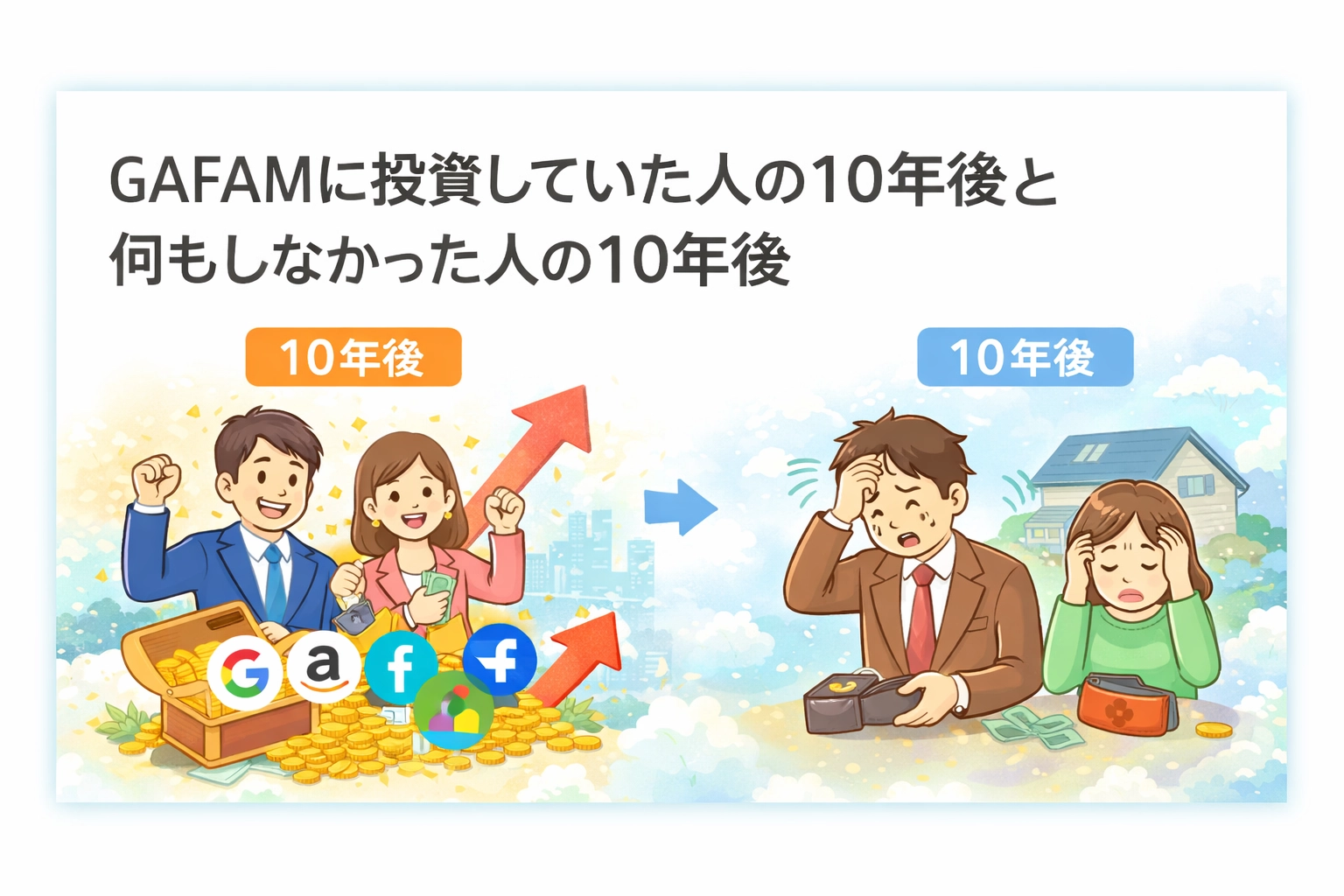

To English (keeping HTML format, no extra line breaks): Copy of the 10 years after investing in GAFAM vs the 10 years after doing nothing
If I could write a letter to my 10-year-old self, what would I say?
Travel more, spend more time with family, take care of your health. Many people would write such things. However, when it comes to investing, many people in Japan regret the same things.
“I should have bought Apple back then.”
In early 2016, Apple's stock price was about $95 per share. By 2026, it has surpassed $200. It has more than doubled in ten years. And if you had reinvested dividends, the return would be even higher.
What about Microsoft? Its stock price in early 2016 was about $50. It is currently over $400. About eightfold.
Alphabet (Google's parent company) was about $700 in 2016, and after stock splits, it has risen considerably since then. Amazon likewise. And Meta (formerly Facebook) experienced a drop of more than 70% in 2022, but its price tripled from 2023 to 2024 due to a comeback rally.
Over the last decade, how big is the gap between those who continued investing in GAFAM and those who did nothing? Today, I will honestly lay out the concrete numbers and the underlying story behind them.
Who are GAFAM? Let’s clarify again
First, the premise: the meaning of GAFAM.
It is an acronym formed from the first letters of the five companies: Alphabet (which runs Google), Apple, Meta Platforms (formerly Facebook), Amazon, and Microsoft. It refers to the five giants that dominate the global IT market.
These five companies are not just big. They operate infrastructures deeply embedded in our daily lives. If you use an iPhone, that’s Apple; if you use Gmail, that’s Alphabet; if you shop on Amazon, that’s Amazon; if you look at Instagram, that’s Meta; if you use Word or Excel at work, that’s Microsoft. Without realizing it, virtually everyone today uses something from these five companies every day.
In April 2020, the combined market capitalization of GAFAM surpassed the total market capitalization of all companies listed on the Tokyo Stock Exchange First Section. Five companies held a value greater than the entire Japanese stock market. When many Japanese people learned this, they confronted the question, “Why don’t I own U.S. stocks?”
But even earlier, in the previous ten years, GAFAM had already achieved overwhelming growth. A huge gap emerged between those who knew and acted, and those who knew but did not act.
Seeing the “10-year gap” in concrete numbers
Let’s look at the actual numbers.
Consider investing 1 million yen in each of the five stocks at the beginning of 2016, totaling 5 million yen, evenly diversified.
The 1 million yen invested in Apple became roughly 2 million to 2.5 million yen over the next ten years. Including dividends, the real return would be even higher.
The 1 million yen for Microsoft grew to around 7 million to 8 million yen, thanks to the successful shift to cloud computing and early AI investments. Microsoft showed the most stable growth among the GAFAM.
The 1 million yen for Alphabet rose to about 4 million to 5 million yen, supported by the rapid growth of search advertising, YouTube, and Google Cloud.
The 1 million yen for Amazon grew significantly as it shifted earnings pillars from e-commerce to AWS, with drastically improved profitability.
The 1 million yen for Meta was the most volatile. In 2022, due to the failed metaverse investment and privacy issues, its stock price plunged by more than 70%, dropping into the 3 million yen range. However, since then, a drastic rebound occurred from 2023 to 2024 due to the recovery of the advertising business and AI-driven performance. For long-term holders, it ultimately turned into substantial gains.