Financial Instruments Business Operator Kanto Finance Bureau Director (Kinsho) No. 1960 / Membership Association Investment Trusts Association, Japan Membership No. 012-02323Go to GogoJungle Home
25 years of stock investing experience
At first I learned by trial and error and experienced many failures, but through that accumulation I now practice long-term investing mainly in U.S. stocks
While aiming for stable operation with mutual funds as the mainstay, I also slightly diversify by including Japanese stocks
I prioritize asset formation that avoids decreasing rather than significantly increasing
I would be happy to support those who are anxious or悩み about starting investment!)
Just hearing the word investment makes many people tense. "Seems difficult," "I might lose money," "only rich people do it." With that image in mind, it's hard to take the first step. You who are reading this article may have arrived here with such feelings as well. That's perfectly fine. In fact, I think that level of warmth is just right. There's only one thing I want to convey. The New NISA system is not for people who are already experts in investing. Rather, it is a system designed for those who had little connection with investing until now. And now, leaving this system as something “somehow seems difficult” is quietly becoming a reason for ongoing losses. This article explains what the New NISA is, why you should start now, and how to start, in a way that someone with zero investment knowledge can understand. I kept jargon to a minimum and wrote in my own words as much as possible. If you feel that a difficult topic has appeared, go back and reread it. You will surely be able to read it to the end. First, let’s straighten out common misconceptions about investing. When many people hear “investment,” they envision something close to gambling: repeatedly buying and selling while watching stock price charts, the sight of numbers filling the screen on TV, and professional traders making quick judgments. But investing with New NISA is completely different. You don’t need to watch the market every day. You don’t need to time buys and sells. Once you set it up, you can largely leave it alone. That is the style of dollar-cost averaging with New NISA. So, what exactly is New NISA? In one word, it is a mechanism where profits from investments are not taxed. In a normal taxable account, when you earn profits from stocks or funds, about 20.315% tax is applied to that profit. If you earn 100,000 yen in profit, about 80,000 yen will be left after taxes. The remaining about 20,000 yen goes to taxes. This is normal taxation. However, with an account called New NISA, this tax is zero. If you earn 100,000 yen in profit, the full 100,000 yen stays in your hands. You might think 20% is not a big deal, but the difference grows larger the longer you invest. For example, if you invest 30,000 yen a month for 20 years and manage it at 5% annual interest, the asset after 20 years would be about 12.3 million yen on a principal of 7.2 million yen. If about 5.1 million yen were taxed, that would be over 1 million yen in taxes. With New NISA, that 1 million stays in your hands. The same amount, for the same period, using the same method, but just using the system makes a difference of well over 1 million yen. The New NISA was significantly revised in 2024, making this system even easier to use. Here’s a quick summary of what changed from the old NISA. The old NISA had two types: “tsumitate NISA” and “general NISA,” and you could use only one of them. There was also a limit on how long you could hold tax-free: 20 years for tsumitate NISA and 5 years for general NISA. The New NISA changed this substantially. First, it provides both “set-up to invest periodically” and “growth investment” frames, allowing up to a total of 3.6 million yen to be invested per year. And the tax-free period is unlimited. There’s no need to sell after 5 or 20 years; you can hold purchases tax-free for decades. Furthermore, the lifetime investment limit is set at 18 million yen. That’s a substantial amount. Even saving 50,000 yen per month would take 30 years to exhaust, which is beyond what a typical employee can use in a lifetime. For most people, starting is far more important than exhausting this limit. Now, the question: is investing truly safe? I think this is what many people care about most. To answer briefly: risk varies greatly depending on what you invest in and how long you hold it. If you try to grow quickly in the short term, the risk is higher. On the other hand, a long-term, steady, incremental approach is historically known to carry lower risk and provide stable returns. Among the investments often chosen with New NISA are globally diversified stock index funds. Popular options include the fund known as “eMAXIS Slim All-C world (World/All-country, ORCAN)” and the S&P 500-linked US fund that invests in about 500 big US companies. Let me quickly explain what an index fund is. For example, the S&P 500 represents the stock prices of about 500 leading US companies like Apple, Microsoft, Amazon, Google, Nvidia, etc. A fund that tracks this index means you are broadly investing in all 500 companies. If you only invest in one company, you could lose everything if that company goes bankrupt. But if you diversify across 500, the impact of one company’s failure is less than about 0.2% of the total. Diversification dramatically reduces risk. Since 1928, the S&P 500 has delivered an average annual return of about 10%. It has fallen sharply during events like the Lehman Brothers collapse and the COVID-19 shock, but over the long term it has continued to trend upward. Of course, past performance does not guarantee future results, but the long history is important evidence for investing considerations. Here is one important point: when discussing investment risk, many people only think about the possibility of losing money. But there is risk in not investing too. That is inflation risk. Inflation means prices rise. When prices rise, you can buy less with the same amount of money. A product that cost 1,000,000 yen now might cost 1,200,000 yen in ten years. This is inflation’s essence. From 2023 to 2024, Japan saw rising prices for groceries, utilities, and dining out. Many people feel their monthly expenses have crept up, even though they buy the same items at the supermarket. That’s the impact of inflation. If you keep money in a regular bank account, the interest rate is nearly zero. So, even though the nominal amount doesn’t decrease, its real value declines as prices rise. The action of keeping money in a bank "for safety" quietly erodes wealth. Knowing this changes how you choose. Now, how do you actually start? First, you need to open a brokerage account. You need an account for investing, separate from a bank account. The recommended two options are SBI Securities or Rakuten Securities. Both are online brokerages where you can handle everything on your smartphone, without visiting a branch. Fees are very low, and many index funds have no purchase fees. To open an account, you need a My Number card or a combination of a notification card and an identity document. It takes several days to up to a week to open. Once the account is open, set up a New NISA account. In addition to your regular securities account, you must apply for a New NISA-only account, which can be completed online. Next, choose the index fund for monthly investment. For beginners, the previously mentioned Orcan (eMAXIS Slim All-World) or S&P 500-linked index funds are often recommended. The reasons are simple: low fees, high diversification, and suitability for long-term holding. If you’re unsure, these two should be your primary consideration. Finally, set your monthly investment amount. It doesn’t have to be a large sum. It can be 10,000 yen per month or 30,000 yen per month—start with an amount you feel you can continue. After that, the purchases are automatic and you can largely leave it alone. A common question is “From how much should I start?” The answer is simple: start within a range that doesn’t affect your current life. You don’t need to tighten your lifestyle for investing. You don’t have to cut back on monthly groceries or rent, and you shouldn’t. The key is to invest with a comfortable amount and gradually build from there. Another common question is “When is the best time to start?” People worry about buying when markets are high. But this worry is less meaningful for long-term, regular investing. If you buy when prices are high, the price per unit is higher, but when prices fall, you can buy more cheaply. By continuing to buy a fixed amount every month, you buy consistently through highs and lows. This is called dollar-cost averaging. When markets fall, that’s when you can buy more. For long-term investing, temporary crashes are opportunities to buy at lower prices. Those who continued their contributions through the COVID-19 crash later enjoyed strong returns; those who paused never benefited as much. There is one more thing to know before you start: New NISA is not magic. The asset won't dramatically grow the first month, nor is growth guaranteed. Investments always carry the risk of losing principal. However, many economists and investors support the view that risk is reduced over time by long-term, diversified investing. The three principles—long term, diversification, and low cost—are the basics to avoid mistakes in investing. New NISA provides an environment under which you can invest following these three principles, created by the government. There’s no reason not to use it. I often hear people say, “I’ll study a little more before starting.” But in investing, trying to understand everything perfectly before beginning is counterproductive. The feel for investing is gained only by taking action. How you feel during a market crash and how you want to react when there are gains can’t be fully learned just from knowledge; you must experience it. Starting small and learning as you go is the most efficient way to learn in investing. First open an account, start monthly contributions with a small amount, and deepen your understanding as you see actual numbers in motion. This order is the shortest path in the end. If you feel like “this doesn’t concern me” or “it’s too early,” please answer one question: How will you view your choice ten years from now? The most common regret in investing isn’t “I started too early,” but “I started too late.” If you start one year earlier, you gain the benefit of one year of compounding. The difference grows larger as time passes. New NISA is not a system for special people. It’s equally open to those who want to build retirement assets, to those who want to save for their children’s education, and to those who want more options for the future. You can start today or next week. But those who start even a day earlier will gain that one extra day of time’s benefit. Please open a brokerage account first. That alone is a sufficient first step. You don’t need to overthink it. You can gradually learn what you didn’t know. That alone will start to change how you approach your assets.
Add to cart
$6.38/month
Reference price (JPY): ¥980/月 (taxed)
Monthly subscriptions are only available on the Japanese site.
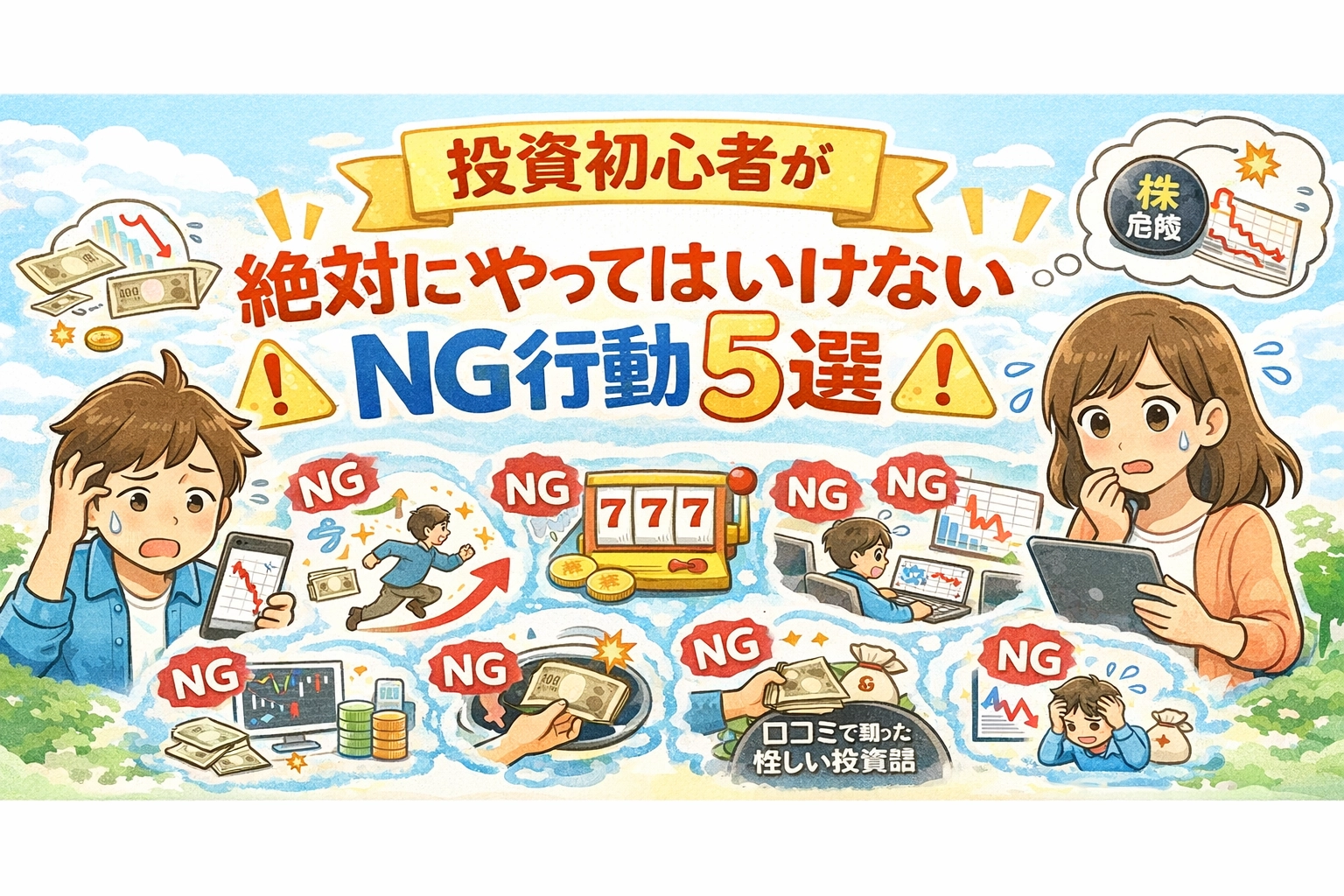
Five NG actions that beginner investors absolutely must not do
Several months have passed since I started investing, but for some reason my money isn’t increasing. On the contrary, it was decreasing when I noticed. I became scared and stopped my regular savings. Each time I hear stories of people who have had such experiences, I realize there is a common factor.
It wasn’t that there was no talent, nor bad luck, nor that the chosen stocks were bad. In most cases, the cause is that people started without knowing the “actions you should not do.”
The world of investing may look simple at first glance. Buy low and sell high, hold for the long term, diversify. If you put it into words, it takes just a few lines. But in practice, what you know in your head and what your body does do not align at all. When the market falls, you get scared; when a stock on social media becomes a hot topic, you become interested; and you become anxious if you don’t see a gain even a little. There is a difficult gap between human emotions and rational investment actions.
In this article, I will explain in detail the five NG (no-go) actions that beginner investors tend to do, including the psychological background and concrete examples of harm. After reading, my aim is for you to understand from the bottom of your heart why you should not do these things.
The first NG action is to seek results in a short period.
Right after starting to invest, many people are full of anticipation. They open their accounts every day and check how the balance has changed. Checking once a month becomes weekly, and eventually daily. If it increases even a little, they are happy; if it decreases even a little, they become anxious. This begins a lifestyle of reacting emotionally to short-term market movements.
If this continues, the emotional gyrations caused by short-term price movements—which should be irrelevant—will prevent you from taking the correct long-term investment actions. If it doesn’t rise in a week, you start to doubt, “Is this product okay?” If there’s no significant change in a month, you begin to look for “a better method” and search for another product. And when you switch to a new product, the previous one starts to recover, creating a repeating pattern.
There is a saying in the world of investing: “Time in the market beats timing the market.” It means that staying in the market for longer is more important than trying to read market timing. Over the long term, the world economy has continued to grow, but that growth is not visible in units of one month or six months. It becomes tangible only on the scale of 10 or 20 years.
In the field of behavioral finance, there is a concept called “present bias.” It is a psychological tendency to prefer immediate small rewards over far-future large rewards. It feels more rewarding to gain 10,000 yen now than to have a large asset in 20 years. This instinct hampers the continuation of long-term investment.
The most effective way to overcome this bias is to automate your savings so you don’t have to be aware of it. If you set it to automatically deduct on a fixed date each month and automatically purchase, you remove the opportunity to decide yourself. If you don’t decide, your emotions don’t move. Solving it with a system is far more reliable than trying to solve it with your mind.
The second NG action is to sell immediately when prices fall.