
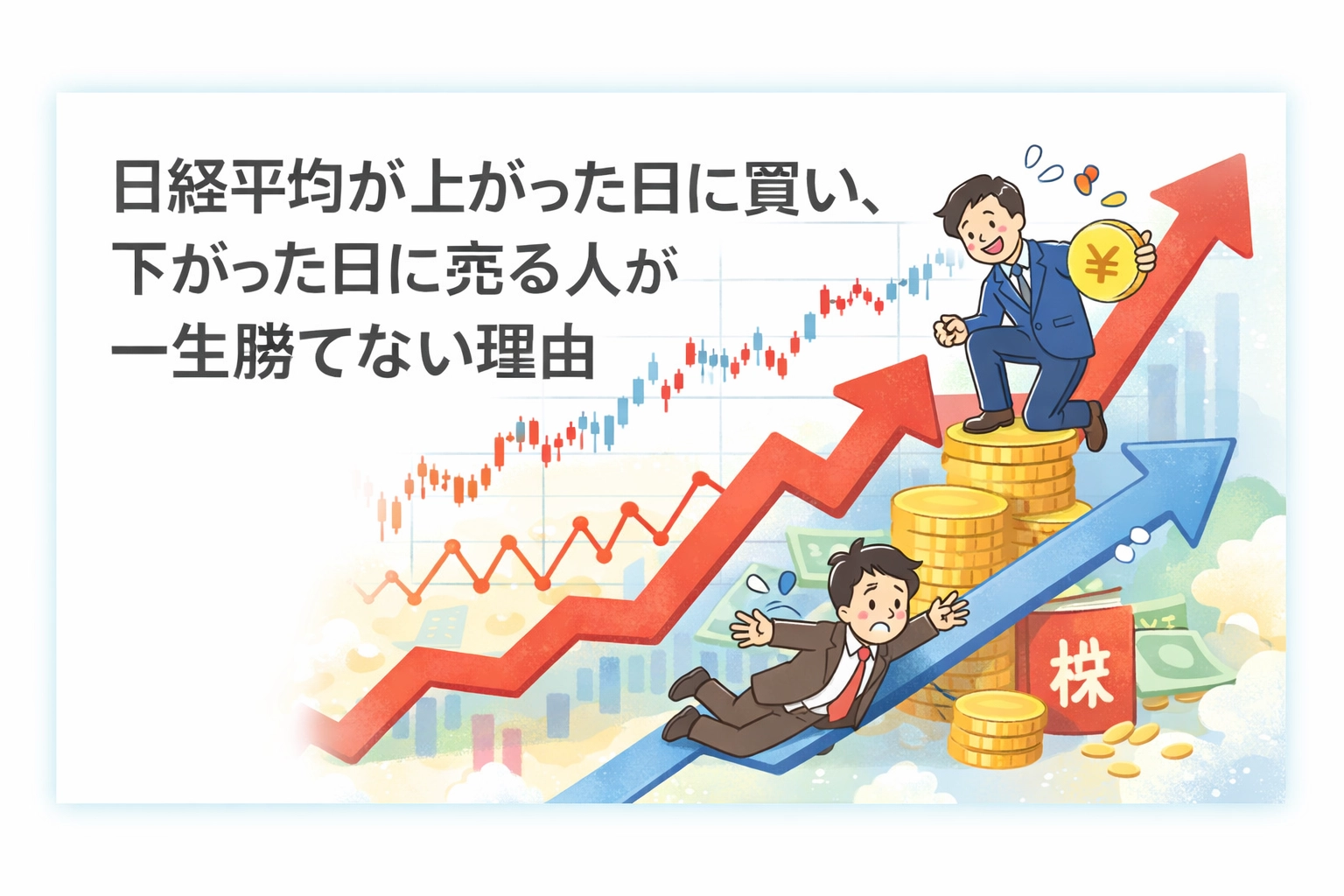
Translation (HTML preserved, no line breaks introduced): A copy of the reason why people who buy on days when the Nikkei average rises and sell on days when it falls will never win
Do you have people around you like this?
When prices rise and the news becomes lively, they say, “I think I’ll start too,” and when the market crashes and pessimism floods SNS, they pull back saying, “Investing is scary, I’d better quit.” Maybe that person is you.
To those who keep repeating this pattern, allow me to share a slightly painful truth.
Buy high and sell low. As long as you keep repeating this behavior, no matter how good the stock you choose or how correct your investment theory you know, your assets will not grow. On the contrary, the vast market system will use your emotions to steadily siphon off your precious money.
Why do so many people fall into this “loser’s cycle”? And how can you break free from it? Today I will write about this as deeply and honestly as possible.
Why emotions are the greatest enemy of investing
The human brain has evolved over tens of thousands of years. Its most proficient function is to make judgments for the survival in this moment. If a wild beast is in front of you, you run. If the surrounding peers start running, you run too. This immediate reaction was an essential ability for humans to survive in primitive times.
But in modern financial markets, this instinct becomes our greatest weakness.
When stock prices surge, the feeling of “I must not miss out” from watching the surrounding enthusiasm comes from the same neural circuits as the instinct to run when the herd moves in primitive times. The fear of being left behind, known as FOMO (fear of missing out), is an impulse deeply carved into our brains through evolution and cannot easily be erased.
Conversely, when stock prices are crashing and the screen shows red numbers, the fear you feel is the same as an instinct to sense danger and flee in primitive times. The amygdala signals “danger,” temporarily suppressing the functioning of the prefrontal cortex responsible for thinking. In other words, during a crash, our brains are literally driven into a state where we cannot think straight.
Understanding this structure is the first step in fighting emotions in investing. If you realize that you feel “scared” or “don’t want to be left behind” not as rational judgments but as ancient instincts in action, you can distance yourself from those emotions a little.
Behavioral economics reveals “human irrationality”
Daniel Kahneman and Amos Tversky studied investor behavior at the intersection of psychology and economics for decades, proving that humans systematically make wrong judgments in investing. Their work culminated in the Nobel Prize in Economics and is known as “Prospect Theory.”
Among the findings, the one that most directly affects investing is “loss aversion bias.” People feel the pain of losses about 2 to 2.5 times more intensely than the pleasure of gains.
The joy of a 1,000,000 yen profit and the pain of a 1,000,000 yen loss are not psychologically equal. Losses feel much larger. This asymmetry distorts investors’ behavior.
When you have an unrealized loss, you either: (1) cut losses to end the pain, or (2) hold on forever, afraid that the loss will be realized.
Ironically, many individual investors choose the worst timing in this two-option scenario. Selling during a downslide when you feel you’ve hit the limit is often near the bottom. And the stocks you held because you were afraid of realizing the loss may not truly have a recovery, causing losses to grow snowball-like.
Another phenomenon, the “disposition effect,” has been documented. People tend to sell profitable stocks too early and hold onto losing ones. From a rational perspective this is backwards. Letting go of profitable, quality stocks and keeping underperforming ones worsens portfolio quality unintentionally.
These behavioral biases are not confined to the extraordinarily foolish; any investor worldwide has them to varying degrees. The issue is whether you know about them. If you know, you can pause when you feel yourself being pulled by your emotions.
What goes on in the heads of those who buy at high prices
From 2020 to 2021, many people in Japan started investing for the first time. The rapid market rebound after the Covid shock and the need to manage assets in a low-interest-rate environment led to record highs in new brokerage accounts.
But many who started investing then experienced hardship during market downturns after the good times.
Reason: many started after seeing headlines that “stocks are rising.” Rising prices mean many people are already buying. Jumping in at that stage is like trying to enter a venue where the seats are nearly full.
There is a Wall Street saying in the world of markets: “A bull market is born in skepticism, grows in doubt, matures in optimism, and vanishes in euphoria.” As this proverb shows, many individual investors feel the urge to invest at the stage of “optimism to euphoria.” The paradox of emotion is that you want to buy at the point of highest risk.
The fear of missing out is real. When others are making money, you feel you are losing. SNS is flooded with posts like “I earned 3 million yen with this stock.” Yet posts about losing money are few. The survivorship bias makes the market look rosier than reality.
Those lured by this illusion buy at high prices and later, in the downtrend, experience “this wasn’t supposed to happen.” This experience can lead to the emotion “investing is scary, I lost money, I’ll quit,” ending in the worst outcome of selling at a low price.
What goes on in the heads of those who sell at a low price
In March 2020, many sold stocks during the Covid shock, when the Nikkei average dropped below 20,000 and headlines about the worst drop since the Lehman shock dominated the news.
Imagine the hearts of those who sold then.
Every day you open your account, unrealized losses mount. At first it was 1,000,000 yen, then 2,000,000 yen, 3,000,000 yen, growing. Sleepless nights follow. The fear of “what if it falls further” won’t leave your mind. There is a weight in not being able to tell your family about your investing.
And when the limit arrives, you sell saying, “I can’t take it anymore.”
The moment you sell, oddly enough, your mind feels a little lighter. The loss is realized, but you gain a sense of relief that “it won’t fall any further.”
But soon after, the market rebounded quickly. The seller watches the recovery with regret, thinking, “If I had held on, I would be better off now,” and the pain shifts to another form.
Many people who experienced this “bottom selling” repeat the same mistake in the next rally. In their hurried attempt not to miss the rebound, they buy again at high prices, and sell again when the next drop comes. This repetition is the “loser’s cycle.”
Those in the loser’s cycle mechanically repeat the worst pattern: buy when the market goes up, sell when it goes down, while cool-headed investors buy at lows and sell at highs. Wealth moves steadily from emotional investors to calm investors.
The cruel arithmetic that 50% loss requires 100% gain to recover
There is a harsh truth about investing math that many people cannot intuitively grasp.
If your assets drop 50% from 1,000,000 yen to 500,000 yen, what percentage gain is required to get back to 1,000,000 yen?
To recover a 50% loss, you don’t need a 50% gain. You need a 100% gain, i.e., double your money.
To turn 500,000 yen into 1,000,000 yen, you need a 500,000 yen gain. A 500,000 yen gain on 500,000 yen is a 100% return.
This asymmetry is the essence of why losses are so frightening. A 10% loss requires about 11.1% gain to recover. A 20% loss requires 25% gain. A 50% loss requires 100% gain; a 70% loss requires 233% gain.
Understanding this arithmetic helps explain why Warren Buffett has repeatedly said, “The first rule of investing is not to lose money; the second rule is not to forget the first rule.” Minimizing losses is far more important than maximizing gains for long-term wealth creation.
Panic selling is especially dangerous for this reason. Selling in a crashing market to avoid further losses fixes a large loss. The return needed to recover will be larger than the loss itself. Once you fall into a deep hole, it can take years to climb out.
A shift in thinking from “price” to “value”
Investors who don’t let emotions rule their decisions have a sense of value rather than price.
Many people think, “I want to buy because prices are rising,” or “I’m scared because prices are falling.” But with this mindset, you are always dragged by emotions.
Value-focused investors ask a different question: “What is the intrinsic value of this company? Is the current price higher or lower than that value?”
Stock prices change daily, sometimes by the minute. However, the value of the company, meaning the total future cash flows it will generate, does not change so easily.
When the shares of a good company cratered during the 2020 March Covid shock and the Nikkei fell 30%, did the intrinsic value of Japan’s good companies drop by 30%?
In many cases, the answer is no. Stock prices fell due to investors’ fear, not because the business value of the companies changed. This gap between price and value becomes a buying opportunity for value investors.
Buffett’s maxim—“Be fearful when others are greedy and greedy when others are fearful”—expresses the mindset of exploiting this price–value divergence. When others are rushing in with enthusiasm, price exceeds value and is overvalued. When others are panicking and selling, price falls below value and becomes undervalued.
However in reality, it is very difficult to compute the exact value of individual companies precisely. That is why, for many individual investors, a more practical option is to invest in a diversified market-wide index with long-term systematic investing. This rests on the assumption that the overall market’s value does not shrink dramatically just because fear grips the world.
Having your own rules is the only solution
The only way to invest without being swayed by emotions is to not change pre-set rules while the market is moving.
Investing without rules is like sailing without a compass. You get blown by the waves and lose sight of your destination. And when a storm comes, without a standard to maintain the right direction, you are left making emotional judgments.
As examples of rules, first clearly define your investment goal and time horizon. Write down what this money is for and until what year you will not use it. If it is for retirement, it is money you won’t touch for at least 20 years. Even if that asset temporarily falls by 30%, if it recovers in 20 years, you will have achieved your purpose. When the purpose is clear, you don’t need to react emotionally to short-term declines.
Next is automating your monthly contributions. By setting automatic deductions, you won’t decide to stop contributing just because the market is down this month. The system prevents emotional interference. You can buy more cheaply when prices are crashing, and automation prevents you from stopping.
It’s also effective to decide how often you will check your account. If you watch your account every day, price fluctuations will sway your emotions. Setting a rule to check only once a month or once a quarter allows you to focus on the underlying trend rather than noise.
A mindset to win in a market where 90% lose
In investing, there is a harsh statistic that 90% of investors underperform the market average. Among individuals, those who consistently profit over the long term are even fewer.
Why do so many people lose to this extent?
Because the market functions as a mechanism that transfers wealth from emotional investors to calm, rational investors.
The people who sold in fear hand over the shares to those who will buy calmly; those who bought wildly in euphoria pass their profits to those who take profits calmly. This transfer happens every day in the market.
Saying that 9 out of 10 lose implies that 1 out of 10 wins. What these winners have in common is not special knowledge or talent, but “not being moved by emotions” and “following rules.”
Here is an important question: Is “not being moved by emotions” the same as “not having emotions”? Not quite.
It’s natural to feel fear when you see a crash or to feel a rush not to miss a surge. It isn’t necessary to deny these emotions.
What matters is to separate feeling from action: you feel scared, but you don’t sell; you feel you’ll miss out, but you don’t buy at the top. This separation is at the core of a long-term investor’s mindset.
Preserving compounding is the greatest strategy
The greatest strategy Buffett, revered as the god of investing, has practiced for decades is not to break the chain of compounding.
Compounding grows stronger with time. If you invest 1,000,000 yen at a 7% annual return, you’ll have about 1,970,000 yen after 10 years, about 3,870,000 yen after 20 years, and about 7,610,000 yen after 30 years. The most important factor is not the 7% return itself but the uninterrupted chain of compounding over 30 years.
However, with panic selling at every crash, this chain is repeatedly broken. Once broken and later reconnected, the lost compounding time cannot be recovered. If after 10 years you incur a large loss and it takes 3 years to recover, effectively only about 7 years of compounding functioned.
Emotional investors break the compounding chain each time they experience market turmoil and distance themselves from its benefits. On the other hand, investors who stick to their rules and stay invested continue to benefit from compounding even through crashes, gaining long-term rewards.
There’s a paradox: sometimes doing nothing yields the greatest return. Buying and then doing nothing, simply staying in the market, can outperform repeatedly buying and selling. This is one of the most misunderstood yet crucial truths in investing.
What will you do when the next crash comes?
As you read this, the market may be calm. But the next crash will come. Historically, major crashes occur every 10 years or so, sometimes a few times within a decade.
Then, what will you do?
If you follow your emotions, you will sell out of fear and regret the rebound.
But you who read this article have another option.
When a crash comes, notice the signal your brain sends to “run.” That signal is honest. But remember that it is an ancient primal instinct, and in modern financial markets it is often a faulty signal.
And while you feel that emotion, execute the pre-set rules: continue with your contributions. Continue to hold. Even if you must avert your eyes from the account numbers, you must follow the rules.
That accumulation of feeling scared but not acting builds the mental resilience of a long-term investor.
Investing is a battle with yourself. The market constantly tests your emotions. Wealth steadily moves from those who act on emotions to those who overcome them.
When the next crash comes, remember this article. And while you feel fear, check your contribution settings. Do not change them. Do not touch them. Doing so alone can help you avoid many common mistakes.
Unremarkable persistence is the strongest weapon for long-term investing.