

Are you unsure about stock investment methods? Choose the one that suits you from three methods!
Investing must be conducted in a way that fits your goals.
For someone who cannot endure stock price fluctuations, investing only in highly volatile small-cap stocks is tough, and even an 80-year-old investing with a 30-year horizon is unlikely to benefit financially.
In standard buy-and-hold strategies, investment stances can include the following:
- Accept price fluctuations and aim for substantial growth
- Hold stable companies and grow while preserving capital
- Enjoy income gains from dividends
1. High risk, high return—timing is everything
The first method is high risk, high return. Growth stocks with potential for large rises tend to have high P/E ratios, sothe decline when expectations fade can be very large。
The necessary abilities arethe eye to discern growth stocks andthe readiness to cut losses quickly if they are not working. Without either, it would be difficult to maintain profits over the long term.
Timing is also crucial.From the Lehman Shock (2008) to the pre-Abenomics period (2012), even growth stocks had many with low P/E ratios. In hindsight, that was the “accumulation period.”
After that, with global monetary easing, prices rose steadily.Many people became millionaires by riding the uptrend. However, recently it has become harder to find bargain stocks.
A well-known individual investor with assets of 13 billion yen, Akira Katayamaspeaks in an interview with Nikkei Money as follows.
I once told others to buy small stocks that institutions would not touch, and that was the correct strategy over the past 10 years. From now on, as people stop investing in stocks and sell off, stock prices will not return to previous levels, and may even fall further.
Source: Nikkei Money, May 2019
Judging from Katayama’s interview and recent market conditions,it may be wise to refrain from starting this approach now.
2. Excellent companies take time to mature
Unlike method 1, timing is not as critical for method 2. Because,true excellent companies expand value over time.
For a company that can sustain a 10% annual return, its value would multiply by 1.6 in 5 years and by 2.5 in 10 years. If you bought such a company at a P/E of 10, and 10 years later favorable market conditions push the P/E to 20,the stock price would rise by about five times.

You need to time your purchase to when the P/E reaches 10x, but even if you bought at 20x, you can still achieve about 2.5x gains.Usually, look for excellent companies and invest when their stock price has fallen significantlyas the standard approach.
If a company is truly excellent, it can continue to operate without deteriorating earnings, so downside risk is limited. If you can overlook some price fluctuations,you can expect the stock price to grow over time—an ideal investment.
Warren Buffett, who has continued this approach for decades, says the following.
Is this a business that creates something trustworthy and something everyone will want even after 10, 20, or 50 years? These are my criteria for investment decisions. My view on this has not changed at all.
Source:Meigendan (Wit and Wisdom Database)
3. Earn a 7% dividend yield while also achieving 30% capital gains
If price volatility worries you, or you want regular income more than increasing principal,high-dividend stocksare sensible investments.
In recent years, Japanese companies have emphasized dividends, and dividend yields have risen. With recent stock price declines,yields exceeding 5% are no longer uncommon.
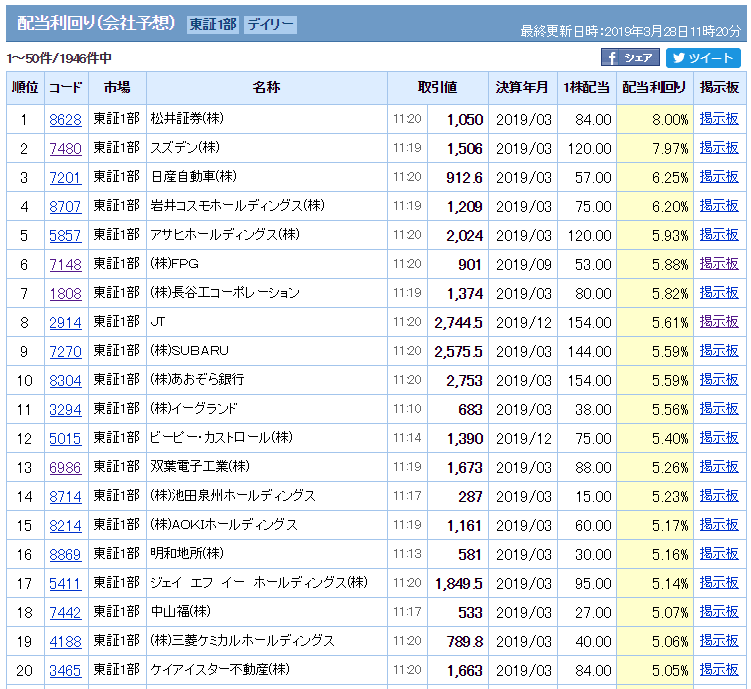
An annual dividend of 5% is far better than keeping funds in a savings account. If you don’t need to dip into principal, I think you should allocate part of your assets to stocks, real estate, or REITs.
Be mindful of the risk of dividend reductions. High-dividend stocks can be supported by dividends, but if dividends fall, both the payout and the stock price will drop, leaving you worse off.
To judge the risk of dividend cuts,looking at historical performance is effective. If dividends were cut during times of economic downturn like the Lehman Shock, there is a risk they may do so again, so caution is needed.
In the above table, securities companies and automobile manufacturers adjust dividends significantly based on results. On the other hand,domestic-oriented companies less influenced by the business cycle are more likely to maintain dividends.
Initially, you might invest for dividends, but as the market rises, it’s not uncommon for prices to surge. At that time, you cancapture capital gains as well—a two-birds-one-stone investment.

A diagram that derives the right method for you from age and asset amount
Beginners who are starting to invest or those unsure about investment methodsshould consider which of these three suits them best.
If you’re unsure,refer to the diagram below that imagines age and asset amount. Depending on where you fall, you can form an image of an investment method that suits your profile.
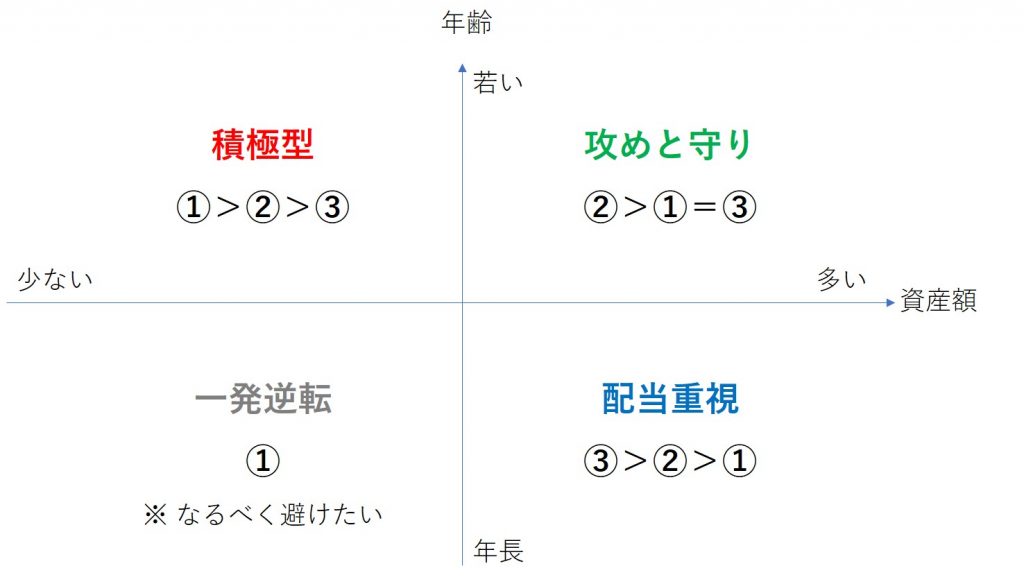
※ There are no strict criteria, but it’s reasonable to view assets around 10 million yen and age around 60 as a central reference point.