

[Special Free Sample] We’ll show you a paid article released on 3/23! | “Why Does the Market Stop There?” Bollinger Bands × Harmonic Capturing market turning points with high precision through the fusion of statistics and geometry! (Lefty-golfer YOSSY)
To commemorate the feature publication, we are offering the following paid series articles for free for a limited time.
This time,
we will compare with the
“Russell 2000”
which is called the “canary in the coal mine” that leads in a falling market.
[Overall Scenario Probability]
This week’s overall market is…
“Rise: 40% / Fall: 60%”
Note: With the expansion continuing in the four major U.S. indices, the downtrend is dominant.
However, a temporary rise is possible.
Provided for reference level.
[Key Market Focus This Week]
The four major U.S. indices remain in a downtrend with an “expansion” and “trend channel state,” and the Nikkei 225 is under similar downward pressure.
USD/JPY and the U.S. 10-year Treasury yield have risen again, maintaining an “inverse correlation.” Whether USD/JPY, upon reaching +2σ, reverts to a “positive correlation,” or stock indices reverse higher will greatly influence the future market direction.
↓ From here onward is normally paid content ↓
------------------------------------------------------------
[Market Environment Recognition]
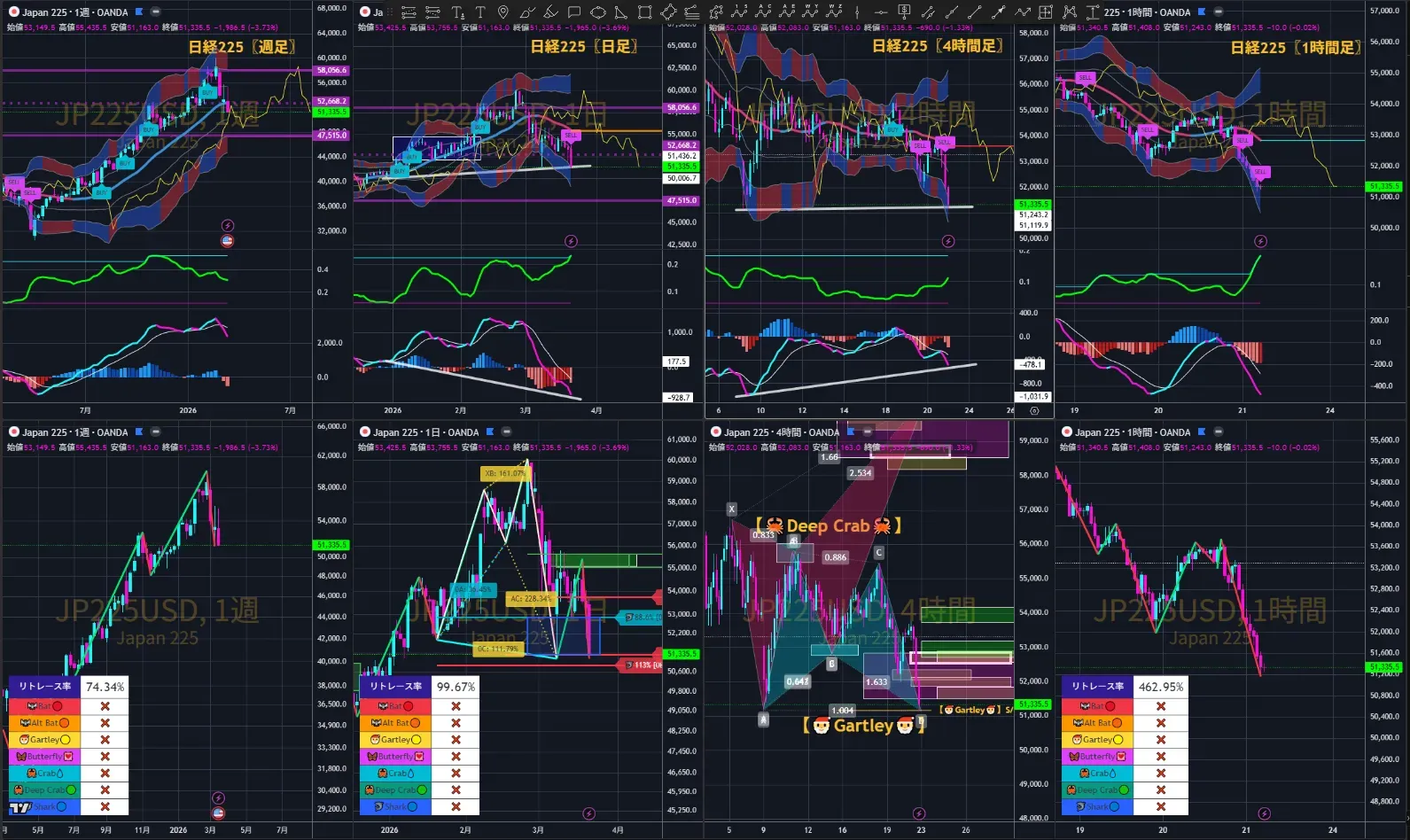
[Nikkei 225]
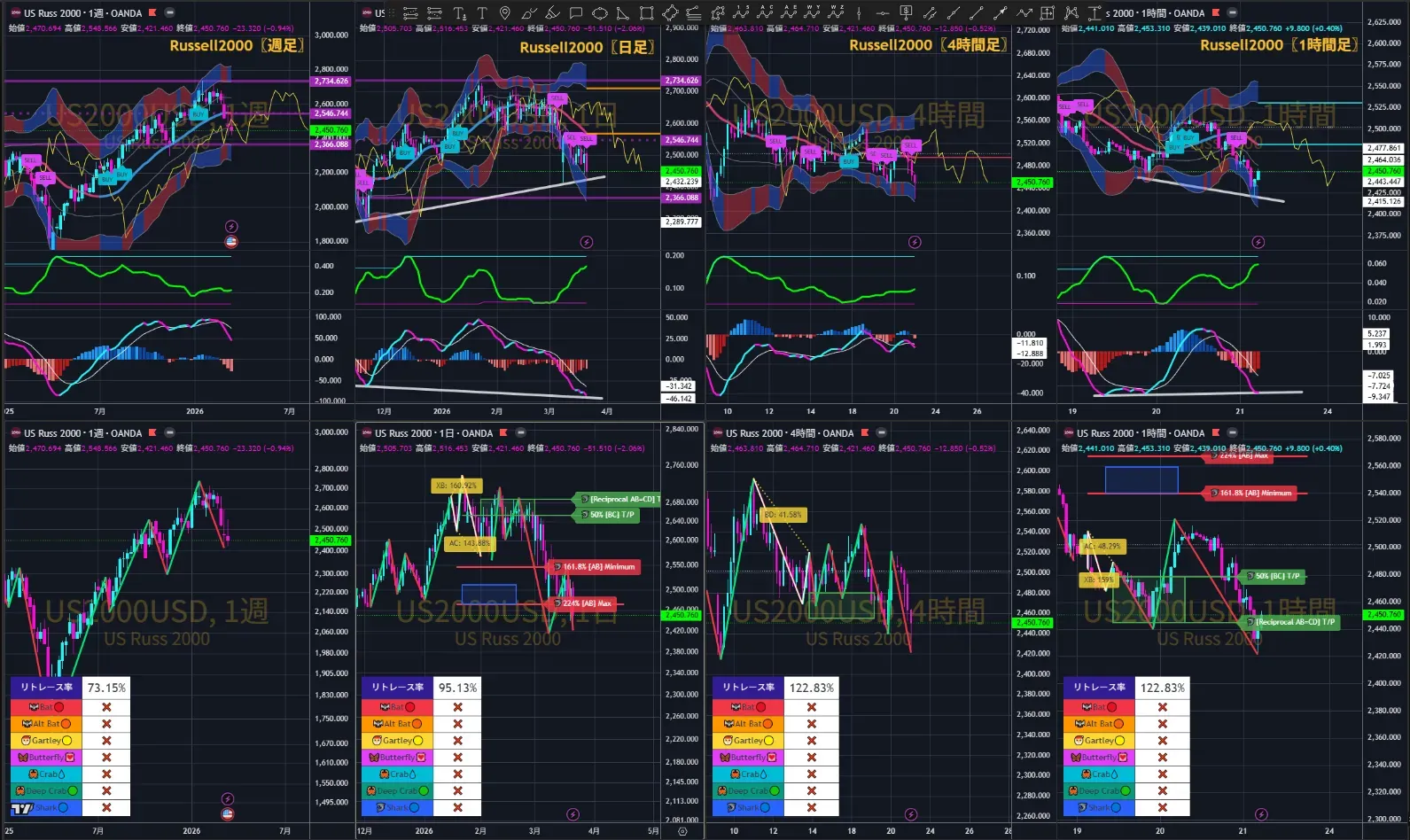
[Russell 2000]
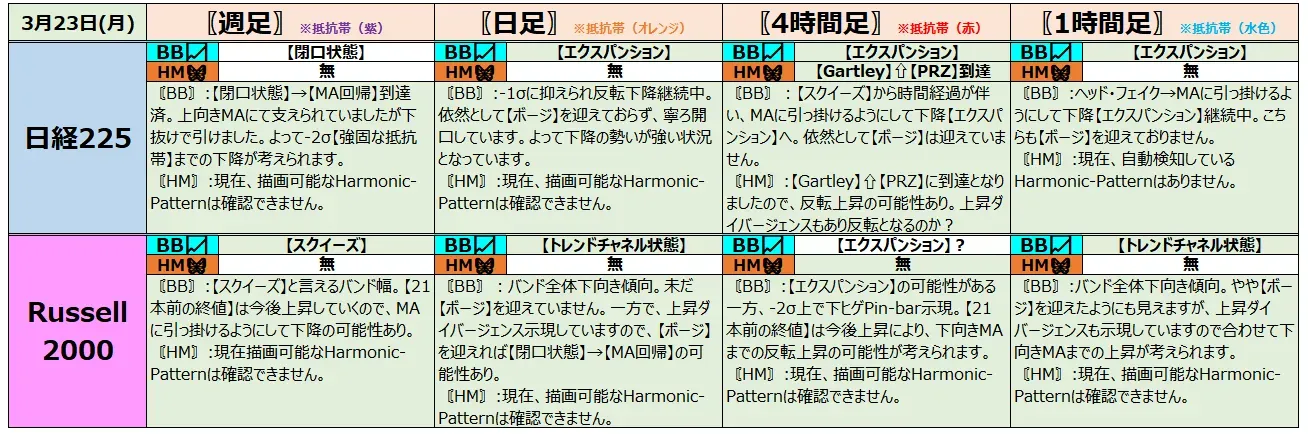
〖Harmonics Reaching the [PRZ]〗
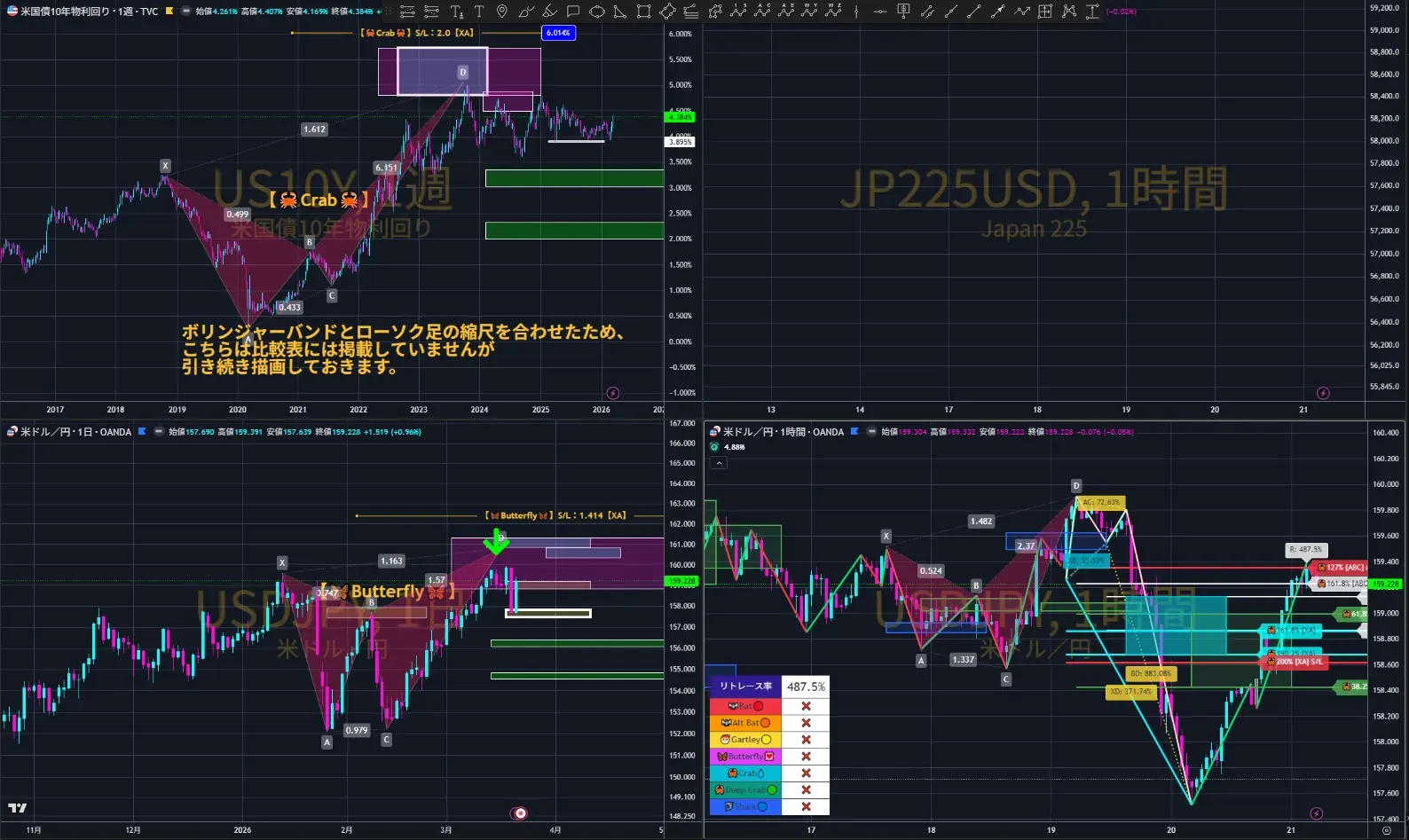
USD/JPY 〖Daily〗: [Butterfly] ⇩
USD/JPY 〖1H〗: [Shark] ⇩ [Invalidated]
U.S. 10Y Treasury Yield 〖Weekly〗: [Crab] ⇩
[Correlation]
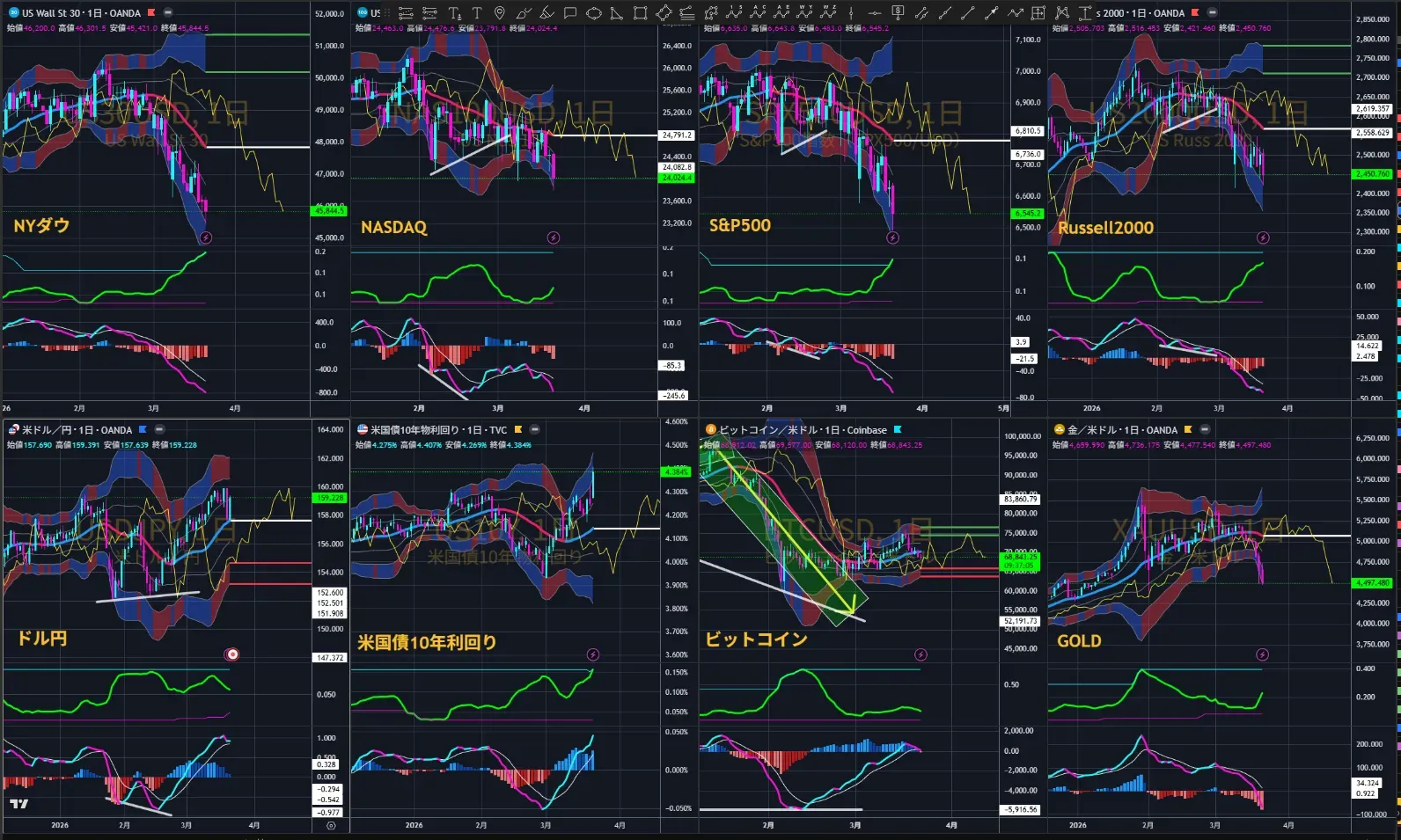
We show the 〖Daily〗 charts of each instrument.
[Bollinger Bands]
[Harmonic]
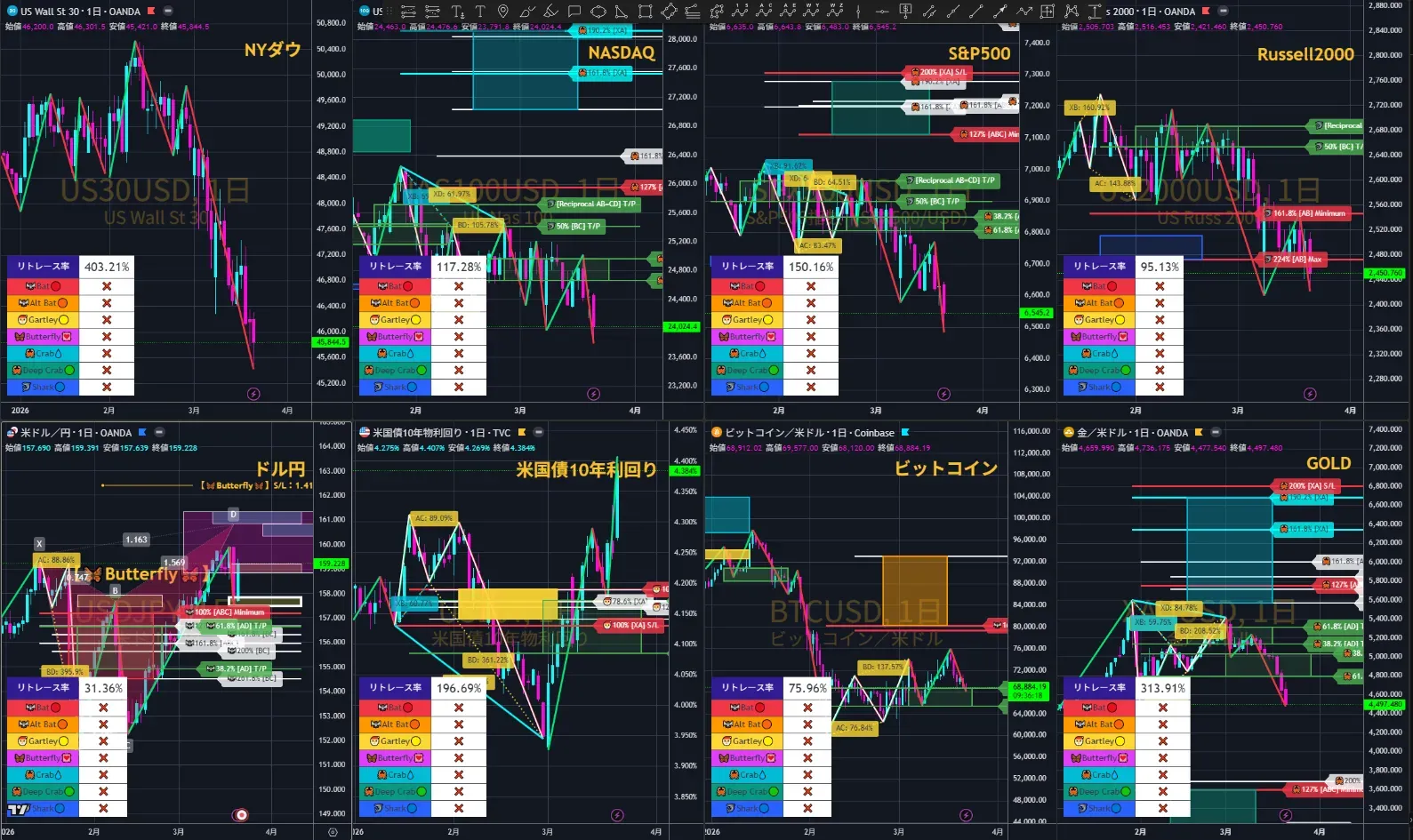
Harmonic patterns that have reached the [PRZ] are two: U.S. 10Y Yield 〖Weekly〗 [Crab] ⇩ and USD/JPY 〖Daily〗 [Butterfly] ⇩. Both indicate downside patterns, so from a harmonic perspective we maintain a bearish outlook.
For USD/JPY 〖Daily〗 [Butterfly] ⇩, there is an approximate overlap zone of key levels near the upper bound of the [PRZ], so we had considered the possibility of a rise toward that level. However, since price temporarily broke below the [PRZ] and re-entered, we view the confidence as somewhat reduced.
Scott M. Carney notes that one can enter if price returns to the [PRZ], but my tests show the probability decreases in such cases; therefore, I do not view a re-entry as a valid point.
[Correlation: Harmonic]
No harmonic patterns are currently auto-detected.
[Correlation: Bollinger Bands]
On the Nikkei 225 〖4H〗, reaching the [Gartley] ⇧ [PRZ] suggests a potential reversal higher, but
looking at the 〖Daily〗 “correlation,”
the four major U.S. indices (Dow, NASDAQ, S&P 500, Russell 2000) are currently in an “expansion” and “trend channel state,” i.e., a downtrend.
Also, USD/JPY has resumed rising supported by an upward MA, and the U.S. 10Y yield is in “expansion” and rising again, continuing an “inverse correlation” with the four U.S. indices and the Nikkei 225.
When USD/JPY reaches +2σ, there is a possibility that USD/JPY and the U.S. 10Y yield will reverse lower.
Possible scenarios then are:
1) USD/JPY and the U.S. 10Y yield revert to a “positive correlation” and both decline.
2) The “inverse correlation” between USD/JPY and the U.S. 10Y yield persists, and the four U.S. indices and Nikkei 225 reverse higher.
Details on the Nikkei 225:
Reaching the 〖4H〗 [Gartley] ⇧ [PRZ] suggests a possible reversal higher.
However, since USD/JPY 〖Daily〗 still has distance to +2σ, if the Nikkei 225 keeps falling, the [Gartley] ⇧ will be invalidated.
Although bullish divergence appears on the 〖4H〗 and 〖Daily〗, the band width is opening, suggesting strong downward momentum.
Details on the Russell 2000:
On the 〖1H〗, there is a slight possibility of a “bulge,” implying a potential short-term rebound.
Bullish divergence appears on the 〖Daily〗 as well, but the most important Bollinger band shape is opening, so the main scenario remains downside.
[Summary]
Two harmonic patterns—U.S. 10Y Yield 〖Weekly〗 [Crab] ⇩ and USD/JPY 〖Daily〗 [Butterfly] ⇩—have reached their [PRZ], so from a harmonic perspective we maintain a bearish view.
USD/JPY temporarily broke below the [PRZ] and re-entered, reducing the confidence of a rise to the key level somewhat.
On Bollinger Bands, the four major U.S. indices continue their downtrend with “expansion” and “trend channel state,” maintaining an “inverse correlation” with USD/JPY and the U.S. 10Y yield.
Upon USD/JPY reaching +2σ, the key question is whether
1) a “positive correlation” return leads to joint declines, or
2) continued “inverse correlation” leads to a rebound in stock indices.
Both the Nikkei 225 and Russell 2000 show bullish divergence, but with bands still opening, the main scenario remains bearish.
[Scenario Probabilities for Target Markets]
[Nikkei 225]
“Rise: 40% / Fall: 60%”
Note: Although a temporary rise is possible due to the 〖4H〗 [Gartley] ⇧ reaching the PRZ, continued opening favors the downtrend.
[Russell 2000]
“Rise: 40% / Fall: 60%”
Note: A short-term rebound is possible from a 〖1H〗 bulge, but downtrend remains dominant.
Provided for reference level.
[Points of Interest]
[Nikkei 225]
● 〖Weekly〗: After breaking below the MA, will it fall to -2σ?
● 〖4H〗: From the [Deep Crab] ⇩ [PRZ], will it rise toward the T/P Zone (green)?
[Russell 2000]
● 〖Weekly〗: Will it fall to the -2σ “strong resistance zone” that will rise with price?
● 〖Daily〗: Bands are opening; will the “trend channel state” continue?
Will it shift from a “closed state” to an “MA reversion”?
● 〖1H〗: Will it shift from a “closed state” to an “MA reversion”?
[Specific Entry and Exit Strategies]
[Nikkei 225]
[Entry Strategy]
• Short entry: With bands continuing to open, downward momentum is strong. Consider short entries after confirming a stall near the 〖4H〗 [Gartley] ⇧ T/P Zone (green). Continuation of the “trend channel state” in the four U.S. indices supports this.
• Long entry: Consider longs only if a reversal higher from the 〖4H〗 [Gartley] ⇧ [PRZ] is confirmed and the scenario of a “positive correlation” return after USD/JPY reaches +2σ becomes realistic. However, the bearish scenario currently dominates, so keep position sizes small.
[Exit Strategy]
• Take profit on shorts: Take profits in stages upon reaching 〖Weekly〗 -2σ.
• Take profit on longs: Take profits early in stages upon reaching the 〖4H〗 [Gartley] ⇧ T/P Zone (green).
• Stop loss: For shorts, stop out if the 〖4H〗 downward MA is broken to the upside. For longs, stop out if the [Gartley] ⇧ is invalidated and the decline resumes.
[Russell 2000]
[Entry Strategy]
• Short entry: With continued 〖Daily〗 band opening, the main scenario is down. Consider short entries when a temporary rebound from a 〖1H〗 “bulge” fades and price reaches the downward MA. Although 〖Daily〗 bullish divergence is present, as long as bands keep opening, prioritize the bearish bias.
• Long entry: Consider longs if the 〖Daily〗 downward MA is broken to the upside.
[Exit Strategy]
• Take profit on shorts: Take profits in stages at 〖Weekly〗 -2σ. If bands continue to open, it may be viable to hold until a MACD bullish turn.
• Take profit on longs: Take profit upon reaching 〖Daily〗 +2σ, a “strong resistance zone.”
• Stop loss: For shorts, stop out if the 〖Daily〗 downward MA is broken to the upside. For longs, stop out if the 〖4H〗 develops into an “expansion.”
[Common Notes]
For both the Nikkei 225 and Russell 2000, continued band opening makes the bearish scenario dominant.
While the Nikkei 225 〖4H〗 [Gartley] ⇧ [PRZ] and the Russell 2000 〖1H〗 “bulge” suggest short-term reversals, do not over-rely on bullish divergence as a reversal signal unless band opening contracts.
When USD/JPY reaches +2σ,
1) a return to “positive correlation,” or
2) continuation of “inverse correlation,”
will greatly determine overall market direction. Manage positions with this timing in mind.
If a scenario breaks down, execute stop losses promptly.
[Caution]
Harmonics implies that upon reaching the [PRZ], price has a high probability of reversing,not that it always will.
Price does not necessarily reach the [PRZ] either.
Please be careful not to misunderstand this!
That’s all for this time.
Thank you for reading to the end today.
This article is special free access content originally published as paid content in the following series.