
[EA Production] Create a characteristically bad EA
Hello, this is 2pay!
Today is Sunday, so I’ll make and play with an EA.
The theme this time is“A poorly behaved EA”.
In previous articles,“MA cannot be used” has been criticized.
Since it’s true that MA can’t be used, I won’t retract that criticism, but“making the virtual enemy use MA”yields meaningful results according to verification.This has been understood from the tests.
The virtual enemy treated here is defined as the“losing discretionary trader”.
In other words,Make the losing trader use MA to win is the idea.
MA is a tool that leads to losses if used carelessly. If so, by reversely using a losing usage, one should be able to win.
(Is there no human heart?)
Environment
・USDJPY M5
・EMA13
・EMA25
・EMA75
The period uses popular numbers. Beginners who like USD/JPY, with the recent tendency toward EMA over SMA, are intended.
It isn’t that there is a “particularly good combination,” but it aims for the most trendy setting.
Strategies the virtual enemy would take
The strategy is a summary of things commonly written in beginner FX guides and beginner columns online.
・Follow the trend (trend following, the trend is a friend)
・Follow the slope of MA
・Buy on pullbacks, sell on retracements
・Golden cross, dead cross
・Use multiple indicators to reduce false signals
・Place TP and SL once you enter
I think you’ve heard of all of these at least once.
There is abundant beginner information, making it easy to collect.
Based on this,
・When three MA lines undergo a Golden Cross, buy
・When three MA lines undergo a Dead Cross, sell
・After taking a position, set SL, do not use TP, use a trailing stop of the short-term MA
.
When is the Golden Cross judged?
→ Wait for the candle to close. Because there can be false signals.
Where should SL be placed?
→ You learned to place it at the most recent low/high.
Thus, the strategy was decided.
Exclude individual traders’ quirks, and only formalize things that traders at the same level would commonly consider.
My own strategy
For the virtual enemy’s strategy, how can I position myself to gain an advantage?
The answer is simple:
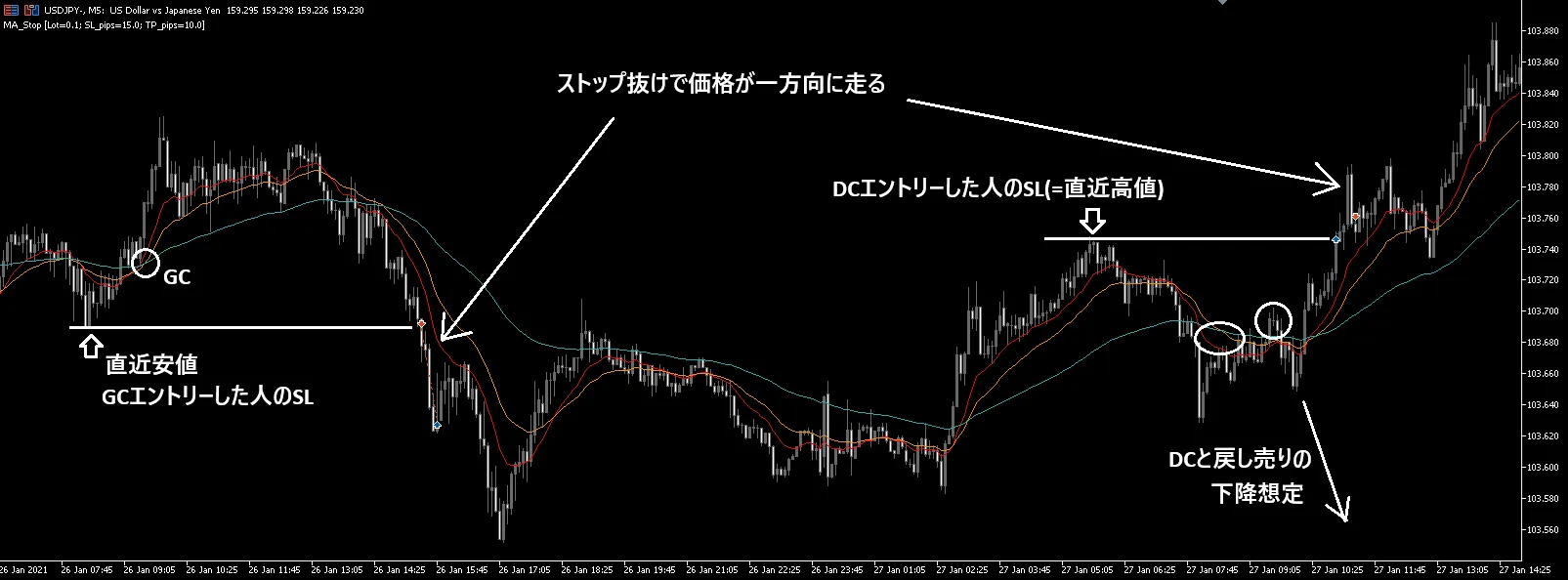
Attack when the SL is breached.
It’s easier to understand by looking at the order book, but
the recent high and low tend to accumulate stop-loss orders.
And when the price reaches where many stop orders have accumulated, orders are filled one after another.
Points with many stop orders concentrate will move in the direction of stop orders until all are filled.
This is one advantage.
This arises at the initial movement (the moment it breaks the recent high/low).
After that, you must consider whether the trend will continue or not.
Also, orders that don’t disappear near the recent high/low are a common feature of discretionary traders.
(If it were algorithmic, quotes danglers, spoofing, etc., could cancel or mislead)
If you don’t cancel and the stop orders remain, HFT will encourage the stops.
Leverage that and chase with the trend until the order book thins out.
In simple terms, go with the break of the recent high/low and grab a few pips.
Thus,virtual enemy’s stop loss → your profitstructure emerges.
(What is mine is mine, and what is mine is mine)
Well, in reality, the waiting system is as tough as Kaoru Hanayama.
Estimating Stop (Stop-Loss)
Regarding the calculation of the most recent high/low.
Discretionary traders would place it in a visually prominent spot.
The problem is when systemizing it.
Here is a simple example.
From the virtual enemy’s behavior,
① Buy at GC
② Attach SL to the position
in that order.
Entering at GC means it wasn’t GC before entering.
GC (and perfect order) indicates you are in the midst of an uptrend.
At entry, the prior market condition before GC would be the recent trend.
Then, if you define the most recent low as the lowest price between the end of the previous GC and the start of the new GC, you’re set.
Non-GC periods are periods dominated by participants who do not think it will rise.
Breaking the lowest point in this period means those participants have regained control.
For GC supporters, this completely negates the scenario, so estimating the most recent low is the final line of defense for uptrend supporters.
Assemble and test
I’ve explained at length, but ultimately what you do is
grab a few pips on a break of the recent high/low
and that’s all.
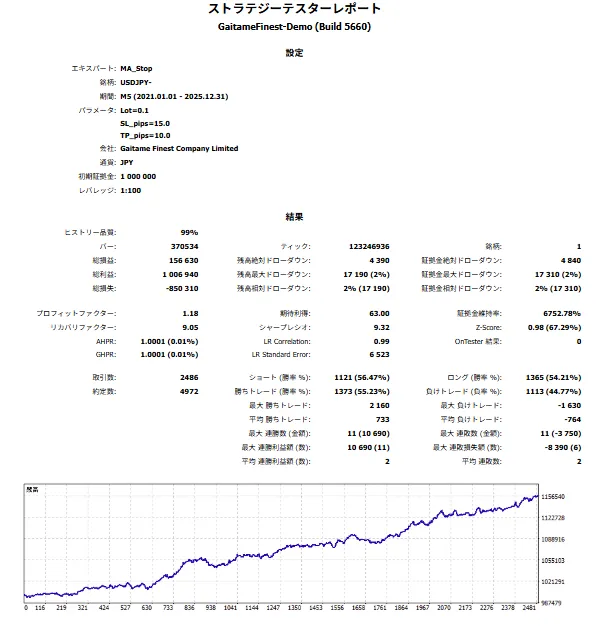
Below are the test results.
USDJPY M5 2021-2025 (5 years)
SL: 15 pips
TP: 10 pips
Maximum holding time: 34 minutes
I changed parameters a bit.
SL: 12 pips
TP: 7 pips
Maximum holding time: 34 minutes
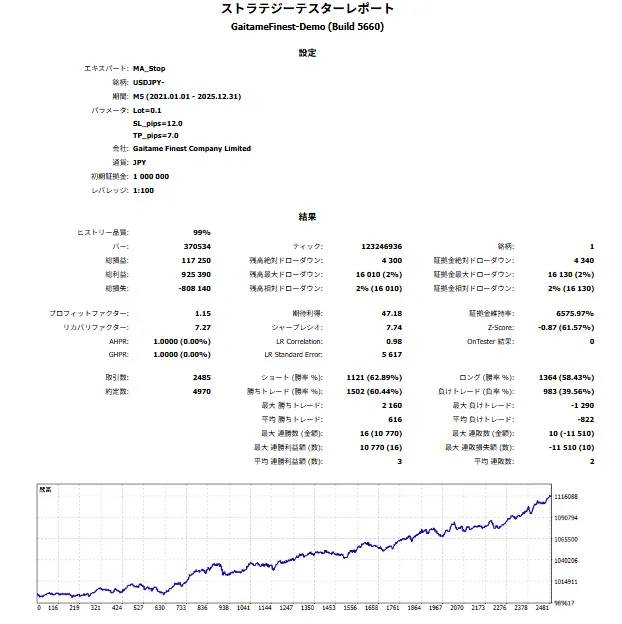
Although the SL/TP ratio hasn’t changed much, you can see the win rate improved by about 4–6%?
Generally, win rate is related to risk-reward and trade-off, but under conditions where profit margins affect expected value, this kind of phenomenon occurs.
The key of this strategy is the selection of the most recent high/low.
If there aren’t many virtual enemy stop orders gathered, the price won’t run.
Once you understand that, you can reproduce it even discretionarily.
In fact, many of the FX millionaires use a similar strategy for scalping.
J-san’s remark that “MA isn’t used to time entries, but is displayed to read crowd movement” comes from using it in this way.
This trading model is designed based on human psychology, so it can be used in many micro-markets and will continue to function as an advantage in the future.
Humans repeat mistakes, and many people are lazy and don’t try to improve their habits.
As long as such people do not disappear, you can feed on them almost indefinitely.
FX can’t view the order book, so please estimate where it tends to accumulate by other means, or refer to the OANDA book as a workaround.
This concludes the current content.
Thank you for reading until the end.