

Even AI can crumble? History teaches the “strongest trap”
Can AI Collapse Too? The “Strongest Trap” History Teaches

A Sense of Déjà Vu Overlapped in the AI Era
— Why did what was once called the “strongest” fall apart?
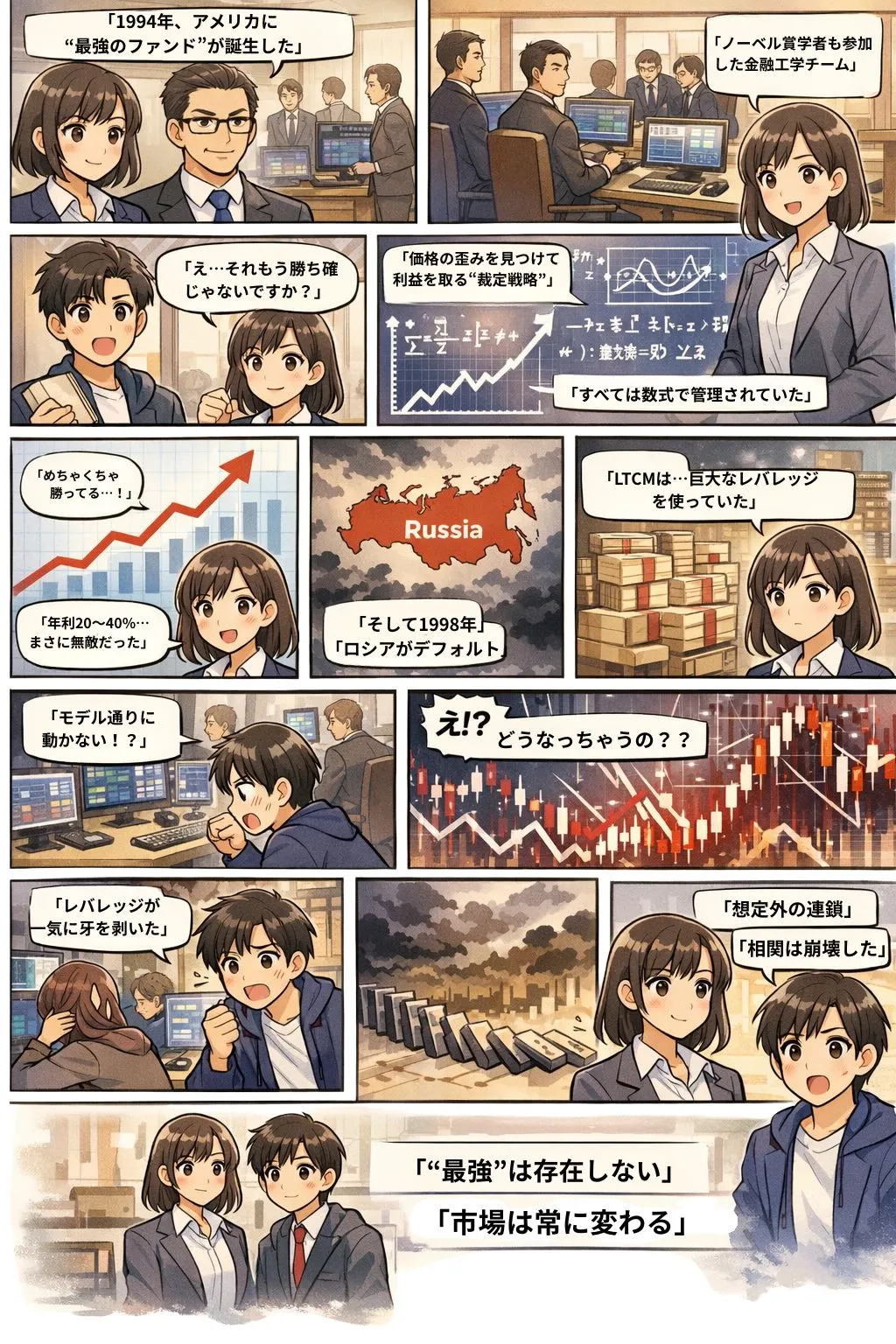
In the mid-1990s, a single “symbol” emerged in the world of finance.
That was Long-Term Capital Management (LTCM).
Its founding involved Wall Street’s top traders as well as scholars who had won Nobel prizes in economics.
Prices in the market theoretically converge—the premise is to use statistics and mathematical models to detect distortions and convert them into profits.
In short, it was a group that seriously aimed to “conquer the market with mathematics.”
A few years after its founding, the results were overwhelming.
It consistently delivered returns of over 20% annually, and came to be treated as a kind of “perfect form” within the financial industry.
.A huge amount of capital gathered, and its influence continued to expand.
Advanced theory, exceptional talent, and proven track records. Everyone began to recognize it as unquestionably correct.
But the story did not last long.
In 1998, triggered by Russia’s default, the market showed sharp distortions.
Correlations that had functioned until then collapsed, and movements outside expectations spread in a chain reaction.
The models were designed assuming “normal conditions,” so they were astonishingly powerless in abnormal situations.
Moreover, LTCM used enormous leverage.
Even a slight misalignment would be transformed into losses exponentially.
As a result, capital evaporated rapidly in a short period, and concerns about a broader market impact grew,
leading to an unprecedented rescue by financial institutions.
What had been called the “strongest” collapsed within a few years.
This event was not merely a single failure; it can also be seen as a kind of warning.
No matter how sophisticated a model is, if the world it assumes changes, its correctness can be easily shaken.
And another important point is that, as the technique becomes widely recognized,
as the same kind of thinking permeates markets, the very distortion that once existed also disappears.
Competitive advantage fades the moment it is shared.
After reading this far, some may sense a familiar atmosphere in the current situation.
In recent years, the word AI has been spoken in all kinds of domains.
In finance, too, data analysis, algorithms, and machine learning
are becoming available for individual use at the personal level,
and environments that once only major institutional investors could access are opening rapidly.
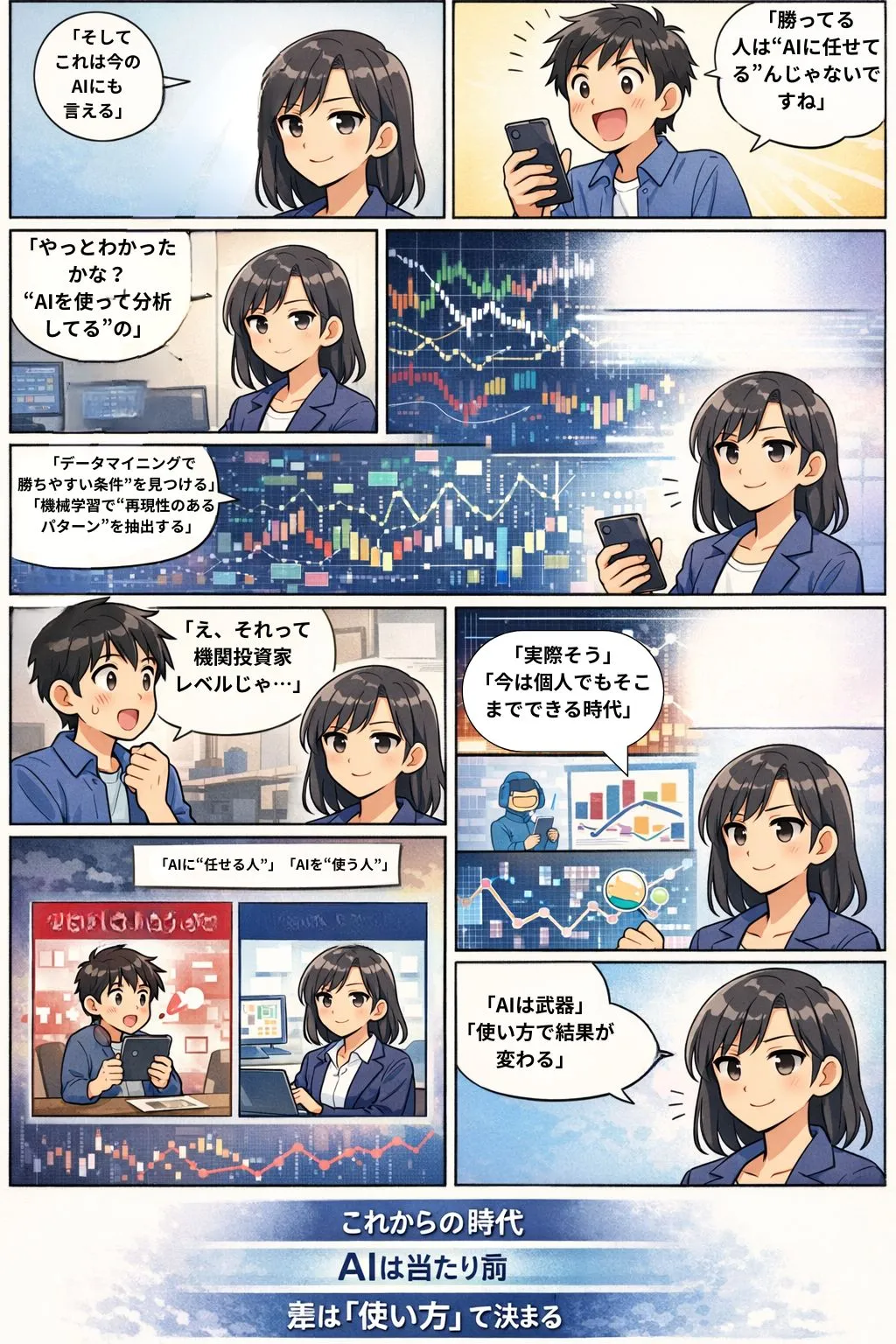
In fact, more individuals are achieving results by leveraging AI.
They organize vast historical data, extract behaviors under specific conditions, and discover reproducible patterns.
Such processes indeed feel close to those of the former professionals.
Yet at the same time, there is a sense of expectations and atmosphere that we have seen somewhere before.
“If we use AI, we can win.”
“If we conduct advanced analysis, we can gain an edge.”
The idea itself is not wrong.
But the fact that results are guaranteed by that alone is something history already shows.
AI, too, is built on past data.
In other words, at its core there is always a tendency to optimize for the past.
And the market sits on the extension of the past, yet remains a continuously changing environment.
Furthermore, if the same tools and logic spread widely, more participants will make similar decisions.
If that happens, patterns that were once effective may gradually stop working.
This is not something exceptional; it is a natural process.
That is why the question becomes less about “what you are using” and more about “how you use it.”
Some entrust decisions to tools,
while others treat tools as materials to work with.
At first glance, similar actions can differ greatly in their relationships. The former depends on external factors, the latter involves agency.
Which approach can better adapt to long-term change is not hard to imagine.
In a world where AI becomes commonplace, the differences will become even more evident.
Because you have access to the same environment, the way you use it directly translates into the result.
What LTCM once showed was the reality that being highly sophisticated does not necessarily mean you can sustain it.
And now, a similar dynamic may be repeating in another form.
It does not require anything special.
Only, whether you accept what is given as is, or step back and handle it.
That difference has become a major turning point without you realizing it.
As technology advances, choices become simpler.
Whether you stay on the receiving end or move to the user side.
That boundary exists more quietly, yet more surely, than you might think.