

Does the Holy Grail exist?
In FX trading, the term "holy grail" is generally equated with a surefire method, and the common stance is "there is no surefire method, in other words there is no holy grail." I used to think that as well.
On the other hand, among the system trades and buy/sell signal products sold on Gogojan, there are many that boast an abnormally high win rate and, probabilistically, could be considered surefire methods or holy grails, at least in the promotional copy.
Among them, there are many that have a large number of purchasers, but recent results are lackluster; I think most have expired in usefulness. I also thought, “Of course that would happen; if such things existed buyers would rush in and trade at the same time, causing performance to decline. Therefore a durable holy grail is impossible, and Gogojan’s demand and supply for new holy grail-like products would never run out.”
However, recently, while casually browsing the top page of system trading, I noticed by chance that when my cursor hovered over the real account EA operating rate (past one month) chart, various circles show the EA name, operating period, number of operations, and operating rate.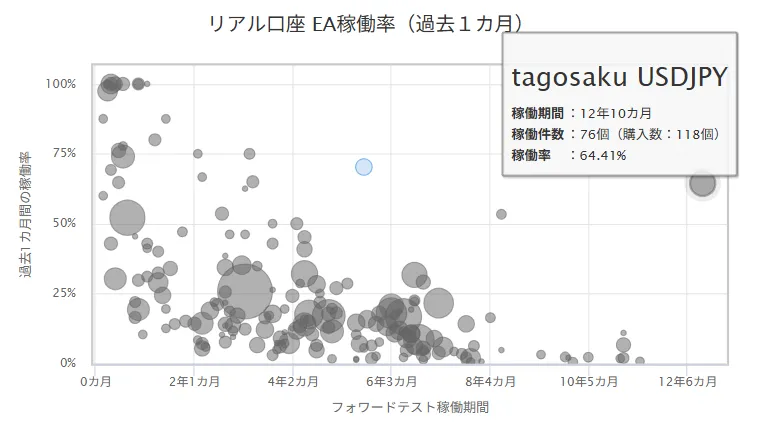
This chart is quite well made. By looking at it, you can instantly see that EA with long operating periods and high operating rates are excellent. A high operating rate reflects a higher expected value or actual performance.
Most notably on the upper right is tagosaku USDJPY, operating period 12 years 10 months, operating rate 64%. The total period Profit Factor (PF) is 1.25, and the win rate is 38.01%. It isn’t particularly high, but the profit/loss curve is almost steadily rising, which means that simply running the EA and leaving it could be profitable, which could be called a kind of holy grail. However, it seems to be updated frequently, which may be contributing to its stable results. The current version is 26-2, and the backtest results shown span from 2005 to 2017.
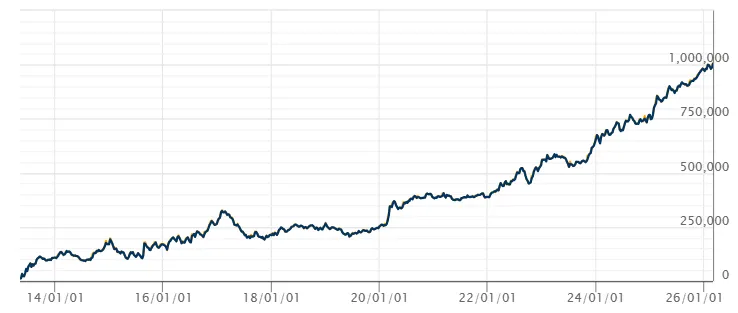
The profit curve is not perfectly rising from start, as for 152 months from 2013 to 2025, 56 months (37%) were negative. In terms of annual terms, over 13 years there were 3 negative years, so without trust in the developer and Gogojan and, above all, faith in the law of large numbers, ongoing operation would be quite stressful.
K-Behati_EURUSD_M30 has an operating period of 5 years 8 months and an operating rate of 72%. The overall PF is 3.08, and the win rate is 75.52%, which is high, but it is a mean-reverting type, so there are occasionally quite large drawdowns. This cannot be called a holy grail. However, compared to the drawdown, there appears to be sufficient profit outlook (risk-return ratio 2.4), so many people operate it long-term.
Thus, the above EA operating charts are not guaranteed to be a surefire method, but they are very useful for searching for a “semi” holy grail that profits by simply running and leaving it. The true holy grail may not exist, or it may be extremely rare, but there are likely many semi-holy grail EAs being sold on Gogojan that have not yet sold. I thought that among EAs with many backtesting trades and small forward testing deviation, there might be a “semi” holy grail.
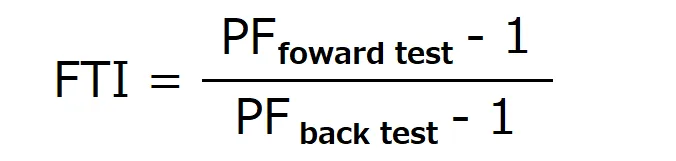
If there were a diagram showing the relationship between forward-test duration, changes in the PF, and backtest PF, it would be convenient for searching for semi-holy grails. However, Gogojan’s site does not have such a diagram. So, somewhat crudely, I defined and plotted forward-test PF index (FTI) as follows.
Backtest PF is roughly between 1.15 and up to 5, but there are some as low as 1.02, 0.97, or even 0.73. In the “USDJPY Great Reversal” series, the backtest PF is below 1, while forward test and official operation are good and have buyers (see below). The error in the PF value from backtesting is likely large, and while it is better than lottery-aid, I was surprised.
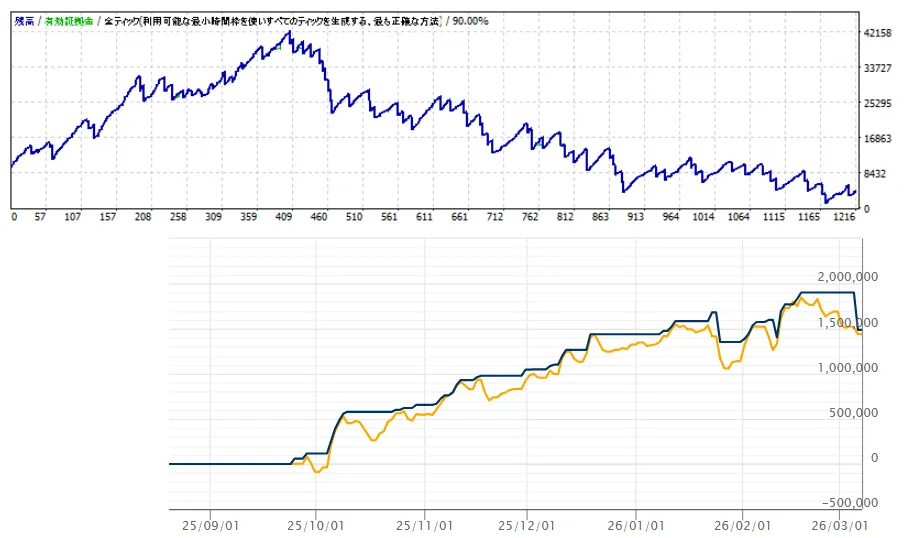
When PF is small, the sign of the FTI can flip or take on abnormally large values, so I omitted those with backtest PF less than 1.10 and plotted only one year, as shown below. Plotting extremely large or small values directly would be hard to read, so values above 200% are clipped to 200% and values below -200% are raised to -200% for plotting.
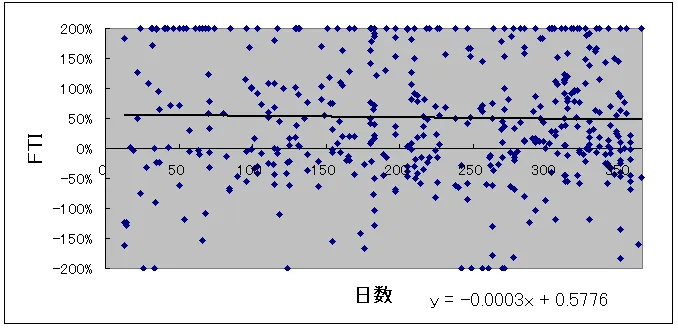
The points are almost scattered everywhere. Although the FTI does not show a clear convergence to 100% as days pass, its lack of change can be interpreted as PF being maintained on average. In other words, newer products may be more in tune with the current market, so it is not necessary to assume they are preferable.
The median FTI is 59% at 0-4 months, 36% at 5-8 months, and 37% at 9-12 months. If the FTI is positive, it means profits. If 36% or more, it seems safe, so more than half of Gogojan’s EAs could be profitable even with long-term operation.
Conversely, it is not correct to think that a negative FTI means it is not a “semi” holy grail. When calculated over short periods, even a semi holy grail can have a negative FTI. For tagosaku USDJPY, the win rate by month is only 63%. The win rate by year is 77%, so at least six months to two years of FTI are necessary to evaluate an EA properly, to avoid mistakenly eliminating a semi holy grail.
Thus, among the EAs sold on Gogojan, there may be many semi holy grails that profit from long-term operation. Those with proven sales performance are only a small portion. Not selling does not mean it won’t profit. There may be a windfall in leftovers.
When searching for semi holy grail EAs, be careful about sample size. You are often drawn to flashy win rates and profit rates right after release, but those have small sample sizes and poor reliability, so selecting them would be foolish. It is generally said that several hundreds of samples are necessary, so across days, at least 180 days, i.e., half a year, is required to properly evaluate.
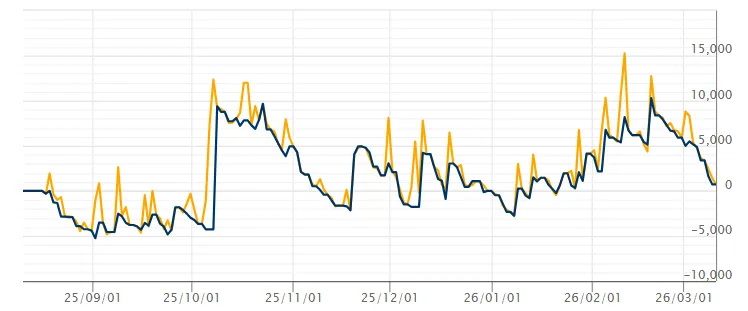
Having many days alone does not guarantee enough. If trades per month are only a few, the effective sample size is greatly reduced. EAs like the ones in the figure are not suitable for evaluation in this sense.
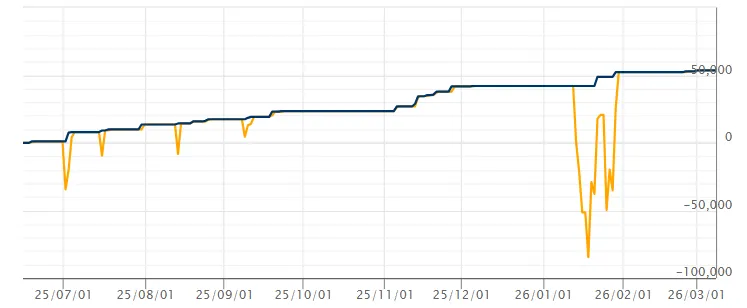
Having many trades does not guarantee enough either. For high-win-rate EAs, the number of losing trades is greatly reduced. In other words, high-win-rate EAs cannot be evaluated properly with short forward tests, so they should be avoided. In cases like the next example, allowing the final breakdown as an exceptionally rare event would be unacceptable.
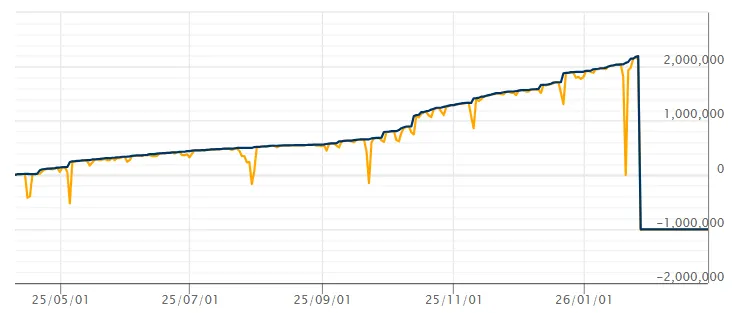
Similarly, EAs with low win rates and small losses with large profits also cannot be properly evaluated with short forward tests because the number of winning trades is too small, so avoid them.
I summarize my recommended method for searching semi-holy-grail EAs.
① EAs that have been on sale for more than 6 months
② EAs with win rates of 35-65%
③ EAs with little discrepancy between backtest and forward test (FTI > 50%)
These are the targets.
If the official profit curve shows a range of 6 months and nearly a steadily rising random walk, you can consider it likely a semi holy grail. Not all, but perhaps about ten percent of the EAs sold on Gogojan fit this profile. By running multiple EAs in parallel, you can stabilize revenue, so choose several from different types and operate them steadily without reacting to short-term results.
Here are some example profit curves.
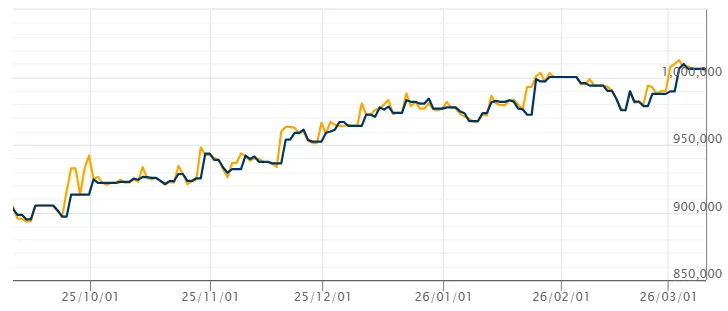
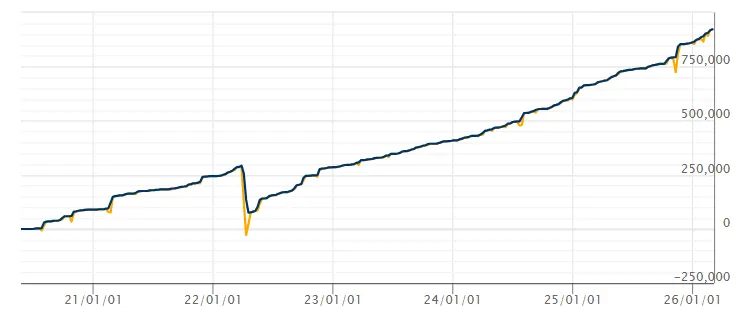
This is the ideal profit curve for tagosaku USDJPY. Win rate 38.0%, FTI 104%.
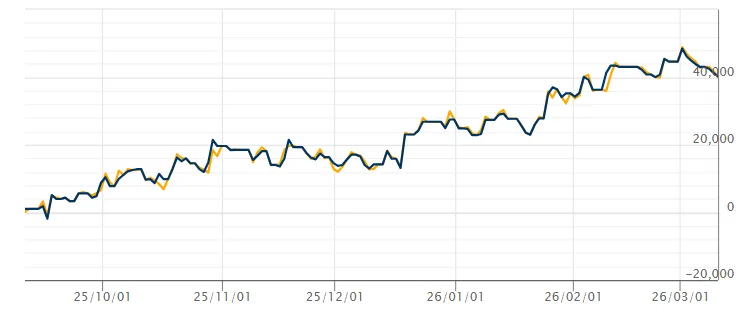
There are no purchase records, but the profit curve for tagosaku USDJPY closely resembles it. Win rate 39.5%, FTI 62%.
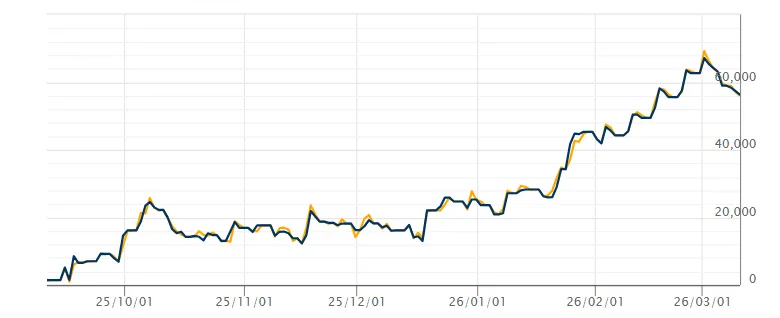
This one also has no purchase records. Win rate 41.8%, FTI 109%. In the shown six months, the first half was a bit sluggish, but month-by-month it has been steadily positive.
Last December I listed “Rainbow Beyond OTR2515,” which is currently in its fourth month of forward testing but shows relatively good performance, so please consider it as a candidate for a semi holy grail in the coming months.
Somewhere over the rainbow
Way up high
There's a land that I heard of
Once in a lullaby
Somewhere over the rainbow
Skies are blue
And the dreams that you dare to dream
Really do come true
***
Somewhere over the rainbow
Bluebirds fly
Birds fly over the rainbow
Why then, oh why can't I?
If happy little bluebirds fly
Beyond the rainbow
Why, oh why can't I?