

Today's macro correlation【March 10, 2026】 The reason stocks and BTC rebound amid crude oil at $85 and credit concerns — current status of geopolitical risk and capital flows
Today's Macro Correlations [March 10, 2026]
Why Stocks and BTC Rebound Amid Oil at $85 and Credit Caution
Current Geopolitical Risks and Capital Flows
The financial markets in March 2026 are entering a phase where geopolitical risk and capital flows are intricately intertwined.
While crude oil remains pressured by Middle East tensions and credit-market caution persists, stocks and Bitcoin are rebounding, creating a seemingly contradictory market structure.
Looking at the current major macro indicators, market balance sits in a very delicate position.
・Credit spread: 3.13%
・VIX: drifting down into the 20s
・Oil: around the $85 level
・Dollar strength continues
・Gold/Silver: range-bound
・Bitcoin: back above $70,000
Taken together, these indicators suggest that the financial markets are not in a full risk-off mode, but caution remains — an intermediate phase.
This article organizes the macro environment centered on Middle East dynamics, and analyzes the current market structure and future correlations.
The financial markets in March 2026 are entering a phase where geopolitical risk and capital flows are intricately intertwined.
While crude oil remains pressured by Middle East tensions and credit-market caution persists, stocks and Bitcoin are rebounding, creating a seemingly contradictory market structure.
Looking at the current major macro indicators, market balance sits in a very delicate position.
・Credit spread: 3.13%
・VIX: drifting down into the 20s
・Oil: around the $85 level
・Dollar strength continues
・Gold/Silver: range-bound
・Bitcoin: back above $70,000
Taken together, these indicators suggest that the financial markets are not in a full risk-off mode, but caution remains — an intermediate phase.
This article organizes the macro environment centered on Middle East dynamics, and analyzes the current market structure and future correlations.
■ The Middle East Sets the Energy Market
The most important factor in understanding the present financial markets is the geopolitical risk in the Middle East.
The confrontation over U.S.–Iran nuclear issues remains unresolved, and regional tensions, including with Israel, stay elevated.
This situation directly affects the oil market.
Oil prices are currently rising into the $85 range.
This level reflects not only supply-demand factors but also an added “geopolitical premium.”
The Middle East is the nerve center of global oil supply, with the Strait of Hormuz alone handling about 20% of world oil transport, making it a strategic chokepoint.
As tensions in the region escalate, markets price in supply risk and crude prices tend to rise.
Oil surges impact the global economy in two ways.
First, higher inflationary pressures.
Second, higher corporate costs.
Thus, ordinarily this would be a negative for equities.
However, in the current market, equities have not collapsed. The reason lies in the internal structure of the financial markets.
The most important factor in understanding the present financial markets is the geopolitical risk in the Middle East.
The confrontation over U.S.–Iran nuclear issues remains unresolved, and regional tensions, including with Israel, stay elevated.
This situation directly affects the oil market.
Oil prices are currently rising into the $85 range.
This level reflects not only supply-demand factors but also an added “geopolitical premium.”
The Middle East is the nerve center of global oil supply, with the Strait of Hormuz alone handling about 20% of world oil transport, making it a strategic chokepoint.
As tensions in the region escalate, markets price in supply risk and crude prices tend to rise.
Oil surges impact the global economy in two ways.
First, higher inflationary pressures.
Second, higher corporate costs.
Thus, ordinarily this would be a negative for equities.
However, in the current market, equities have not collapsed. The reason lies in the internal structure of the financial markets.
■ Credit Spreads at a Cautionary Level
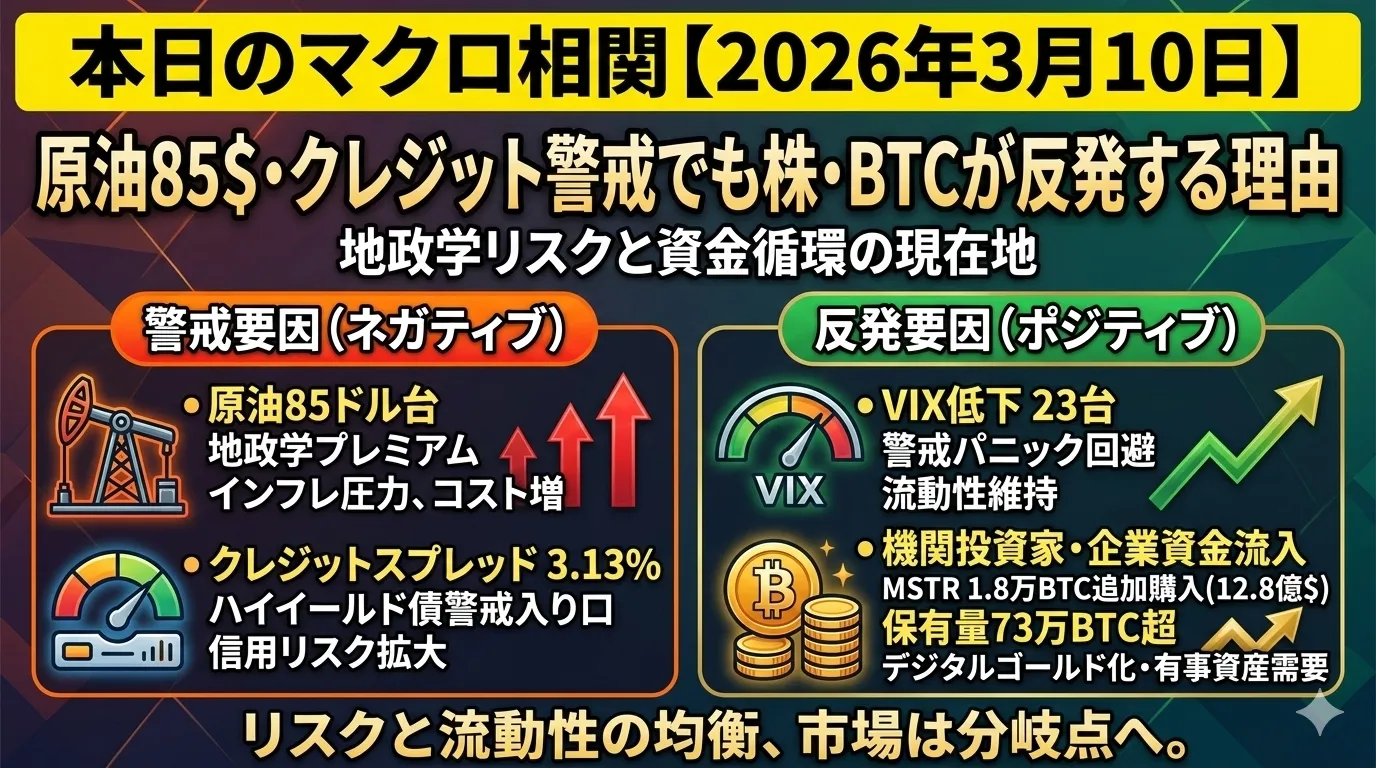
Currently, the credit spread on high-yield bonds has widened to 3.13%.
Credit spread is the difference in yields between high-risk corporate bonds and safe US Treasuries, a key leading indicator for the stock market.
There are common thresholds used in markets.
・Below 2.5%: stability
・Around 3%: caution entering
・Above 4%: credit stress
・Above 5%: financial crisis
At 3.13%, we are clearly in the caution zone. However, it is not yet a financial-crisis level.
In other words, the credit market is “watchful but not panicking.”
This intermediate state shapes the current financial-market characteristics.
Currently, the credit spread on high-yield bonds has widened to 3.13%.
Credit spread is the difference in yields between high-risk corporate bonds and safe US Treasuries, a key leading indicator for the stock market.
There are common thresholds used in markets.
・Below 2.5%: stability
・Around 3%: caution entering
・Above 4%: credit stress
・Above 5%: financial crisis
At 3.13%, we are clearly in the caution zone. However, it is not yet a financial-crisis level.
In other words, the credit market is “watchful but not panicking.”
This intermediate state shapes the current financial-market characteristics.
■ The Decline in VIX and Market Psychology
The stock-market fear gauge, the VIX, rose to the upper 20s briefly and is now in the low 20s.
Typical interpretations of the VIX are as follows.
・Below 15: optimism
・Around 20: normal
・Around 25: caution
・Around 30 or higher: crisis
The current level of around 23 indicates that caution remains, but the market is not in a state of panic.
In other words, investors may be judging that
“there is risk, but a financial crisis is not imminent.”
This psychology helps support the rebound in the stock market.
The stock-market fear gauge, the VIX, rose to the upper 20s briefly and is now in the low 20s.
Typical interpretations of the VIX are as follows.
・Below 15: optimism
・Around 20: normal
・Around 25: caution
・Around 30 or higher: crisis
The current level of around 23 indicates that caution remains, but the market is not in a state of panic.
In other words, investors may be judging that
“there is risk, but a financial crisis is not imminent.”
This psychology helps support the rebound in the stock market.
■ The Meaning of a Strong Dollar and Gold-Silver Range
The market is currently seeing continued dollar strength.
Typically, geopolitical risk drives gold prices higher.
But this time, gold and silver have not begun a clear uptrend and remain range-bound.
This is because safe-haven funds are split between
・Gold
・U.S. dollar
now, with the dollar’s liquidity being high, the dollar is favored as a safe asset.
As a result, gold prices have a hard time entering a strong uptrend.
This structure is sometimes called a “dollar-driven risk-off regime.”
The market is currently seeing continued dollar strength.
Typically, geopolitical risk drives gold prices higher.
But this time, gold and silver have not begun a clear uptrend and remain range-bound.
This is because safe-haven funds are split between
・Gold
・U.S. dollar
now, with the dollar’s liquidity being high, the dollar is favored as a safe asset.
As a result, gold prices have a hard time entering a strong uptrend.
This structure is sometimes called a “dollar-driven risk-off regime.”
■ Bitcoin's Recovery to $70,000: The Backdrop
The most watched aspect of this market is Bitcoin’s movement.
Bitcoin fell to the mid-60,000s before rapidly rebounding to reclaim $70,000.
This rebound results from multiple factors.
First, institutional buying.
On March 9, Michael Saylor-led MicroStrategy announced the purchase of 17,994 BTC.
The purchase amount reaches about $1.28 billion.
Approximately 198.4 billion yen.
With this purchase, the company’s Bitcoin holdings exceed 730,000 BTC.
This makes it one of the largest corporate Bitcoin holdings globally.
More importantly, the funds for the purchase were raised via stock issuance.
In other words, the company is leveraging capital markets to accumulate Bitcoin.
This has significant implications for the crypto-asset market.
The most watched aspect of this market is Bitcoin’s movement.
Bitcoin fell to the mid-60,000s before rapidly rebounding to reclaim $70,000.
This rebound results from multiple factors.
First, institutional buying.
On March 9, Michael Saylor-led MicroStrategy announced the purchase of 17,994 BTC.
The purchase amount reaches about $1.28 billion.
Approximately 198.4 billion yen.
With this purchase, the company’s Bitcoin holdings exceed 730,000 BTC.
This makes it one of the largest corporate Bitcoin holdings globally.
More importantly, the funds for the purchase were raised via stock issuance.
In other words, the company is leveraging capital markets to accumulate Bitcoin.
This has significant implications for the crypto-asset market.
■ Bitcoin's Macro-Asset Status
The Bitcoin market is undergoing a major structural shift.
Historically, Bitcoin moved mainly on individual investors and short-term speculative funds.
Now, however, institutions are flowing in via ETFs and corporate investment.
This shift has given Bitcoin three characteristics.
・Risk asset
・Liquid asset
・Non-state asset
In particular, rising geopolitical risk could strengthen Bitcoin’s third role.
Escalating interstate conflicts can trigger capital controls and financial sanctions.
In such environments, demand for assets that do not depend on the state rises.
Bitcoin is a prime example.
This rebound may reflect Bitcoin’s status as an “emergency asset.”
The Bitcoin market is undergoing a major structural shift.
Historically, Bitcoin moved mainly on individual investors and short-term speculative funds.
Now, however, institutions are flowing in via ETFs and corporate investment.
This shift has given Bitcoin three characteristics.
・Risk asset
・Liquid asset
・Non-state asset
In particular, rising geopolitical risk could strengthen Bitcoin’s third role.
Escalating interstate conflicts can trigger capital controls and financial sanctions.
In such environments, demand for assets that do not depend on the state rises.
Bitcoin is a prime example.
This rebound may reflect Bitcoin’s status as an “emergency asset.”
■ Is the Stock Market in a Rebound Phase?
The stock market stands at a critical inflection point.
Negative factors include:
・Oil at high levels
・Widening credit spreads
・Geopolitical risk
On the other hand, positive factors exist:
・VIX has declined
・Liquidity is maintained
・Corporate earnings remain resilient
Therefore, the stock market may currently be in a
“post-adjustment rebound phase.”
Whether this rebound lasts depends greatly on the trajectory of credit markets.
The stock market stands at a critical inflection point.
Negative factors include:
・Oil at high levels
・Widening credit spreads
・Geopolitical risk
On the other hand, positive factors exist:
・VIX has declined
・Liquidity is maintained
・Corporate earnings remain resilient
Therefore, the stock market may currently be in a
“post-adjustment rebound phase.”
Whether this rebound lasts depends greatly on the trajectory of credit markets.
■ The Next Macro-Correlation Breakpoints
Key points that will determine the future direction of financial markets are below.
・Credit spread 3.5%
・VIX 30
・Oil $90
Breaking above these could push markets toward a full risk-off regime.
Conversely, if spreads compress and the VIX falls, equities could resume an uptrend.
Key points that will determine the future direction of financial markets are below.
・Credit spread 3.5%
・VIX 30
・Oil $90
Breaking above these could push markets toward a full risk-off regime.
Conversely, if spreads compress and the VIX falls, equities could resume an uptrend.
■ Today's Macro Correlations Summary
Organizing the current financial-market correlations reveals the following picture:
・Middle East tension → Oil price rise
・Oil price rise → Inflation concerns
・Credit-market caution → Upward limits on stocks
・Dollar strength → Gold remains in a range
・Institutional and corporate funds → BTC maintains a firm floor
In other words, the market currently is in a balance where risk and liquidity are competing.
“An equilibrium where risk and liquidity are balanced.”
Not panicking, not fully risk-on either.
And the most important point in this market is Bitcoin’s movement.
If BTC can stay strong in this environment, it may indicate that Bitcoin is not merely a speculative asset, but is establishing itself as a new macro asset in the world financial markets.
What is your next move?
Organizing the current financial-market correlations reveals the following picture:
・Middle East tension → Oil price rise
・Oil price rise → Inflation concerns
・Credit-market caution → Upward limits on stocks
・Dollar strength → Gold remains in a range
・Institutional and corporate funds → BTC maintains a firm floor
In other words, the market currently is in a balance where risk and liquidity are competing.
“An equilibrium where risk and liquidity are balanced.”
Not panicking, not fully risk-on either.
And the most important point in this market is Bitcoin’s movement.
If BTC can stay strong in this environment, it may indicate that Bitcoin is not merely a speculative asset, but is establishing itself as a new macro asset in the world financial markets.
What is your next move?