

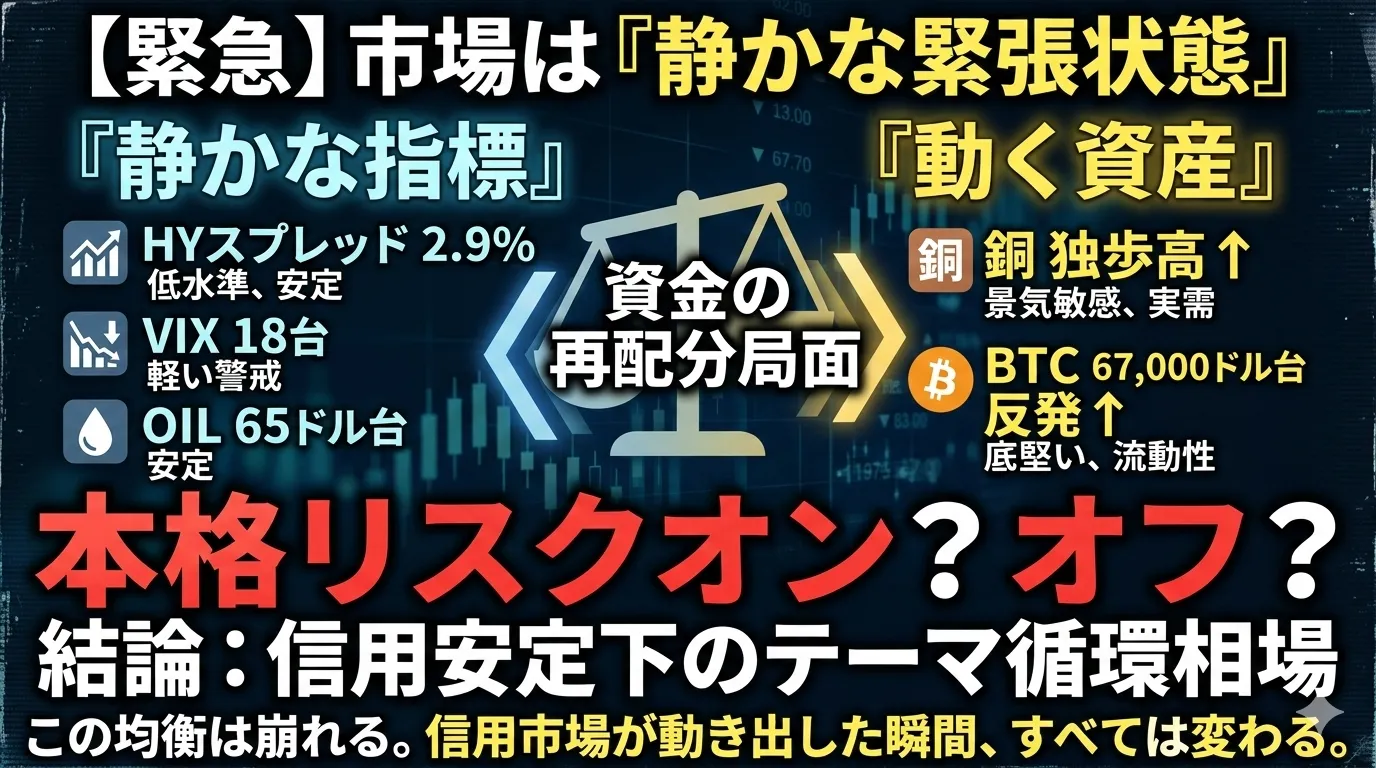
Today's macro correlation "The market is in a calm tension" 【February 27, 2026】
― Reallocation of funds occurring as the credit market remains quiet ―
■ Introduction: The market in a “quiet tension”
In late February 2026, while the ambiguity surrounding the Iran nuclear talks smolders, the market appears calm at first glance.
However, when looking across assets, there is a nuanced “midstate” that is neither purely risk-on nor risk-off.
Current major indicators are as follows.
Nuclear talks: risk of breakdown existing
Gold and silver: unable to rise, capped
Copper: advancing on a solo basis
OIL: in the 65-dollar range
HY spread: 2.9%
VIX: in the 18s
SKEW: in the 140s
BTC: rebounded in the 67,000-dollar range
This combination is highly suggestive.
■ ① Will nuclear talks fail? The market deems the risk as “limited.”
Geopolitical risks around the Iran nuclear talks remain opaque, but market reactions are limited.
In a truly crisis-embedded phase,
oil would surge
gold would surge
HY spread would widen
VIX would spike
simultaneously.
However currently,
OIL is stable in the 65-dollar range (as of now).
Gold is stalling.
HY is at 2.9% at a low level.
This signals that the market has not fully priced in a comprehensive supply shock.
■ ② Reasons why gold and silver cannot rise
Typically, gold is bought when geopolitical risks rise.
But currently,
gold is capped.
silver also lacks upward momentum.
The backdrop for gold not rising includes
real yields not falling sharply
credit markets are stable
no signs of systemic crisis
in other words,
the psychology of “no need to rush to buy insurance” dominates.
■ ③ What copper’s solo rise means
Copper is considered a bellwether for the economy, known as “Dr. Copper.”
Currently, copper is rising on its own.
Possible drivers include:
AI data center demand
power infrastructure investment
China stimulus expectations
and other real-demand themes being recognized.
The combination of gold not rising and copper rising may indicate
a shift of funds from defensive assets to cyclical, economically sensitive assets.
■ ④ The stability of oil in the 65-dollar range—what it signals
Oil stabilizing in the 65-dollar range is also important.
Geopolitical tensions exist, but
supply concerns are limited.
Demand remains solid but not explosive.
Unless oil surges,
the inflation re-ignition scenario retreats.
As a result, financial conditions are unlikely to trend toward excessive tightening.
■ ⑤ HY spread 2.9%: credit markets are calm
This is the key point.
HY spreads at 2.9% are historically quite low.
Benchmarks:
Above 3.5%: warning level
4–5%: clear risk-off
6% and above: recession concerns
Thus far,
credit anxieties are hardly priced in.
This is the main reason why equities have not big-crashed.
■ ⑥ VIX in the 18s: mild vigilance remains
VIX in the 18s is not a fully safe zone.
Below 15: safe
18–20: mild vigilance
Above 25: stress level
Currently,
not fully risk-on, but not in crisis either
— in an intermediate zone.
■ ⑦ SKEW in the 140s: tail risks are moderate
SKEW indicates the concern for large drops or “black swan” events.
110–130: normal
140s: slightly cautious
150+: strong caution
Currently,
hedged to some extent, but not panicking
yet.
■ ⑧ BTC is 67,000 dollars—is it a bottom?
BTC corrected temporarily but has stopped declining around 67,000 dollars.
Key points are:
HY is stable
VIX has not spiked
Gold has not surged.
In other words,
an environment without systemic risk
BTC currently has a three-sided character:
a liquidity asset
a high-beta asset
and a partial digital gold
and as long as the credit market remains stable, it is unlikely to break down significantly.
We see a strong possibility of a bottom.
■ For now, it is an “equilibrium market”
The current market has no fear
nor excessive optimism.
Credit is stable,
spot/future rotation among commodities is occurring.
This can be interpreted as a
“funds reallocation phase.”
■ The Next Branch Point
Key points to watch are,
whether HY exceeds 3.5%
whether VIX drops below 17
whether copper highs persist
whether gold resumes an uptrend
.
The next trend will be decided here.
Current macro correlations show that
geopolitical risk is priced in only to a limited extent.
Credit markets are extremely stable.
Commodities are copper-led by real-demand themes.
Stocks have not collapsed,
BTC is holding steady.
This is a theme cycle under “credit stability.”
Even in a genuine risk-off,
it is not a full risk-on either.
A quiet equilibrium state.
However, this balance is not eternal.
The moment the credit market moves, correlations will break down all at once.
Now, is this the eve of that, or is the stability to continue?
From here, attention should also be paid to the credit markets.
× ![]()