

After a stop-loss, the market reverses... measures to reduce that frustration

▼ Details page for Sanjyu Sentou FX
https://www.gogojungle.co.jp/tools/indicators/65204?via=users_products
This is SEI from Trading Labo+.
Thank you for always watching.
Today’s topic is “What to do after a stop loss to reduce the frustration of a market reversal”.
◆ Everyone experiences the frustration of a reversal after a stop loss
Right after you stop out, the market reverses and moves in a profitable direction.
This frustration is experienced by every trader.
“If only I had waited a little longer...”
“Why does it reverse right after I cut the loss!?”
“It feels like my trades are being watched.”
If you repeat this experience, you gradually become unable to cut losses.
“Perhaps it will reverse right after I cut again.”
When you think like this, you hesitate to cut losses.
However, rest assured. Reversals after a stop loss can be avoided to some extent.
And even unavoidable reversals, if understood correctly, won’t bother you much.
This time, I will share concrete measures to reduce reversals after stop losses.
1. Check reversal rate from your trading records
First, you should understand your current situation.
Even if you feel that reversals after stop losses are common, is that really true?
Check it with data, not just your feeling.
How to check the reversal rate
Review your past trades. Then record the following.
Total number of trades
Number of stop losses
Number of times you reached the take-profit point after a stop loss (number of reversals)
For example, something like this.
Total trades: 100
Stop losses: 40
Reversals after stop losses: 15
Reversal rate: 37.5% (15÷40)
Please produce this number.
What does the reversal rate tell you?
If reversal rate is 30% or less, there is no problem. The stop loss is functioning correctly.
If reversal rate exceeds 40%, there might be an issue with your stop loss position.
If reversal rate exceeds 50%, your stop loss is clearly too early. There is much room for improvement.
First, start by knowing your own reversal rate.
2. Check the stop loss position
If reversal rate is high, the most suspect is the stop loss position.
If you cut losses too early, reversal rate will naturally be high.
Common wrong stop loss positions
1. Very close to the entry point
For example, entering and stopping out after 10 pips.
With this, a small move against you will trigger the stop loss.
Markets move up and down, so reversals will be high by default.
2. Round-number levels
“If it moves against me by, say, 20 pips, I’ll stop out”—an unfounded stop loss position.
Mechanical stops that ignore market movement raise reversal rate.
3. An amount you can psychologically endure
Deciding stop loss position simply because you think you can bear that much loss.
This also ignores market dynamics.
What is the correct stop loss position?
The correct stop loss should be decided based on the market structure.
Just outside the most recent low/high
Breaks of support/resistance lines
Breaks of trend lines
Where your scenario would be invalidated
Place the stop where there is a clear reason that “if this level is breached, my scenario is wrong.”
If you do so, reversals after stop losses will be greatly reduced.
3. Check if volatility and stop-loss width match
Even with a correct stop loss position, reversal rate can be high.
The cause might be that volatility and stop-loss width do not align.
What is volatility?
Volatility is the range of market movement.
When volatility is high, the market moves a lot.
When volatility is low, the market doesn’t move much.
Stop loss width matched to volatility
Setting a narrow stop loss when volatility is high will lead to quick stops.
For example, for a currency pair with high movement like GBP/JPY, a 10-pip stop is too narrow.
Conversely, setting a wide stop loss when volatility is low worsens the risk-reward.
Adjust your stop loss width to match volatility.
Setting stop loss width using ATR
Using an indicator called ATR (Average True Range) lets you set stop loss width according to volatility.
For example, if you set “stop loss width to 1.5 times ATR,” when volatility is high the stop width widens automatically, and when it’s low it narrows.
Mechanical stop losses that ignore volatility raise reversal rate.
4. What to do to reduce reversal after stop loss?
Based on the above analysis, here are concrete measures.
Measure 1: Set stop loss positions based on market structure
Not on round numbers or mental endurance, but based on market structure.
Recent lows/highs, support/resistance, trend lines, etc.
Place stop losses where there is a clear reason that the scenario would be invalidated if breached.
Measure 2: Adjust stop loss width to volatility
Use ATR to set volatility-based stop loss width.
Wider when movement is vigorous, narrower when calm.
Flexible stop loss width aligned with market movement reduces reversals.
Measure 3: Improve entry timing
Actually, one reason for many reversals after stop loss is that entries are too early.
Wait a little longer and enter at a point with higher edge to ensure distance to stop loss.
Don’t rush the entry. Wait for a clear signal.
Measure 4: Increase time frame
Trading on 1-minute or 5-minute charts can pick up noise.
Trading on higher timeframes like 15-minute, 1-hour, or 4-hour reduces noise-related stop-outs.
Higher timeframes tend to have lower reversal rates.
5. Avoid not stopping out and averaging down (nampin)
Are you afraid of reversals after stop loss and doing actions like this?
“Don’t cut losses and leave it as is”
“Nampin to lower the average entry price”
This must be absolutely avoided.
Risks of leaving without stopping out
“If it reverses right after stop loss, why cut it at all?”
You may feel this way.
But if you leave it, one loss could wipe you out.
Reversals after stop loss occur about 30–40% of the time.
The remaining 60–70% is the loss that continues to grow.
Not stopping out is a path toward bankruptcy with a 60–70% probability.
Risks of averaging down
Averaging down is the same.
“I don’t want to stop out, so I lower the average entry price by averaging down”
This simply doubles or triples your risk.
If the market returns, you may be saved, but if not, losses multiply.
Averaging down is gambling, not a strategy.
6. Accept some reversals after stop loss
Up to here I’ve outlined ways to reduce post-stop-loss reversals.
But finally, one important point.
You should tolerate reversals after stop loss to some extent.
You cannot eliminate them completely.
Why can’t reversals be completely zero?
The reason is simple: you cannot predict future markets perfectly.
If you tried to make reversals completely zero, you would have to place stops extremely far away.
But placing stops far away increases the loss per trade and worsens risk-reward.
Reducing reversals and maintaining risk-reward is a trade-off.
What is a reasonable reversal rate?
In my experience, a reversal rate of about 20–30% is acceptable.
That level of reversal happens naturally when you trade.
Don’t chase perfection.
Reversals after stop loss happen. Accept them and aim for overall profit.
This is the mindset of a proper trader.
7. Be glad you can cut losses; you are already ahead
Finally, a message for you.
If you can cut losses, you are already a winner.
Many traders cannot cut losses.
They hold losses and get wiped out by a stop-out.
But you can cut losses.
Even if reversals occur after stop loss, you followed the rules and managed risk.
That’s wonderful.
Cutting losses is not “a loss”
Many traders think of cutting losses as a loss.
But it isn’t.
Cutting losses is risk management.
It prevents large losses and allows you to move to the next trade.
If you can cut losses, you are ahead of 90% of losing traders.
Don’t worry about reversals after stop loss
If it reverses after stop loss, think like this:
“This time, it was just bad luck. But I followed the rules. I’ll make up for it in the next trade.”
As long as you end with overall profit, that’s fine.
Don’t focus too much on each individual result.
Summary: Reversals after stop loss can be reduced. But don’t expect perfection
Reversals after stop loss are indeed frustrating.
However, with correct measures, reversal rates can be greatly reduced.
―――――
What you can start today
―――――
1. Check reversal rate from your trading records
Know your reversal rate with numbers
If it’s over 40%, there is room for improvement
2. Revisit stop loss position
Decide based on market structure
Round numbers and mental criteria are not acceptable
3. Match volatility
Use ATR to flexibly adjust stop loss width
4. Do not leave uncut losses or average down
Short-term may seem okay, but long-term leads to ruin
5. Do not aim to eliminate reversals completely
20–30% reversal is acceptable
As long as total profit is positive, it’s OK
6. Acknowledge that you can cut losses
If you can cut losses, you are ahead of many traders
Think in total terms, not per trade
―――――
Do not fear reversals after stop loss.
If you cut losses correctly, you will surely win overall.
Today as well, follow the rules and trade in a calm manner.
◆ “Sanjun Do FX” is perfect for people like this.
・Those with night shifts or irregular work hours limiting trading time
・Parents who can’t stay glued to charts・Working people doing FX as a side business
・Those not good at complex analyses and want to trade simply・Those who find it bothersome to look at dozens of indicators
・Those not confident in judging chart patterns・Those who want to target large pips efficiently in little time
・Those who prefer swing trading to scalping・Those who tire from reacting strongly to price moves
・Those who hesitate at stop loss levels and end up in salt trading・Those who have become a knowledge collector
・Those who buy signal tools but can’t win

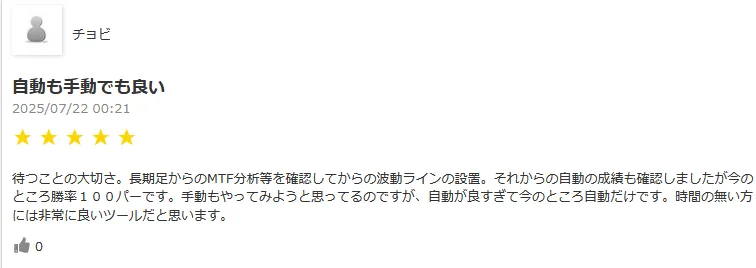
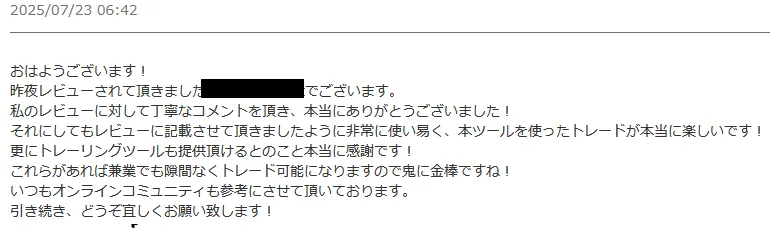
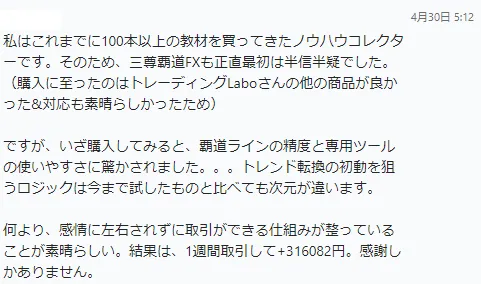

◆ Join Sanjun Do FX here ↓ ↓ ↓
https://www.gogojungle.co.jp/tools/indicators/65204?via=users_products