

Behind the 100% win rate… How developers explain how to spot a “pseudo AI indicator, EA”
AI has been making remarkable progress in recent years, hasn’t it?
In fact, the MT4 and MT5 industries are no exception,
Over the past few years on SNS and elsewhere“AI indicators, EA”have been circulating widely.
So, what do you imagine when you hear the term “AI”?
If it were an “AI-implemented indicator,”
◆ AI automatically analyzes the market
◆ AI automatically makes appropriate buy/sell decisions
◆ You can enter without thinking at all (discretion-free) and still win
… Wouldn’t that be the case?
Indicators or EAs that include AI must be万能
However, is what’s inside truly AI?
In fact, there are cases where consumer psychology is exploited“AI-fake indicators and EAs”are traded at high prices on SNS and the like.
? This article will cover
-
Definition of AI indicators
-
Characteristics of AI-fake indicators
-
How to spot them
thoroughly
What exactly is an AI indicator?
In recent years, the investment industry has seen a sharp increase in words like “AI-equipped” and “AI analysis.”
But when you say AI indicators, there are many different implementations,
where some truly use AI and
some merely present conventional logic in an AI-like way. That is the current situation.
First, let’s organize the basic definition of “AI” in investment tools.
Definition of AI (in investment tools)
In investment fields, systems called AI typically include the following three elements.
➡Machine Learning
Learn from vast historical price data and market data,
automatically extracting market patterns and statistical tendencies.
Rather than humans crafting rules,
the AI itself discovers “patterns that tend to win.”
➡Data Training
Not only exchange rates, but also
・Volume
・Volatility
・News factors
・Market sentiment
etc., it takes in multi-dimensional data and continuously improves model accuracy.
➡Inference
Based on learned data,
“Is the current market rising advantageous?”
“Is the entry expectancy high?”
It makes real-time judgments.
Unlike mere signal displays,
it makes decisions on a probabilistic basis, which is a major characteristic of AI.
Difference from simple logic
■ Traditional indicators (rule-based)
・Moving average crossover
・RSI above a threshold
・MACD golden cross
are fixed judgments determined by human-set conditions.
■ AI indicators (learning-based)
・Statistical analysis of past patterns
・Automatically extracts high-win conditions
・Weights adjust according to changing environments
In other words,
AI is not about following rules, but creating them.
➡Fixed calculation vs. adaptive judgment
■ Fixed calculation logic
Always yields the same result with the same calculation formula.
The logic remains unchanged even as market conditions change.
■ Adaptive AI
・Trending markets
・Ranging markets
・High-volatility periods
and so on, it changes judgment criteria by situation.
In other words,
? The market is “fitted to” by AI
? The market is “forced to fit” by conventional logic
This difference is very significant.
Characteristics of pretend AI indicators

Now, here is the main topic.
As the term AI has become generalized,
in the investment tool industry, products claiming to be “AI-equipped” have surged.
However in reality,
there are many cases selling logic unrelated to AI as “AI-like.”
Here, we整理 common features of so-called“pretend AI indicators”.
① No learning capability
Real AI always has a “learning process.”
On the other hand, with pretend AI?
➡ No re-learning of past data
➡ No model updates
➡ No weight adjustments
In other words, the logic does not evolve after implementation.
From start to finish, it runs on afixed logic.
② No external integration at all
To operate an AI model, typically you need
・Python environment
・DLL integration
・Cloud API
・WebRequest communication
and so on.
However, with pretend AI?
➡ MT4 alone can suffice
➡ No DLL required
➡ No WebRequest required
➡ Offline operation
In this case,
it's highly unlikely that it communicates with external AI models.
③ Basis for signals is “not disclosed”
Even on the LP page,
・No explanation of calculation logic
・No explanation of training data
・Unknown AI model type
What’s common instead?
➡ “Proprietary AI”
➡ “Latest AI”
➡ “Top-secret algorithm”
and other abstract terms.
Not technical explanations, but constructed with a mood of buzzwords.
④ Zig-zag and repaint-type logic is common
What’s frequent with pretend AI?
➡ Zig-zag patterns
➡ High/low detection
➡ Visually a 100% win rate from the outside
These make it easy to create a visually appealing chart and can give the impression of “predicting the future.”
.
But what is the reality?
・Late confirmations shown on finalized bars
・Repositioning of past signal points
・Post-hoc optimization of win rate
Many cases are close to the so-called“repaint” display.
Note: such cases are often seen on “X old Twitter.”
Many pretend AI indicators are traded at high prices through individuals, so caution is needed.
⑤ Backtest/real-trading data are unnatural
On LP pages, you see things like
➡ Win rate over 90%
➡ No losing streaks
➡ Very small drawdown
such extreme figures.
But note?
・Spread not considered
・Fill-delay not reflected・Post-hoc verification
・Not aligned with real trading
Thus, verified data shown on LPs often cannot be scrutinized in detail via mobile access.
If you see a tool on SNS that concerns you,
Have that verification dataanalyzed by AIas one method to verify.
How to spot pretend AI indicators
So, in reality, before purchase, is it possible to determine
whether it is a real AI or AI-like?
In short, yes—by checking a few points, the accuracy of the identification greatly increases.
In the next chapter, from a developer’s perspective, we will explain concretely a checklist for identifying AI indicators.
Key points include…
◆ Real AI indicators/EA
✅DLL check
✅ WebRequest setup
✅ VPS required?
✅ Learning updates
✅ Subscription or perpetual license(Note: perpetual licenses typically from around 100,000 yen or more)
※ If the LP or attached manual does not mention these items,
the likelihood of real AI being embedded is extremely low.
Also, manuals for receiving AI-related settings are usually published as a separate booklet.
◆ A single ~10-page manual
◆ Manual focuses on indicator usage
◆ No description of AI reception settings
? Such indicators or EAs are almost certainly “pretend AI software.”
AI indicators/EA development process

Saying it is “AI-equipped” in one word hides a lot of engineering work behind the scenes.
Here, we briefly explain how a typical AI trading tool is built from development to deployment.
① Data collection
First, secure learning data.
➡ Historical exchange rates (Tick / minute / daily)
➡ Volume data
➡ Volatility index
➡ Economic indicators
➡ Market sentiment
AI accuracy is proportional to data volume,
so cases handling several years to over a decade of data are not rare.
② Data preprocessing (cleansing)
Collected data cannot be used as-is.
➡ Missing value imputation
➡ Noise removal
➡ Normalization
➡ Feature extraction
After this, data becomes in a form that AI can learn from.
It’s a low-profile but the most crucial step that determines accuracy.
③ Learning model construction
Design the core model of the AI here.
Examples?
➡ Machine learning (Random Forest / SVM)
➡ Deep learning (LSTM / Transformer)
➡ Regression models (autoregressive AR-type)
In market forecasting,
time-series analysis models are commonly used.
④ Training
Feed data to the model and
➡ Win rate
➡ Profit factor (PF)
➡ Drawdown
➡ Expected value
and optimize based on these metrics.
This step can involve
・GPU computation
・Several hours to days of processing
and can place a heavy load on a personal PC.
⑤ Inference system implementation
Integrate the trained model into the real trading environment.
Here we get to?
➡ MT4 / MT5
➡ EA / Indicator
➡ DLL integration
and it operates as a trading tool.
In other words,
MT4 itself plays a role close to a “display terminal.”.
⑥ Operation, retraining, and maintenance
AI is not finished after being built.
➡ New data addition
➡ Retraining
➡ Accuracy verification
➡ Model updates
As market conditions keep changing, ongoing updates are essential.
The market for typical “real AI FX tools”
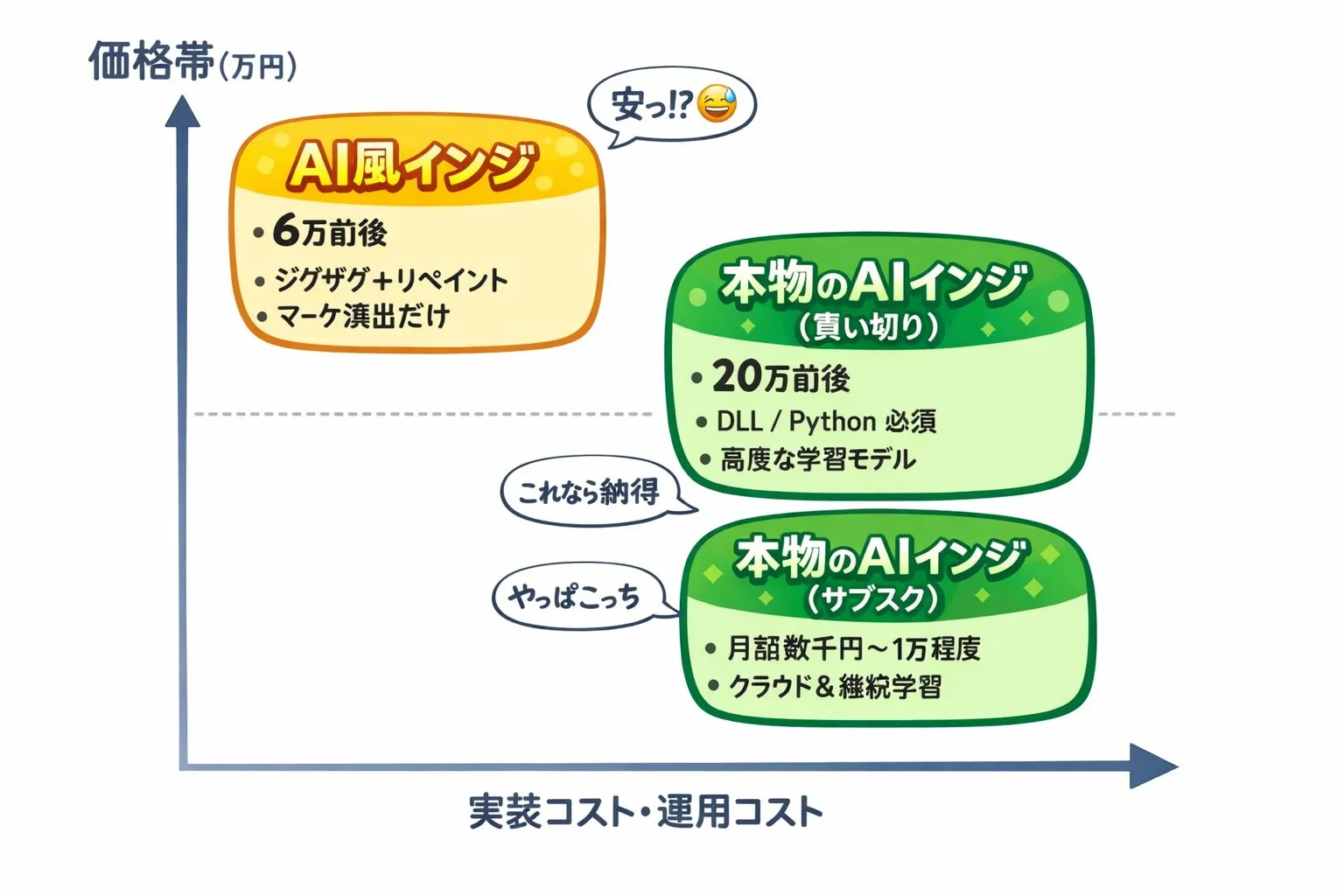
With the above development process in mind, the pricing structure for AI tools becomes clearer.
① Perpetual license
If real AI is offered as a perpetual license?
➡Around 100,000–300,000 yen
➡ Primarily developed for enterprises
➡ Support limited
Considering development and server costs,
sub-100k prices are quite rare.
② Subscription model
This is increasingly mainstream?
➡ Monthly5,000–30,000 yen
➡ Cloud AI operation
➡ Regular updates
As users grow,
・Server costs
・API costs
・Retraining costs
to be recovered, a subscription model becomes rational.
③ Corporate AI service domain
It becomes even more serious?
➡ Hedge fund AI
➡ Securities company AI development
➡ Proprietary trading AI
Prices are non-disclosed,
or range from tens of thousands to millions of yen.
Completely in the corporate realm.
Summary
As explained above,
AI indicators are not uniform;
there are big differences in their content.
➡ Whether they learn?
➡ Whether there is external integration?
➡ Whether retraining occurs?
➡ Whether the operating cost structure is reasonable?
By discerning these,
you can usually distinguish AI-like tools
from real AI tools
More importantly, if you lack knowledge, you cannot reliably tell.
Judging solely by sales page presentation or words increases the risk of missing the essence.
I hope this is somewhat helpful.
※ While not AI indicators,
we list many indicators here▼
◆ Scalping Signals
◆ Gold-focused scalping signals with semi-auto settlement EA