
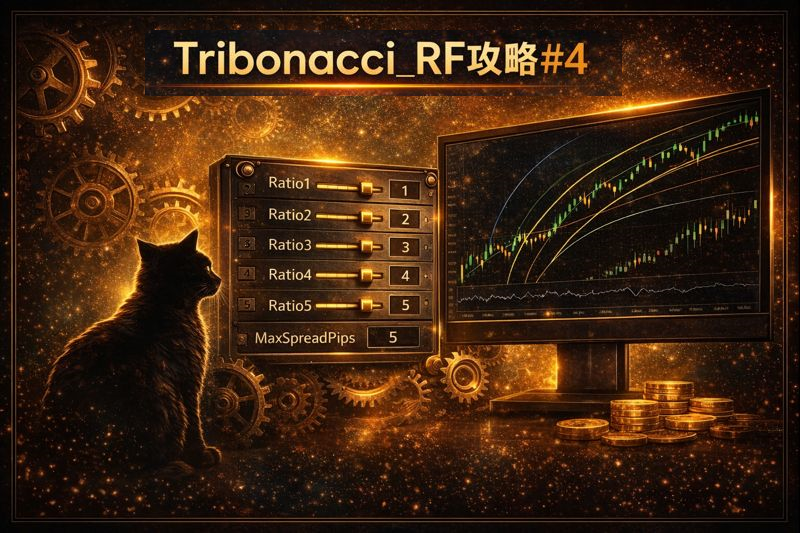
Tribonacci_RF攻略#4: How to set initial parameters (reference bars / deviation pips / lot allocation)
It is a black cat.
Last time (Tribonacci_RF攻略#3), we organized the choice of active trading hours and currency pairs by “spread × range characteristics × abrupt change risk.”
As a continuation, this time we summarize how to determine robust initial parameters.
In short, at the start you should not be aggressive, but
• Entrant too much
• Entering at strange places
• Should be easy to verify
…Prioritize these three, and build in the order of 【setting benchmarks → fine-tuning】.
1) First decide the “reference bar count”
This EA draws lines by picking high/low from the most recent reference range.
In other words, the reference bar count is a setting for 【which wave to look at for pullbacks/retracements】.
• Fewer reference bars: tends to pick smaller waves (reacts finely)
• More reference bars: tends to pick larger waves (more stable, but longer wait)
For beginners, starting with 120 bars is easy to understand.
(Doesn’t diverge much from verification articles or explanations)
2) Next decide the “deviation pips (0%–50% distance)”
Deviation pips, in short, is a 【price-motential filter】.
• Deviation pips too high: hard to enter (skips all calm markets)
• Deviation pips too low: easy to enter (reacts to noisy markets and becomes volatile)
What beginners should do first is
not “enter when it doesn’t appear → go down,” nor “enter too much when it appears → go up,” but first
• Reference bar count = 120
• Deviation pips = a safe mid value
to fix, and check the compatibility of currency pairs and timeframes.
(The “operating band” organized in #3 is effective here)
3) Lot distribution (ratio-based lots) can start evenly
This EA has multiple ratio lines, so you can vary lots by ratio.
However, if you adjust this from the start, it’s easy to lose track of what is actually effective.
Starting with this is OK!!!
Ratio1〜Ratio5: same lots (equal)
After you see winning/losing tendencies,
adjust “thin pullbacks” or “deep pullbacks” in thickness
4) Recommended order for initial settings (this order won’t collapse if followed)
It’s safest to decide in the following order at first.
• Reference bar count (wave size)
• Deviation pips (potential extension filter)
• Lot (equal)
Finally, MaxSpreadPips (spread avoidance)
Before trying to increase win rate by tweaking lots,
it’s more stable to first adjust based on the environment (time of day, currency, spread).
5) Common failure patterns (typical beginner pitfalls)
Changing reference bar count too much so you can’t verify
Lowering deviation pips too much so you pick up noise markets and get volatile
Changing the lot distribution from the start makes it unclear what was beneficial
Better to have a verifiable setting rather than a “make it win” setting.
Summary
Reference bar count = which wave to watch (120 is a common baseline for beginners)
Deviation pips = extension filter (check compatibility before pushing forward)
Lot distribution = start equal (adjust after you can see trends)
The initial goal is to create a verifiable form rather than maximizing win rate
Product page
(GoGoJungle)
Note:In the current version values are fixed, but to improve verifiability we are applying for a version 1.6 where reference bar count and deviation pips can be adjusted. It will be reflected after approval.
Next time (Tribonacci_RF攻略#5)
Next time we will cover “how to fine-tune parameters.”
From the three states “not appearing / appearing too much / volatile,” we’ll整理 which parts to adjust.
Product page