
Tribonacci_RF攻略#3: How to choose a suitable time window and currency pairs (spread measures / for beginners)
It is a black cat.
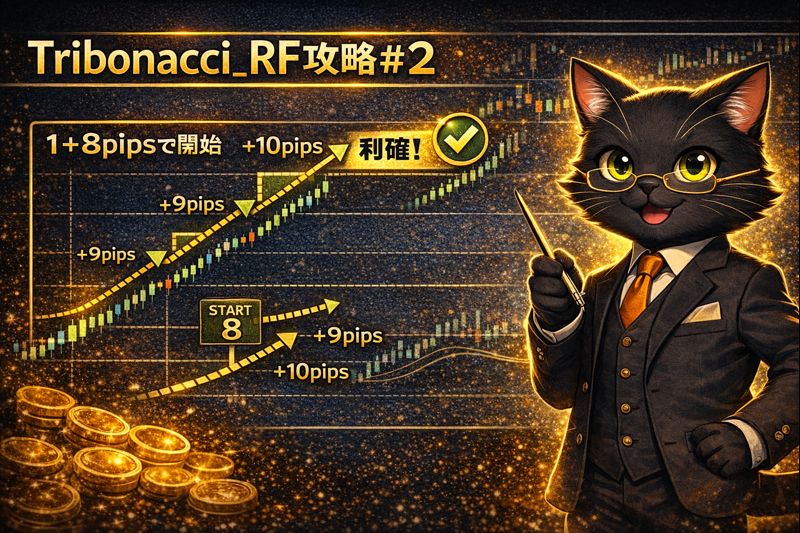
In the previous article (Tribonacci_RF攻略#2), I organized the concept of trailing take-profit (8 pips start / 1 pip increments) and cautions about stop levels and spreads.
This time, as a continuation, I will summarize for beginners which time frames and currency pairs are less prone to accidents.
In short, this EA trails very finely (in 1-pip steps), so
the results are more volatile when operating in times with wide spreads—the entry method, take-profit growth, and losses become more volatile.
1) Why results vary by time frame
This EA enters after waiting for a pullback, but actual execution is affected by spreads and slippage.
In particular, because trailing follows very finely,
・Wide spreads → profits are eroded more easily
・More price reversals → trailing is more easily shaken
・Economic indicators and sudden changes → can become much more volatile than expected
…this is the structure.
2) Typical patterns where spreads become volatile (3)
No need to overthink this; it’s generally these three patterns.
Pattern 1: Thin order book times
When participation is low, spreads widen and executions become rough.
Pattern 2: Indicators and sudden changes
Sharp expansion plus slippage occur, so even aiming for pullbacks can yield inconsistent results.
Pattern 3: Start of the week or weekend
Prices move differently from usual, feel becomes unstable.
3) For beginners: the simplest operating rule
Before deciding to stop, start with this alone.
Rule: Use time periods where spreads are relatively stable as your “operating window.”
Just this changes how the volatility behaves
It’s easier to continue because the barrier to stopping is lower
4) Practice: how to determine your own “operating window”
Because spreads vary by broker and account type, choosing based on your own environment criteria is the strongest approach.
・Limit to 1–2 currency pairs you want to trade
・Observe the spreads during the time window you want to trade (a few days are fine)
・Set the time window with stable spreads as your “operating window”
・On days with apparent indicators or sudden changes, don’t force trades (make it a habit)
5) How to choose currency pairs (3 axes)
Currency pair selection also follows these three axes.
・Spread stability (not just narrow, but non-volatile)
・Range-bound nature (pullbacks and reversals occur more easily)
・Risk of sudden changes (frequency of one-way spikes)
For beginners, it’s safest to start with major pairs that have stable spreads (M15). (Note: starting with minor currencies that have wide spreads from the outset tends to cause more divergence due to the EA’s nature.)
6) Summary
This EA’s trailing is very fine, so it is easily affected by spreads
Therefore, simply choosing the time window to operate in can stabilize results
First, create an operating window where spreads are stable
Choose currency pairs based on “stable spreads × range-bound nature × risk of sudden changes”
Product page
Next episode teaser (Tribonacci_RF攻略#4)
Next time, I will organize how to determine initial parameters (divergence pips / number of reference bars / lot distribution) starting from “settings that do not break initially.”
× ![]()