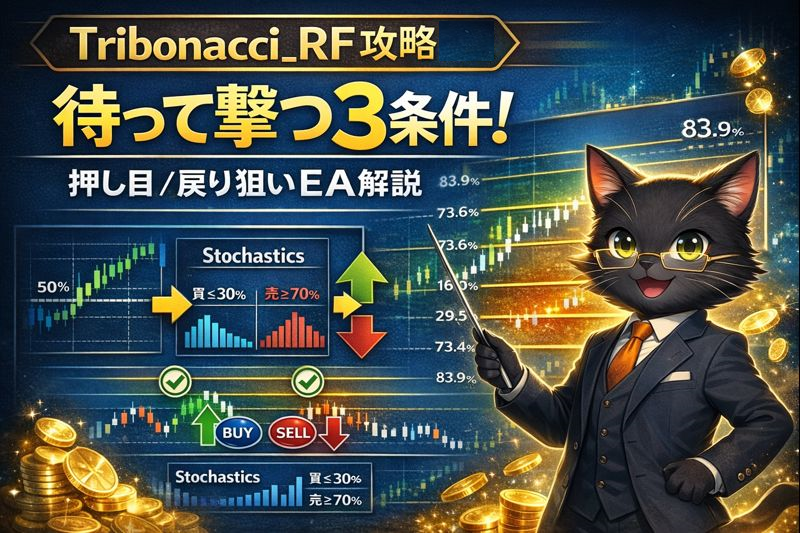
Tribonacci_RF攻略#1: Wait to shoot "three conditions" (pullback/backtest aiming EA explanation)
Hello, this is a black cat.
Last time, I organized the concept of the Tribonacci ratio (5 lines) from the viewpoint of regulating pullbacks/retracements.
This time, as a sequel, I will summarize the "three conditions" that Tribonacci_RF (EA) uses to decide when to enter, waiting to strike.
In short, this EA does not enter immediately when it touches a line, but rather enters only when the three conditions are met, making it good at reducing noise entries.
1) First, premise: this EA waits for a pullback/retracement
This EA automatically creates the Tribonacci retracement (5 lines) from the latest price movement,
and makes the "candidate zones" for pullback buying/retracement selling visible, then waits until the conditions are met.
Recommended time frame: 15 minutes (M15)
Reference: last 120 bars
Ratios: 16.0% / 29.5% / 54.3% / 73.6% / 83.9%
2) The waiting to strike "three conditions"
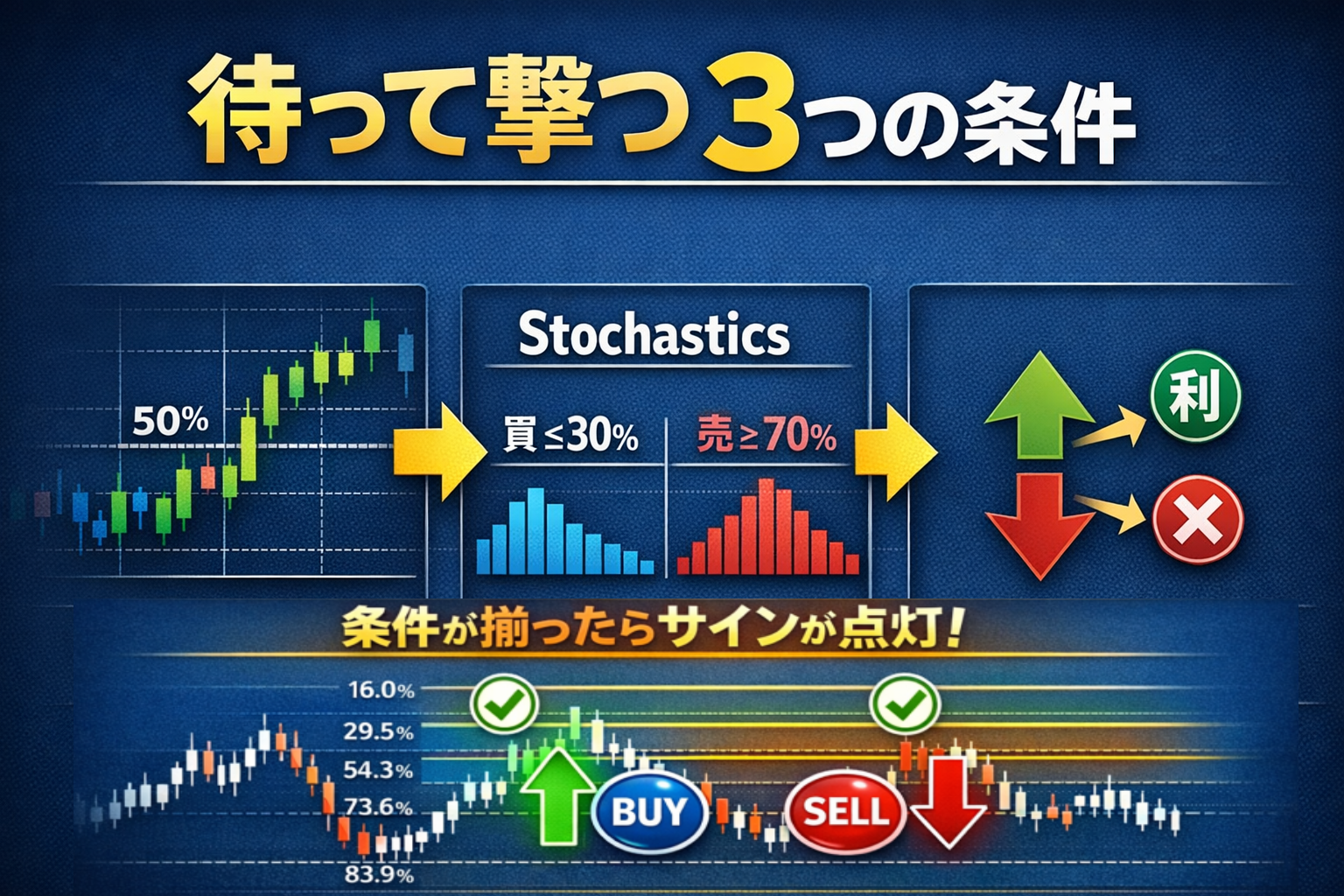
This is the main part. The three conditions are as follows.
Condition ①: Touch of a major line
Condition ②: Distance (pips) from 0–50% is above a certain threshold (check for room to move)
Condition ③: Stochastic condition (buy ≤ 30% / sell ≥ 70%)
3) Condition ①: Line touch (which line are we watching)
Entry candidates are the Tribonacci 5 lines (16.0/29.5/54.3/73.6/83.9).
This EA checks whether the "front foot touched" to avoid impulsive jumps based on momentum alone.
(※This is the first part of the "waiting design")
4) Condition②: Deviation check (look at room to move when distance is 0–50%)
Markets with a distance of 0%–50% have little room to move,
and pullbacks/retracements tend to become "fine noise."
Therefore, this EA only considers there to be potential movement when the distance from 0–50% exceeds a certain number of pips.
(This filter helps reduce wasted trades)
5) Condition③: Stochastic (confirm overbought/oversold)
Finally, with stochastic,
Buy: ≤ 30%
Sell: ≥ 70%
Only when these conditions are met does an entry candidate become valid.
Not just by lines or distance,
but also by timing (oscillator) waiting for alignment is key.
6) Exit is driven by trailing (keep the move)
Tribonacci_RF does not push fixed take-profit only; it aims to capture moves with trailing.
(e.g., start at 8 pips / follow every pip)
※Next time (#3) I will explain this part in detail including how to set it up.
7) Caution (this part is essential)
Accounts with a stop level are not recommended (since 1-pip trailing may cause orders to be rejected)
If spreads widen sharply at times, prevent with MaxSpreadPips
Most issues come from this, so checking first is safer.
Summary
This EA does not enter "immediately upon touch of a line"
Entry occurs only when Line touch + deviation check + stochastic three conditions align
Therefore it is designed to "wait to strike" and helps reduce noise
Product page
Next time preview
Next time (#2) will summarize the trailing take-profit concept and the verification conditions that tend to differ before operation, including spread/stop level.