

Envelope Counter-Trend EA #6: How to choose a time window that is easy to operate (spread measures / for beginners)
0
Hello, this is a black cat.
Last time we organized “currency pair selection” along three axes: spread × range characteristics × abrupt change risk.
In this continuation, putting aside the stop decision for now,
we will summarize an approach that is easy for beginners to tackle and tends to be effective: choosing the active trading time window.
In short, this EA assumes a tolerable spread of 2.0 pips (ver1.2), so the more you run it in times when spreads widen, the more the entry, profit-taking, and losses become volatile.
1) Why does volatility change with time?
In this EA (ver1.2 configuration example),
・Tolerable spread: 2.0 pips
・Tolerable slippage: 1.0 pips
・Stop loss: 5–10 pips (varies with leverage)
・Trailing start: 3–9 pips
・Trailing range: 0.5 pips (fixed)
The stop loss is relatively short (5–10 pips), so as spreads widen,
・entry tends to become unfavorable
・profits can be eroded even if they accumulate
・“Even though touched…” events become more likely
…that is the structure.
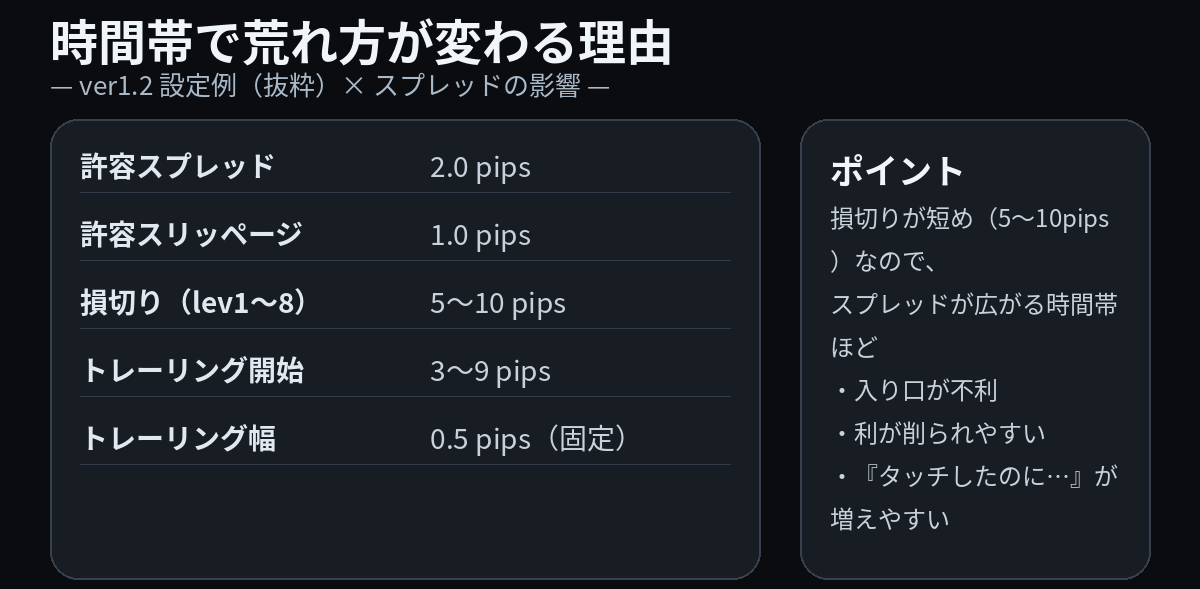
(Reason why volatility changes with time under ver1.2 settings × spread impact)
2) Three typical patterns where spreads widen
No need to overthink this; there are roughly three patterns.
Pattern 1: shallow order book time
When fewer participants trade, spreads open more easily.
Even with the same currency, your feel changes by time of day.
Pattern 2: indicators / abrupt changes
In abrupt-change moments, enlargements and slippage occur more easily, making counter-trend trades volatile.
Pattern 3: Monday start / weekend
Moves tend to be unusual, making the feel unstable.
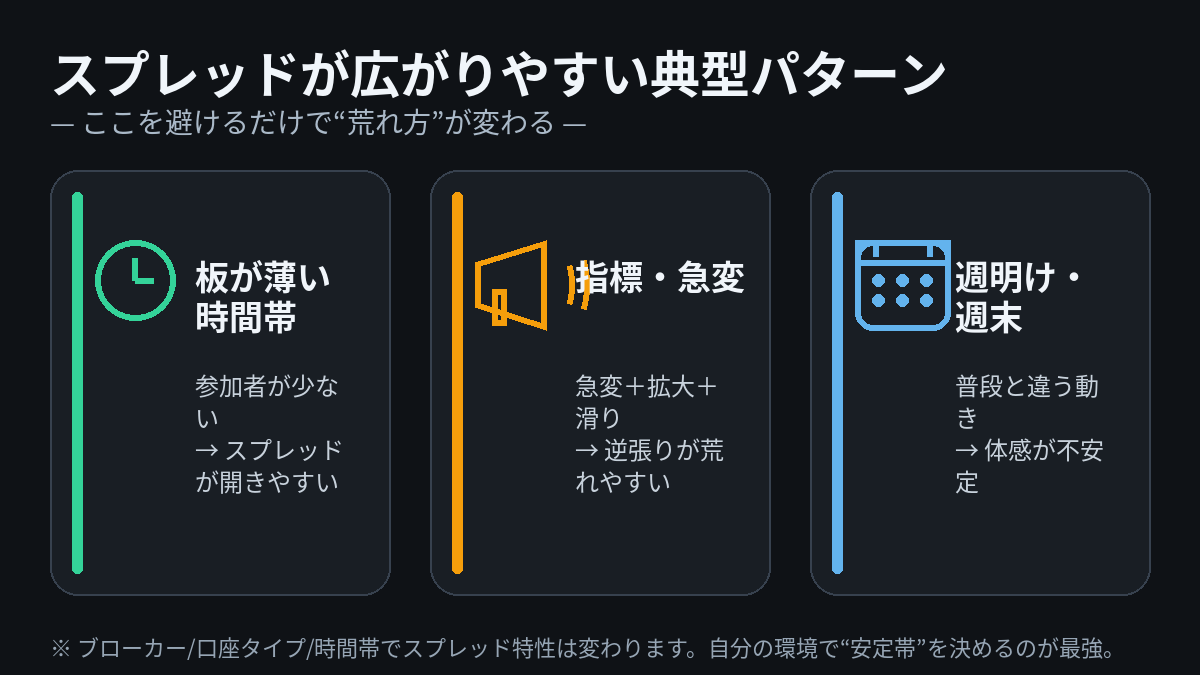
(Three typical spread-widening patterns: shallow order book times / indicators and abrupt changes / Monday start / weekend)
3) For beginners: the simplest operating rule
Before deciding to stop, start with just this.
Rule: Use time windows with more stable spreads as your “active trading window”
This alone changes the pattern of volatility
Less of a hurdle than stopping decisions, easier to continue
4) Practice: steps to decide your own easy-to-trade time window
Because spread characteristics vary by broker and account type, deciding based on your own environment criteria is the strongest approach.
Narrow down the currencies you trade to 1–2 pairs
Look at the spreads during your preferred time window (a few days is fine)
Make the time window when spreads are stable your “active window”
On days with indicator-like abrupt changes, avoid trading forcibly (habitualize)
5) Summary
This EA is (by settings) easily influenced by spreads
So simply choosing the time window where spreads are stable helps stabilize performance
Before deciding to stop, it’s recommended to first establish a “trading window = time when spreads are stable”
Product page
× ![]()