

Envelope Counter-Trend EA #5: How to Choose Currency Pairs (Spread × Rangeiness × Sudden Change Risk)
This is a black cat.
Last time, I summarized three patterns of fixed / upper limit / mild increase for people who fear lots (lot fear).
We will checklistsic finally beginner-friendly “currency pair selection” and explain.
In short, currency pair selection affects more the volatility (how often lev advances) than win rate. The feel changes considerably due to the currency characteristics even with the same settings.
1) Why does performance vary by currency pair
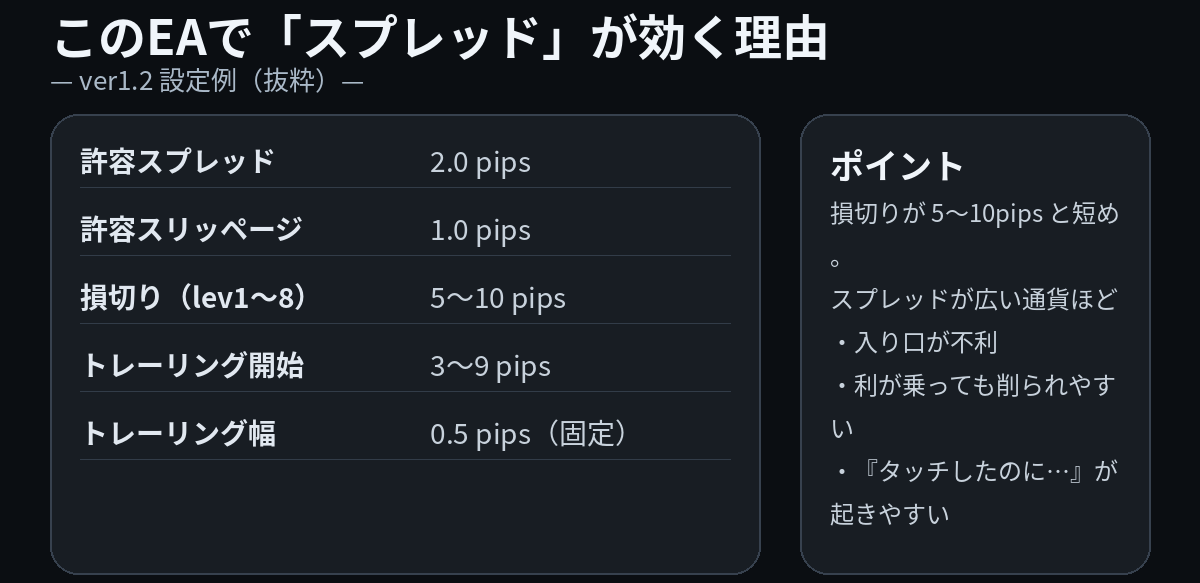
In this EA (ver1.2 setting example),
Allowed spread: 2.0 pips
Allowed slippage: 1.0 pips
Stop loss: 5–10 pips (varies with lev)
Trailing start: 3–9 pips
Trailing width: 0.5 pips (fixed)
These are the premises.
In other words, because stop loss is relatively short (5–10 pips),
currencies with wider spreads tend to be at a disadvantage at entry
profits can be cut back more easily
leading to “difficult to enter despite touching / unstable entry”
…this is the structure.
【Figure 1】 Why the “spread” matters in this EA (ver1.2 setting excerpt)
2) Currency pair selection can be based on 3 axes
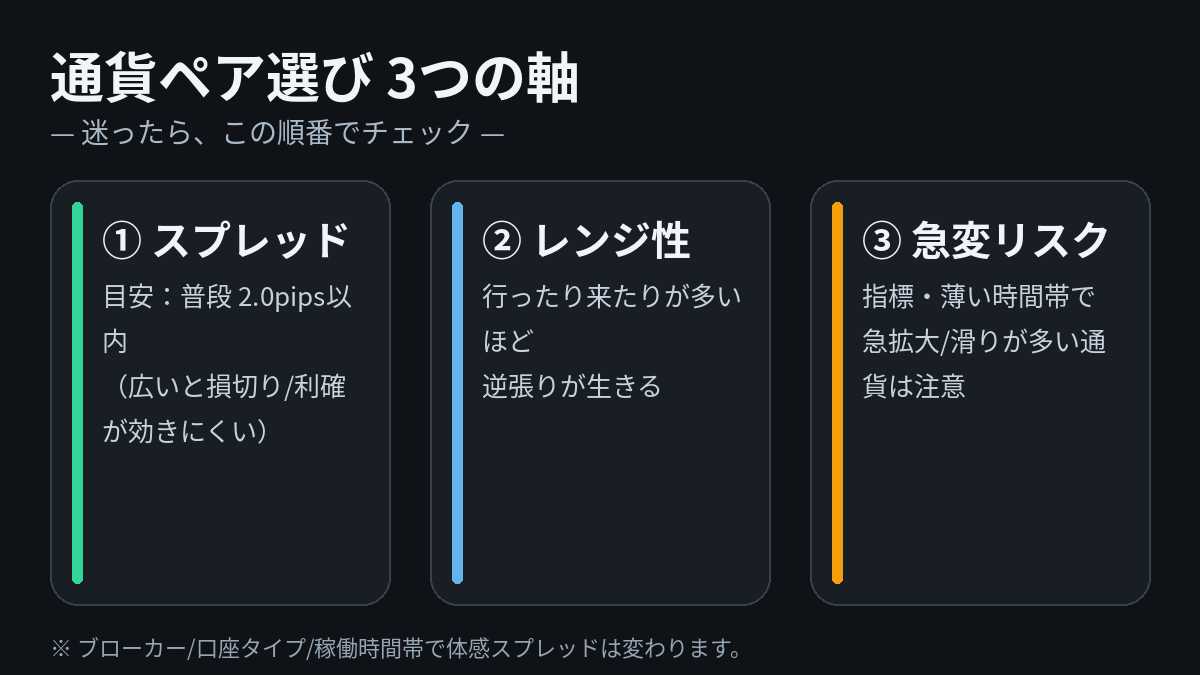
If you’re unsure, just look in the following order and you’re good.
① Spread (top priority)
Whether the usual operation period keeps within 2.0 pips
Avoid currencies where spreads rapidly widen during news or thin times
② Range tendency (suitable for mean reversion)
Better if they go back and forth (return movements) often
The more a currency tends to move in one direction, the more lev progresses
③ Risk of sudden changes (susceptibility)
When sudden change + spread widening + slippage align, mean reversion tends to be volatile
【Figure 2】 Currency pair selection “3 axes” checklist
3) For beginners: step to narrow to 2–3 candidates
Rather than aiming for perfection instantly, this is the most practical way.
Step 1: First narrow down to 2–3 candidates
Don’t immediately broaden to minor currencies; start with ones with abundant data and easy comparison.
Examples (illustrative candidates): EURUSD / USDJPY / AUDUSD / GBPUSD, etc.
※ This does not mean “this currency is guaranteed to win.”
Spread characteristics vary by broker and account type, so this is about position as candidates.
Step 2: Check spreads in your planned trading hours
Even the same currency can feel different depending on the environment.
In your active hours, exclude currencies that tend to exceed 2.0 pips.
Just this step already changes how volatile it feels.
Step 3: Compare under the same conditions and look at “volatility” rather than “win rate”
・Same lot design
・Same time frame
・Same duration
Then prioritize
・How often lev advances deeply
・How often drawdown extends
Beginners are more likely to continue with currencies where losses feel milder.
4) If you’re unsure, just use this (final check)
If the following three are all YES, the currency may be a good fit.
① Usual spread stays within 2.0 pips
② Tends to have returns rather than moving in one direction (more range-oriented)
③ Frequency of spreads jumping dramatically during indicators or thin times is low
5) Product page
Envelope mean-reversion EA (lev8 / lev10) is here
× ![]()