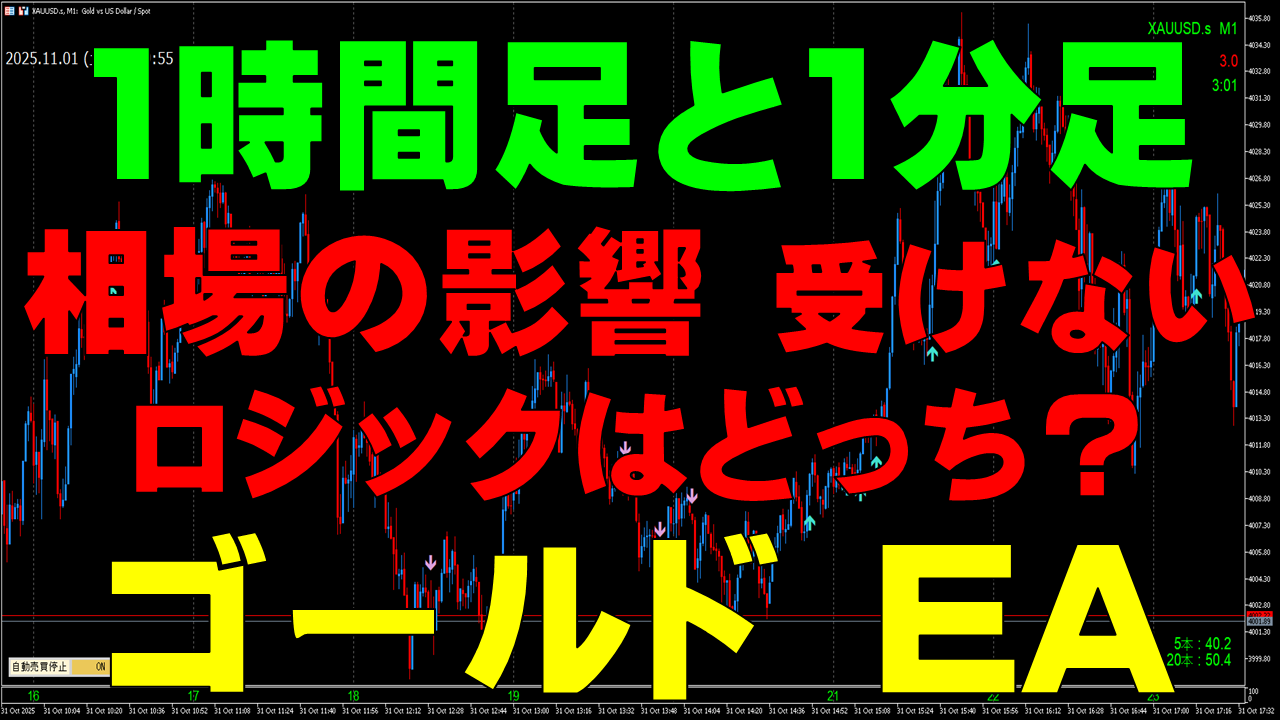
Gold EA: Which is more susceptible to market influence, the 1-hour chart or the 1-minute chart?
Simple Logic FX Sales Page
Simple Logic FX Gold Edition Sales Page
Auto Click Sales Page
Why is System B based on 1-minute bars?
We have explained the development background of System B so far.
As a complement to System A, which mainly uses 5-minute USD/JPY bars,
System B.
A strategy that can win in ranges where System A suffers losses.
That is how we arrived at the 1-minute Gold version.
And then, the breakthrough we needed for scalping logic came from Mr. K.
Mr. K developed a logic triggered by very small price moves at the turning point of ZigZag.
He created a logic triggered by tiny price movements at the ZigZag reversals.
Because the entry logic reacts to subtle moves,
there is almost no impact from larger timeframes.
Given this, it can be said that 1-minute bars are less affected by large market trends or changes in volatility.
In that sense, the conclusion is:
1-minute bars are less influenced by big market moves and volatility changes.
System A operated on 5-minute bars or higher,
so perhaps it could achieve even more stable results with System B.
I feel that is possible.
With Y, a System B user,
we had the following exchange last Sunday.
At the end of this exchange,
there is a description about the advantages of 1-minute bars.
It is quite lengthy, but
it is important, so please take a look.
――――――――――――――――――――――――――――――――
I wonder if there is a name like “overly aggressive filter” or similar,
and whether this is visible on charts as a rough guide,
or if it indicates something about the average candle length?
Or does it indicate something else?
――――――――――――――――――――――――――――――――
* K’s trading style
The first signal appears with “Here we go~”.
At that moment, the conditions are met (entry when over 50%).
If the price later goes above 50% and the first signal disappears,
then if it falls back below 50%, a new signal will appear.
If we determine that the price is being drawn in strongly enough,
entry is made here (entry on the first bar).
Immediately after the first signal appears, we do not enter.
Everything completes on the first signal; we enter before the second signal.
Example in sequence (long example)
1 second: Here we go (signal lights up)
30 seconds: 50% exceeds (signal off)
50 seconds: 49% (signal lights up)
55 seconds: 25% (entry)
The percentages are approximate, but this is the general idea.
More below
――――――――――――――――――――――――――――――――
In a previous video, there was a suggestion that risk management logic might be the main thing,
and I thought, interesting… then
we are now considering increasing entries in a reasonable way,
and this explanation is very relevant to that.
● 2026.01.11: Do.
Regarding K’s trading style page and the term “overly aggressive”
I have just added an explanatory image and notes on the member site.
Mr. K refers to the filter as an “overly aggressive entry filter,”
and the function is prioritized by parameters,
as the latest ZigZag line (swing determination) length filter.
This filter is used as true, so signals occur only when below 50%.
However, once above 50%, if it returns below 50%, you enter by discretion.
Thus, in an EA, you cannot enter, but discretion allows better timing.
Therefore, the ZigZagH_EA does not have the same display functionality for ZigZagH's timings, etc.
But the experience is that the trading entries align better with discretion.
This filter
is of great importance to K.
It does not display on the chart, but
it shows 50% of the critical variable, so you can judge by eye.
Did this help you understand?
As you say,
to increase signals to some extent
and incorporate discretion to raise win rate,
and to increase with money management logic,
I also feel this balance could lead to easier profit growth.
● 2026.01.11: Y
Thank you as always.
Thank you for the quick reply.
After a signal, you make the judgment of 50% for〇〇.
In real-time 1 minute, it seems possible to judge.
But K is amazing.
★
QA noted that when you set a template chart, the EMA100 and ZigzagH indicator appear on the Strategy Tester!
That is convenient.
★
Now a question.
In the lower right of this image,
5 bars 109.7
20 bars 77.5
What does this represent,
and within the verification EA,
is it a parameter related to entry?
★
If the template is set, ZigzagH indicator and verification MA parameters align,
and the entry arrows appear accordingly.
Being able to see where and how entries occur is convenient.
In the future, if within the verification EA you can toggle display on/off,
it would be beneficial for visual backtesting.
Yes, as you say,
to increase signals to some extent
and to boost win rate with discretion,
and to grow using money management logic,
which seems very balanced and conducive to profit growth,
I also feel that.
Yes, I feel the same.
If you follow Do. and K’s exchanges,
K said,
“Backtesting was declining, so I reversed the parameters”
(and it then rose).
This wasn’t due to a clear reason (K may have perceived something from accumulation),
the main thing might really be the money management logic.
That was one reason I felt this.
As mentioned in a recent video,
K’s entry/exit logic is quite developed,
but we are seeking when and at what values or moves the market trend is sensed/judged.
So we’ll continue exploring.
● 2026.01.11: Do.
> After a signal, (Here we go!)
> You are judging Zigzag at 50%.
> In real-time 1 minute, you feel you can judge this.
> But as you said, K is amazing.
Indeed.
K believes this is truly important.
The bottom-right numbers, 5 bars and 10 bars, are the
average pips width of the ZigZag line that has been confirmed.
Five bars represent the most recent confirmed ZigZag line of five bars.
The pips width of ZigZag line may function as a reference value, so I display the values.
The parameters below set the number of lines.
Also, this ZigZag line pips width is used as a filter in the following.
【Parameter Image 2】
ZigZagH_EA has the same filter, so it might be worth testing in a backtest.
> Being able to see where and how entries occur is convenient.
> If in the future the verification EA can display/hide that,
> it would be beneficial for visual mode backtesting.
The ZigZagH indicator arrows, the consolidation reference value,
and the pips width display in the lower right ZigZag line
are set in the verification EA to display in visual mode for confirmation.
In other words, you can operate with ZigZagH_EA alone, without needing ZigZagH in the template, making it clearer,
is that right?
If that is the intention, current ZigZagH_EA will not include a display function for ZigZagH’s data.
EA is fundamentally a tool for entries and settlements.
While it can display history and consolidation reference values,
we have simple limits across Simple Limit, verification EA, etc.,
and we are trying to keep these from becoming overly burdensome.
Essentially, this is about performing what an indicator does, but with an EA.
We aim to keep the EA as lightweight as possible and maintain a simple structure.
(Though we have made it quite complex ^ ^)
From this mindset, we prefer not to include functions in ZigZagH_EA beyond those related to entry and settlement.
However, if adding such functions proves beneficial, we may include them, so please feel free to request.
For this feature, if you can substitute ZigZagH by setting ZigZagH on the tester template, that would be preferable.
If my understanding is incorrect and these features require the EA to function, please let me know in more detail.
> The main thing is really the money management logic, perhaps.
It’s the entry and exit logic for using the money management logic.
Also, backtesting can only reflect superficial price movements.
Whether a large market shift can be managed with semi-discretion is what we’re probing.
Even if backtests show poor results,
semi-discretion may mitigate the impact.
The timing of Singi logic entries is highly developed,
and it captures one-minute bar wave and volatility,
so I believe it has long-term edge.
Using trail exits in backtests can magnify market conditions’ influence,
but with Singi logic, watching one-minute volatility is very important.
With such considerations, semi-discretion is very important.
Semi-discretion and money management logic.
It would be ideal to apply rigorous test results to semi-discretion.
● 2026.01.12: Y
Regarding the questions,
you have attached images, and I appreciate the effort.
As I ask questions, the clarity increases.
I’m learning more about System B’s breadth and depth.
> Try to minimize the burden on EA,
> and keep the structure simple, that is the goal.
> (Though it is more complex than that ^ ^)
> From this perspective
> We don’t want to include anything in ZigZagH_EA beyond entry and settlement.
> We want to include as little as possible.
> Of course, if additional features are beneficial, we may include them, so please feel free to request.
Your consideration is appreciated.
I thought one approach would be simplest, butEA and indicators serve distinct purposes.
> Regarding money management logic,
> entry and exit logic, that is the approach.
That is how I feel.
Since it is built into the system rather than manual,
I definitely want to utilize it.
> Also, backtesting inevitably
> reflects only superficial price movements.
> With overly aggressive entry filters,
> can we adapt to large market changes?
> In backtests, results may be poor, but
> semi-discretion could mitigate the impact.
Indeed, I want to clearly test this possibility.
> Singi logic entry timing is highly developed,
> and captures one-minute wave and volatility,
> thus it has long-term edge.
Yes, I agree. Thanks to Do and K’s accumulated work.
I feel this edge can be boosted with money management logic.
> Using trail exits in backtests can increase impact of market conditions,
> but seeing one-minute volatility is very important in Singi logic.
Yes, the one-minute volatility is something I want to be able to notice and verify.
In my view, as timeframes get smaller, price movements become less directional,
and they relate less to the daily trend,
so there should be points where one can consistently gain (win) regardless of overall direction.
I appreciate your continued support.
● 2026.01.12: Do.
I’m glad my responses have been helpful.
Your feedback helps identify where explanations are lacking and can be reflected in the content.
I believe this exchange will also help purchasers, so I’ll mention it in this weekend’s newsletter and YouTube.
> In my view, the smaller the timeframe, the less directional the movement becomes,
> and the overall daily trend becomes less relevant,
> so there should be points where one can consistently take profits regardless of the overall trend.
I always believed this would be the case.
My aim in running System B on a 1-minute scalper is exactly here.
With this, System A becomes a complement and can form a completely different movement,
allowing for a good portfolio.
● 2026.01.12: Y
“As the timeframe gets smaller, movements become less directional,
and it becomes less related to the overall daily trend
so there should be points where one can reliably take profits regardless of the overall flow.”
Even if manual entries have fewer opportunities,
many people prefer higher win rates.
If you include Gi-Shin and publish this method too,
users will surely be happy.
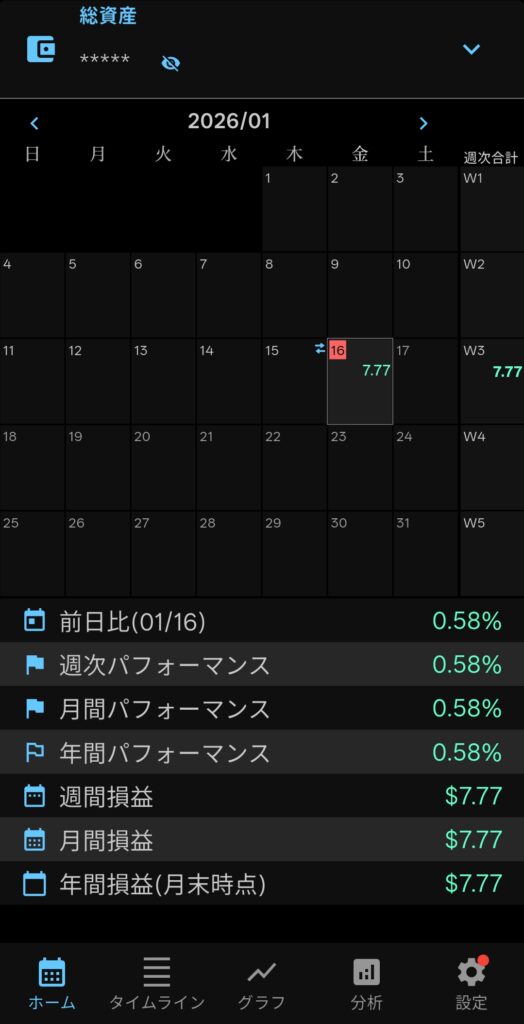
K’s Recommended Trade Management App
Yesterday, I received an email from K.
――――――――――――――――――――――――――――――――
I found a very good app called TradeMemo.
This is really convenient and great!
Even from the office, I can check and it’s enjoyable!
At first, it is free with a limit on entries, but
for 550 yen per month you can import without limits, so I plan to pay for it eventually.