

Logic to aim from 10,000 yen to 50,000 yen in 3 days revealed!
Have you ever heard the word “expectation value”?
Exactly what lies at the heart of trading is thisexpectation value.
The expectation value is the foundation of a trade with reproducibility; if there is no result in past testing, there is no reproducibility.
What is this expectation value?
Expectation value is a number that represents the “future if you continue”
The most important thing in trading is not the result of each individual trade—win or lose. What really matters iswhether, when you repeat the same rules many times, your funds eventually increase or decrease.
That single idea is what we call the “expectation value.”
The expectation value isa number that shows how much you gain (or lose) on average per trade. For example, if you win once and gain 2,000 yen, and after 15 plays the total gain is 15,000 yen, then the expectation value is+1,000 yen per trade. This does not mean you win 1,000 yen every time. Including both wins and losses,the longer you trade, the more your funds tend to increase on average.
A common misunderstanding is the idea that “higher win rate guarantees success.” In reality, you can increase funds even with a low win rate if the expectation value is positive, and conversely, even with a high win rate if the expectation value is negative, your funds will decline the more you trade. The expectation value is the final judgment that includes win rate, profit per win, and loss per loss.
Also, only trades with a positive expectation value will not break even when you employ compounding, increased lot sizes, or automation. This is because the numbers converge in line with reality as you repeat trades. Conversely, applying compounding to a negative-expectation strategy will deplete funds faster than the gains you might make.
In other words, the expectation value can be restated as
“When you continue this behavior, will your future self have more funds?”
It is something that answers that question with numbers.
A trade designed with explicit counts, durability, and growth, and that grows funds according to the numbers.
This way of thinking forms the foundation of reproducible trading.
Now, let’s unravel the logic for the main topic.
First, this is a parameter value that has long been shared in the community
for the White Tiger EA over the six months [July 1 to December 30].
Risk-reward 1:1
Lot: 0.03 fixed
Number of trades: 842 trades (449 wins, 393 losses)
Win rate: 53.33%
Spread setting: enabled (refer to the exchange’s values used by the trader)
Margin: 100,000 → 350,000 (profit 250,000)
If using an aggressive style, margin increases of 0.01 lot every 50,000 can yield further profits.
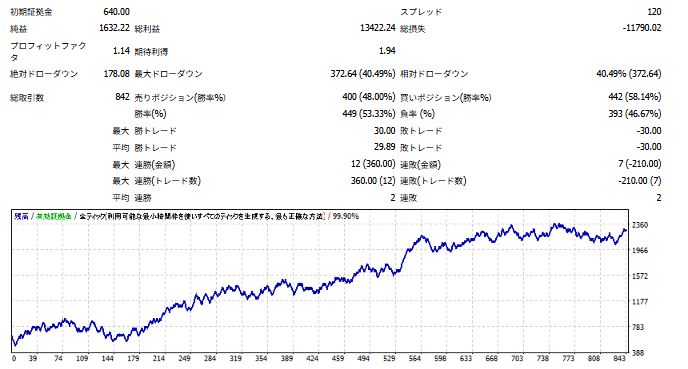
【If you can identify an upward trend this year, results were as follows when focusing on long positions only.】
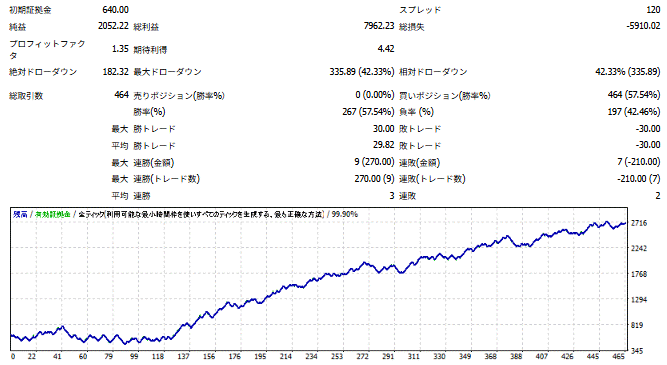
Trades: 464 trades (267 wins, 197 losses)
Win rate: 57.54%
Margin: 100,000 → 400,000 (profit 300,000)
It may seem like a 50,000 difference, but increasing lot by 0.1 every 50,000 makes a big difference.
These are the numbers for the White Tiger EA with a risk-reward emphasis setting.
Next is the win-rate emphasis setting for White Tiger EA【Derived】A parameter set that emphasizes win rate.
In the same period, win rate is about 95%
Using these two methods as a foundation for reproducibility, we build the logic.
First,
step 1【Aim for consecutive wins with win-rate emphasis settings】
Margin 10,000; lot 0.04 (fixed)
Target 10–15 consecutive wins with a 95% win rate
Success rate about 60%
(In actual operation in December, results were even better, but we calculated conservatively with small values)
10 consecutive wins doubles the funds.
From the average number of White Tiger EA entries, roughly about 2 days
step 2【Aim for 1:1 per trade with risk-reward emphasis】
step 1Margin is 2 times or 2.5 times, then trades with risk-reward 1:1 to 1.5 per trade 100% to 150% target.
Win rate, using the average value of risk-reward settings, is calculated at 55%
At the end of trading, margin will be either 0 or 50,000.
If you calculate this as an expectation value
Risk-reward 1:4
Total win rate: 33%
Expectation value: 65%
(If on average you put in 10,000 per set, you would get back 16,500)
(If on average you put in 100,000 per set, you would get back 165,000)
This is the type of expectation value.
I know it sounds bold when I say it, but please compare various expectation values online. It might look like an overestimate, but these numbers are based on six months of data, so I don’t expect them to swing wildly.
Also, I’ve posted history in the Investor Navigator from late November to December, so please take a look if you’re interested.
I’ve written a long explanation, but this logic is a hybrid logic born from a buyer’s question.
Thank you for reading to the end.
【White Tiger EA – Do you go on offense to win or stay consistently winning?】