
Mr. Rikio Shima Past Articles This Week's Outlook In preparation for the President's inaugural address Release date: 2017/01/16 16:10
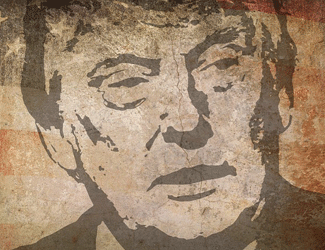
On January 20, the presidential inauguration will finally take place. What policies the Trump administration will actually implement is the biggest focus of 2017. Therefore, this Friday's presidential inauguration is the biggest event of the year.
What Mr. Trump will say won't be known until we actually hear him speak.
However, looking at Mr. Trump's recent words and actions, it seems distant from the financial markets' expectations. What exactly are the financial markets' (unwarranted) expectations? They are that the protectionist aspects are only a fighting pose, and that while he says something, in reality he would raise tariffs, not designate China as a currency manipulator, and push policies to promote economic growth such as corporate tax cuts, income tax cuts, infrastructure investment, and deregulation.
Since the start of this year, Mr. Trump's statements have merely included pressuring car companies and saying he would impose a 38% tariff on exports from Mexico. In the weekend issue of the German Bild, he also talked about imposing tariffs on exports from BMW's Mexican factory; he's only talking tariffs. (He also said that designating China as a currency manipulator is not going to happen immediately.)
This may suddenly change on January 20, but based on the series of statements, imposing tariffs on imports from Mexico seems inevitable.
If that happens, not only Mexico but also China and Japan could face similar measures in the future, it is natural to associate.
Of course he will mention economic policy as well, but if the focus is on tariffs, the market will move significantly around January 20.
(1) If there are only economic policies with no protectionist aspects, the USD/JPY would head toward 120 and trigger another Trump rally.
(2) A little economic policy, with emphasis on protectionist policies, and what if high tariffs were actually imposed on Mexico? In that case, while the economic policy aspects are welcomed, the shock of actually raising tariffs would be large, the USD/JPY would collapse, and stock prices would collapse. It would be the end of the Trump rally.
(3) A scenario with no economic policy and full-on protectionism. It is hard to imagine, but in this case the USD/JPY would plummet toward 100 yen or below.
The market's ideal case (1) is hard to imagine. If it's somewhere between (1) and (2), the market may settle down. However, it would surely be at or below (2).
Looking at the Tokyo market, there are still many who buy on dips, but if protectionist policies come to the fore, the market will change rapidly. And the USD/JPY and the Nikkei average would be the most affected. Ahead of January 20, there is a need to adjust current USD/JPY longs and stock longs. It should be a basic adjustment phase, but there is a demand to reduce USD/JPY longs that could push the market down. If last week's low in the upper 113 yen range is broken, a target around 112 yen would be likely.
Next, it seems Prime Minister May stated in the weekend edition of the British newspaper Sunday Times that she intends to pursue a hard Brexit. There will be a speech on the 17th about this, so pay attention. If hard Brexit becomes unavoidable, the pound-dollar will drop sharply.