

English translation of the HTML, with standard decoding applied: Publicizing the logic to aim for 10,000 to 50,000 yen in 3 days!
Have you ever heard the word "expected value"?
The key to trading is exactly thisexpected value.
Expected value isthe foundation of reproducible trades; those that pass past verifications have reproducibility, and those without results in backtesting have neither.
What is this expected value?
Expected value is the future you would land on if you kept going, expressed as a number.
The most important thing in trading is not the result of a single trade—win or lose. What you truly need to look at iswhether, by repeatedly applying the same rules, your funds eventually increase or decrease.
That, in one phrase, is "expected value."
Expected value isthe average amount by which you gain (or lose) per trade. For example, if you win once and gain 2,000 yen, and after 15 rounds you total gain 15,000 yen, then the expected value is+1,000 yen per trade. This does not mean you win 1,000 yen every time. It includes both winning and losing rounds, andthe longer you run, the more your funds tend to increase on average.
Many people mistakenly think, "If the win rate is high, you will win." In reality, you can increase funds even with a low win rate if the expected value is positive, and conversely, even with a high win rate, if the expected value is negative, your funds will decrease the more you trade. The expected value is the final verdict that includes win rate, profit margin, and loss margin.
Also, only trades with a positive expected value will not break even when you use aggressive strategies like compounding, increasing position size (lot), or automation. This is because, as the number of trades increases, the numbers converge as expected. Conversely, applying compounding to a method with a negative expected value will cause funds to be lost faster than the gains.
Expected value can be reframed as
“When you continue this action, will the future you have more funds?”
And it will answer that question with numbers.
A trade designed with counts, durability, and how funds increase upfront, and building the fund according to the numbers.This mindset forms the foundation of reproducible trading
Now, let's unravel the logic of the main topic.
First, this is the parameter values that have been shared in the community before
the six-month results of Shirou (Hakutou) EA for [July 1 − December 30].
Risk-reward 1:1
Lot 0.03 fixed
Number of trades 842 (449 wins, 393 losses)
Win rate 53.33%
Spread setting enabled (the exchange values referenced by Ikura.)
Margin 100k → 350k (profit 250k)
If in an aggressive style, margin can increase Lot by 0.01 every 50k, enabling further profit.
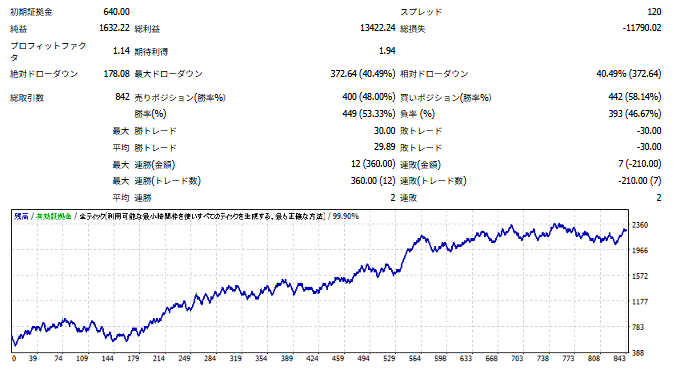
【If you determine this year’s upward trend, you can focus on long positions only and the following results were obtained.】
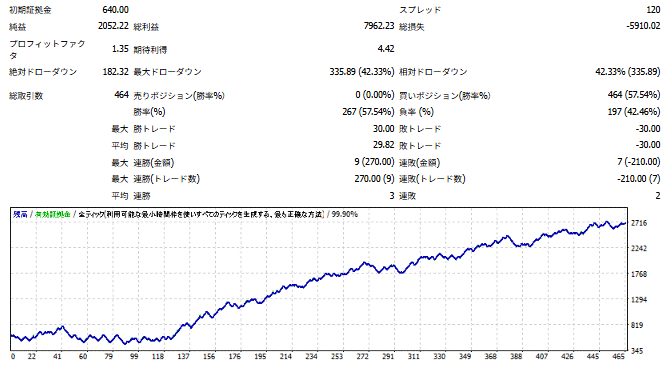
Trades 464 (267 wins, 197 losses)
Win rate 57.54%
Margin 100k → 400k (profit 300k)
You might think the difference of 50k is small, but increasing Lot by 0.1 every 50k creates a substantial difference.
These are the numbers for Shirou EA with the risk-reward-focused settings.
Next is the win-rate-focused settings of Shirou EA【Derivative】Win rate in the same period is about 95%
First,
step 1【Aiming for consecutive wins with win-rate focus settings】
Margin 10,000, lot 0.04 (fixed)
Aiming for 10–15 consecutive wins with a 95% win rate
Success rate about 60%
(In actual operations in December, results were even better, but calculations are adjusted for variability with small values)
10 consecutive wins would double the funds.
From Shirou EA’s average entry count, roughly 2 days
step 2【Aim for 1:1 with risk-reward focus】
2times or2.5times, trades with risk-reward 1:1 to 1.5,1to achieve a 100%to 150%
Win rate is calculated using the average of the risk-reward settings at 55%
At the end of the trade, the margin will be either 0 or 50,000.
If you calculate this as expected value
Risk-reward 1:4
Total win rate 33%
Expected value 65%
(If you invest an average 10,000 per set, you get back 16,500 per set)
(If you invest an average 100,000 per set, you get back 165,000)
As such an expected value.
This number is quite sharp, even if I say so myself. Please look up various expected values online. It might be a high estimate, but I’m using a six-month figure, so I don’t expect it to swing drastically.
Also, from late November to December, Investment Navigator has posted histories, so please take a look if you like.
This long explanation is a hybrid logic born from a buyer’s question.
Thank you for reading to the end.
【Shirou EA − Do you aim to win aggressively or win stably?】