
Logic to aim from 10,000 yen to 50,000 yen in 3 days revealed!
Have you ever heard the word “expected value”?
The key to trading exactly lies in thisexpected value.
Expected value is the foundation of trades with reproducibility; if past tests show no results, there is no reproducibility.
What is this expected value?
Expected value is the future you can expect if you continue.
The most important thing in trading is not the result of a single trade, whether you won or lost. What really matters iswhether, by repeating the same rules many times, your capital ends up increasing or decreasing.
Splitting that into one line is the “expected value.”
Expected value is,the average amount by which your capital increases (or decreases) each time you trade. For example, if “one win adds 2,000 yen and after 15 rounds you’ve gained a total of 15,000 yen,” then the expected value is+1,000 yen per trade. This does not mean you will win 1,000 yen every time. Including both wins and losses,the longer you trade, the more your capital tends to increase on average.
Many people mistakenly think, “if the win rate is high, you will win.” In reality, you can increase your capital even with a low win rate if the expected value is positive, and conversely, you can lose capital even with a high win rate if the expected value is negative. Expected value is the final judgment that includes win rate, profit width, and loss width all together.
And only trades with a positive expected value will withstand aggressive strategies such as compounding, increasing position sizes, or automation. This is because, as the number of trades increases, the results converge to the numbers. Conversely, applying compounding to a method with negative expected value will cause capital to disappear faster than the gains.
Expected value can also be phrased as
“If I continue this action, will my future self have more capital?”
That question is answered with numbers.
It’s a trade designed with the number of trades, endurance, and growth in mind, and it grows capital according to the numbers.
This mindset is the foundation of reproducible trading.
Now, let’s unravel the logic of the main topic.
First, this is the parameter values that have been previously shared in the community.
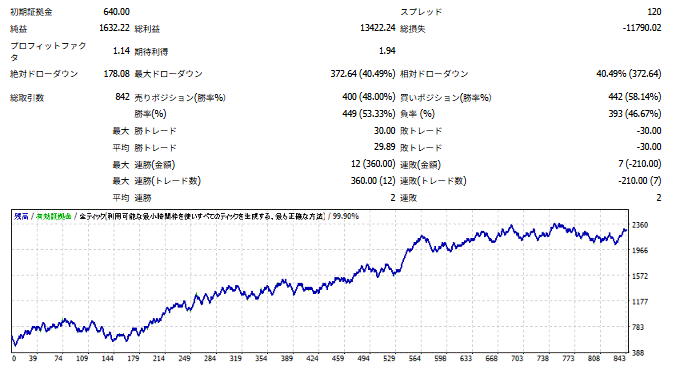
The six-month results of Hakuro (Byakko) EA from July 1 to December 30.
Risk-Reward 1:1
Lot 0.03 fixed
Trading count 842 trades (449 wins, 393 losses)
Win rate 53.33%
Spread setting: enabled (refers to exchange values used by the platform)
Margin: 100,000 → 350,000 (profit 250,000)
With an aggressive style, you can increase the Lot by 0.01 for every 50,000 of margin, enabling further profits.
【If you can identify a rising trend this year, you can focus on long positions only for the following result.】
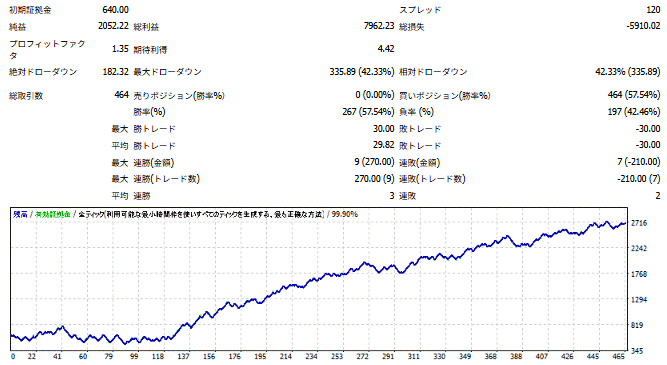
Trading count 464 trades (267 wins, 197 losses)
Win rate 57.54%
Margin: 100,000 → 400,000 (profit 300,000)
You might think 50,000 makes a difference, but raising the Lot by 0.1 every 50,000 margin makes a substantial difference.
This is the basic set of numbers for Hakuro EA with risk-reward emphasis.
Next, Hakuro EA’s win-rate emphasis settings【Derivative】are the parameter values for win-rate focus.
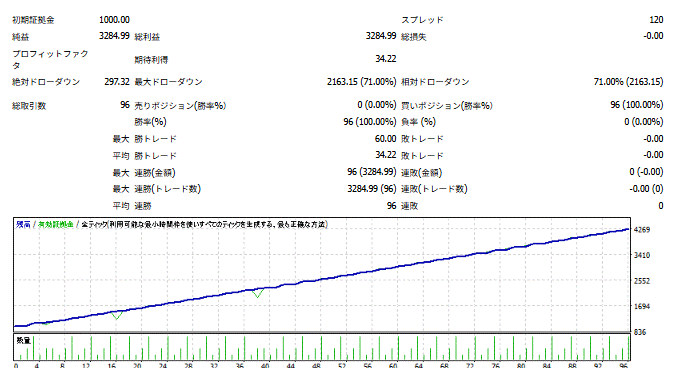
In the same period, win rate is about 95%
Using these two methods, we build the foundation for reproducibility and construct the logic.
First,
step 1 【Win-rate emphasis setting to aim for consecutive wins】
Margin 10,000, lot 0.04 (fixed)
Target 10–15 consecutive wins with a 95% win rate
Success rate about 60%
(In actual operations in December, results were even better, but small values were used to account for fluctuation)
A 10-win streak doubles the capital.
From Hakuro EA’s average number of entries, roughly 2 days
step2 【Risk-reward emphasis aiming for 1:1】
step 1Margin2 times or2.5 times larger, then trade with risk-reward 1:1 to 1.51 time for profitability100% to150%.
Win rate is calculated using the average of risk-reward settings at 55%
At the end of the trade, your margin will be either 0 or 50,000.
If you compute this as expected value
Risk-reward 1:4
Total win rate 33%
Expected value 65%
(On average, if you put in 10,000 per set, you’ll get 16,500 back)
(On average, if you put in 100,000 per set, you’ll get 165,000 back)
This is the expected value.
I know it sounds blunt, but those numbers are quite intense. Please look up various expected values online to compare. It might be an overestimate, but these figures are based on six months, so I don’t expect such sharp fluctuations.
Also, history from November to December is posted on Investment Navigator, so please take a look if you’re interested.
I have written at length, but this logic is a hybrid that emerged from a question from buyers.
Thank you for reading to the end.
【Hakuro EA – Go on the offense to win? Or win steadily?】