
[EA Development] This year's EA operation performance
Hello. This is 2pay.
The year-end is finally approaching. Some of you may be on holiday, right?
I stopped the EA operation last week and closed out for the year.
This year I started operating the EA from April.
From January to March, I was handling requests and creating EAs used for this year’s operations, so effectively this amounts to nine months of performance.
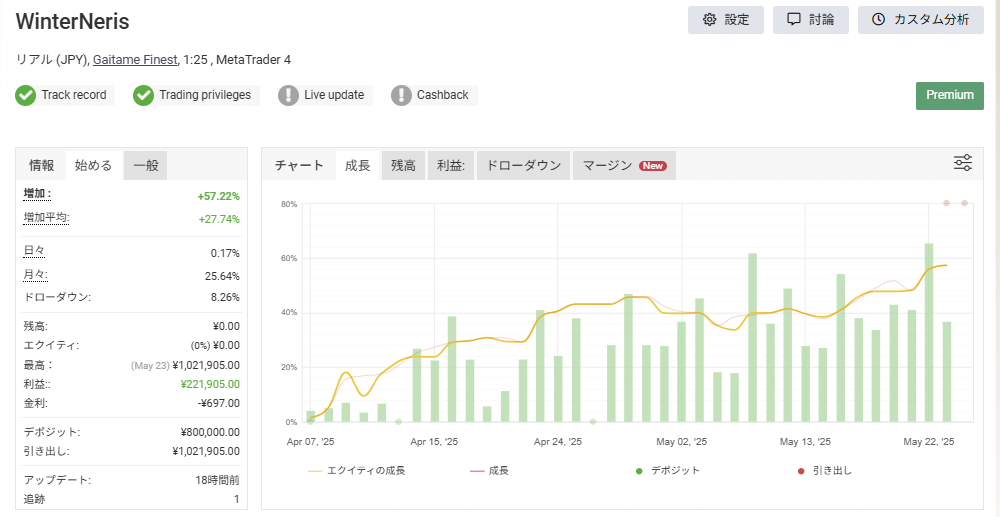
There were two EAs used; operation was with MT4 in April and May, and MT5 from June to December.
The results of the accounts registered on myfxbook are shown below. (Should I also register REALTRADE?)
I’m not sure if it’s okay to link to external sites, so I’ve attached screenshots here.
・MT4
It’s a contrarian EA for CHFJPY. It relentlessly does counter-trend trades, leveraging its proximity to a safe-haven asset.
I traded about three times a day on average, and I almost always held a position.
As of December, the correlation between the yen and the Swiss franc has started to break down, so if I had kept running it, it might have been dubious.
I decided not to pursue full automation (EA commercialization) due to the need to consider operability, and I have instead commercialized it as a sign-based indicator for discretionary use.
Product link:https://www.gogojungle.co.jp/tools/indicators/64013?via=search_product
・MT5
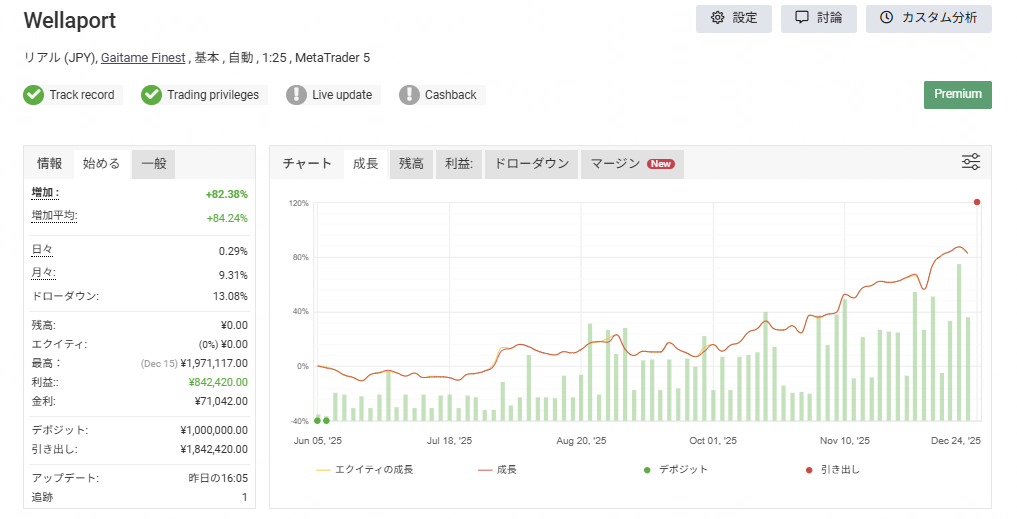
This one is the beloved USDJPY anomaly everyone loves.
I operated with 2% risk until August, and since September I’ve operated with 4% risk.
The most memorable moment was taking about ten straight losses right after starting operation, which set the maximum drawdown.
This year there were rate cuts in the US and rate hikes in Japan, and I was watching for a potential trend reversal and corresponding changes in EA performance.
It wouldn’t be honest to say it isn’t influenced by interest rates, but even so, looking at these results, I feel there is a natural pace to real demand.
Next year I plan to base a further-profit-seeking EA on this one. The EAs used this year will be kept in service as a bridge until they transition to new EAs and then will be retired.
This EA carries some special circumstances, so I have no plans to sell it publicly.
Both EAs incorporate the usual fine-tuned tips I write about in articles.
They’re not just about edge; I designed them thinking about how to reduce risk and how to maximize profits with the same edge.
Win rate is only about 53–60%, but it steadily grows according to the law of large numbers.
In my case, the aim is growth rather than winning, so the results appear as returns.
With the maximum drawdown of 13% during the operation period and a final net gain of 82%, the risk-reward ratio for this period could be regarded as 1:6.
// ---
Developers rarely feel satisfied just because they’ve increased numbers a lot.
Seeing rivals who achieve higher returns with lower risk within the same logic makes me acutely aware of how wasteful my own methods can be.
If someone is achieving better results than you, it means there is room to improve your EA.
This holds at any growth stage: even if you lose this year, if someone who used a similar approach ended the year with fewer losses, that would likewise indicate room for improvement.
The comparisons should be limited to people who are practicing and honestly sharing their results. People who only talk and say “If you do this you will win (not doing it)” should be weeded out.
This concludes the contents for now.
As for this year overall, it was reasonably good, and next year I want to surpass it.
Thank you for reading.