

Test the “valley technique” of Owari’s heaven-and-earth mountains against an actual chart③
Shirou here!
Chart validation of Owari-san's Heaven and Earth Mountain-Vally Method
This is the third time. (This will be the last.)
I will share the validation results.
What is Owari-san's Heaven and Earth Mountain “Valley Method”
- Oscillator TF2 LV1 rising and sticking
- Valley signal (no MTF setting)
- Touches the line
It’s a simple trade, isn’t it.
The ideal for Oscillator TF2 is,
For a long, it should rise straight from -100 to 80
in a straight line.
When it wavily bends or moves irregularly, avoid it.
This pattern is evidence that the market is moving strongly in the favorable direction.
This time’s rules
Basic rules
- 15-minute chart
- About 10 currency pairs
- Oscillator is TF2 LV1 only
- (Signal display only in all directions)
- Display only peaks and valleys
- Stop-loss at the most recent high/low → set RR 1:1 for the width
- There may be changes depending on chart condition
I’m also unfolding the logic I actually consider, so I hope you’ll find it helpful.
The currency pair letters are small, but please refer to the top-left corner.
Validation of Owari-san's Heaven and Earth Mountain “Valley Method” on an actual chart③
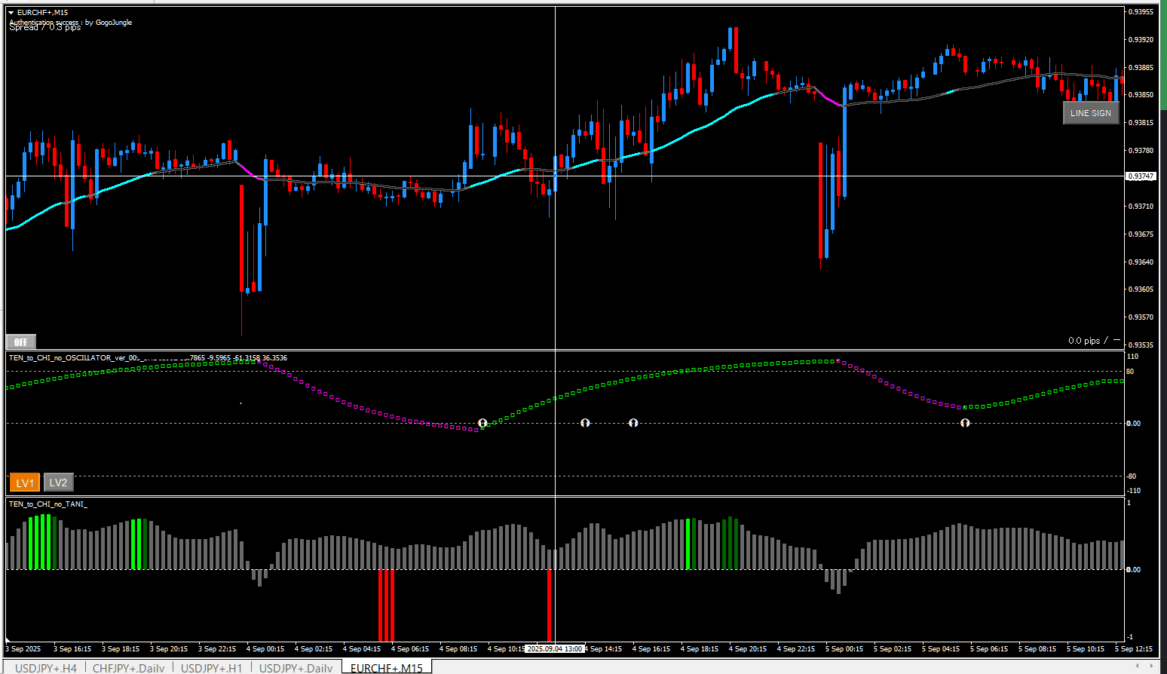
TF2 iscolor-changing midway, so be carefulhowever, the mountain still has about half of its previous amount remaining.
It also touches the line.
If it were me, I would cross the Heaven and Earth lines with a solid line, then start the next candle and enter, targeting the most recent high/low (in this case, the wick before the cross) to 1:1.
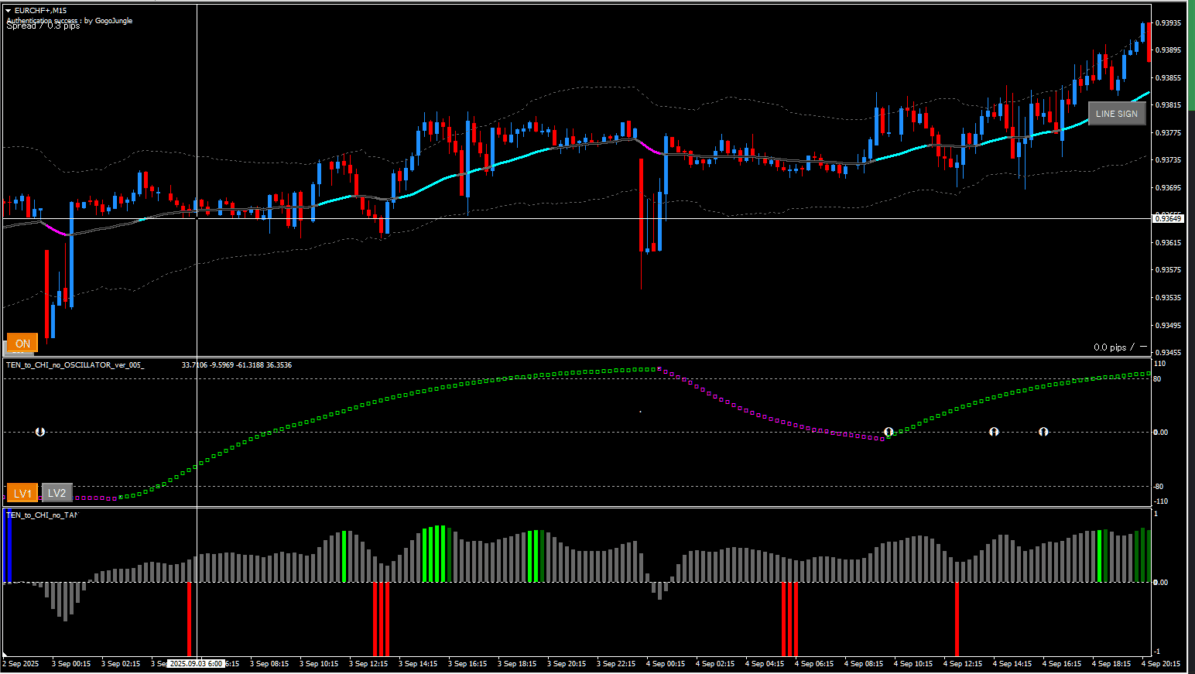
What a superb TF2.
Smooth, and not turning color in the middle but from oversold to color-change
It also touches the line, but there is no recent high/low.
Band settlement 2.0 should be fine.
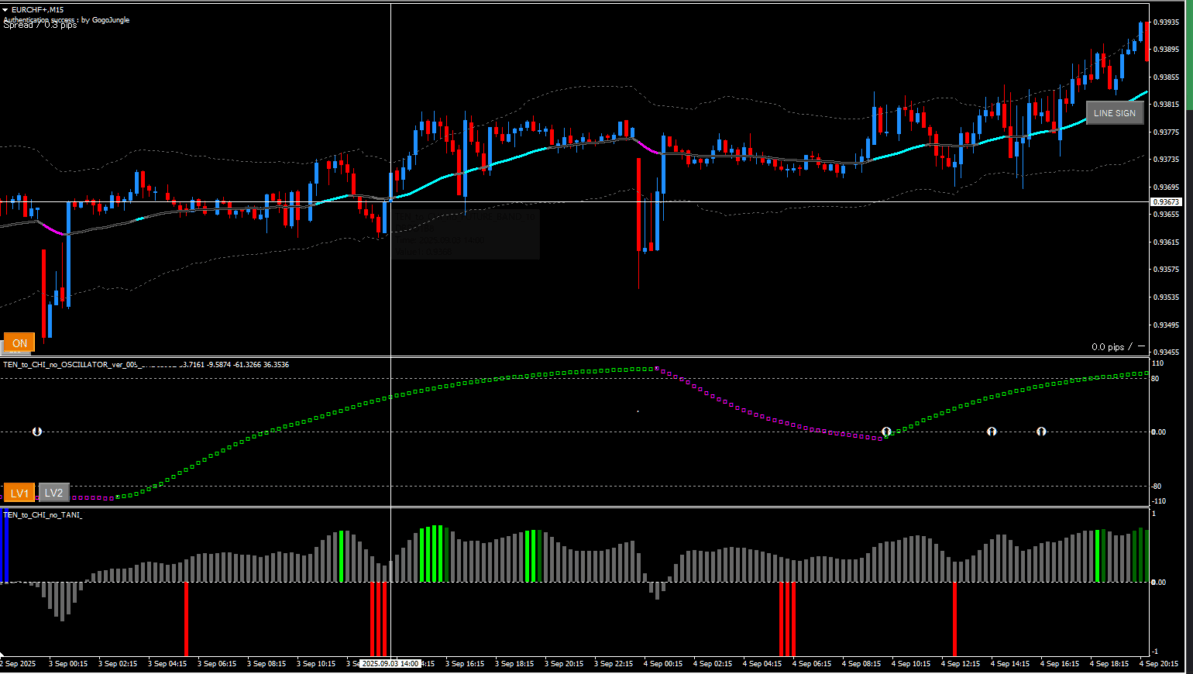
Continuing from earlier.
Here too, TF2 condition is good and smooth.
With a line-touch entry, recent highs/lows are hard to capture, so band settlement 2.0 would be fine.
Since it’s a time with volatility around 20:00, you might let the profit run to where you can.
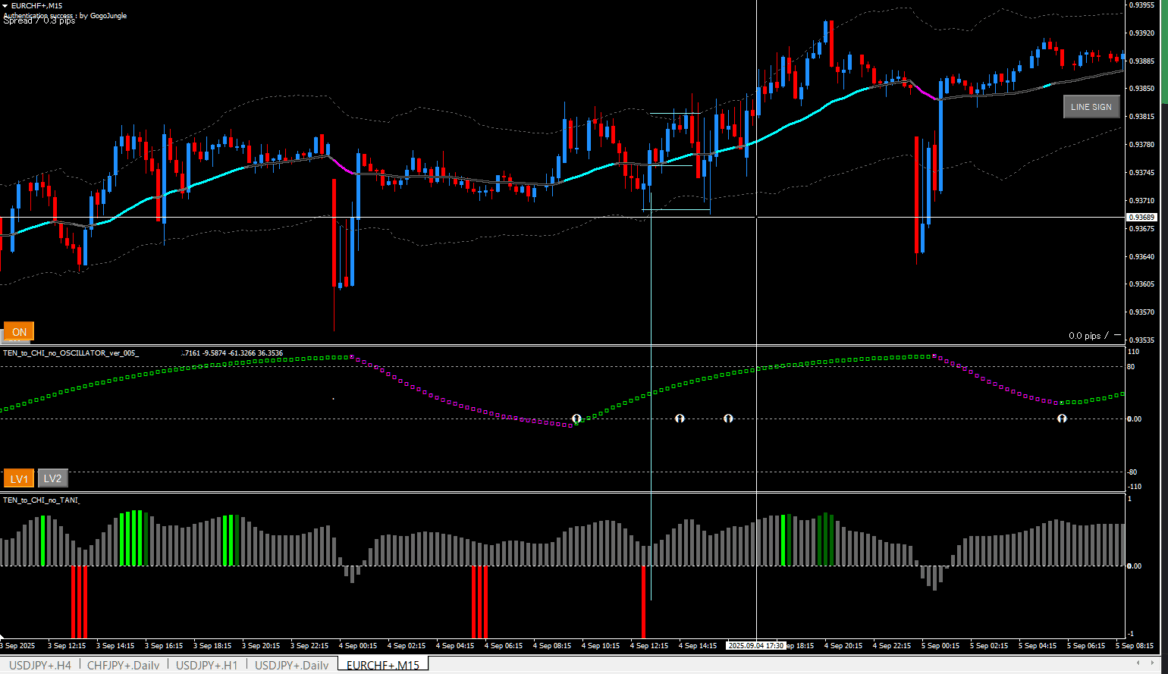
Color change midway in TF2, so be careful)
The mountain remains, so it’s a valid valley.
All-direction oscillator is ahead, so I’ll align my reasoning with this.
Entry with half the lot, since the recent high/low is near the band, band settlement also seems good.
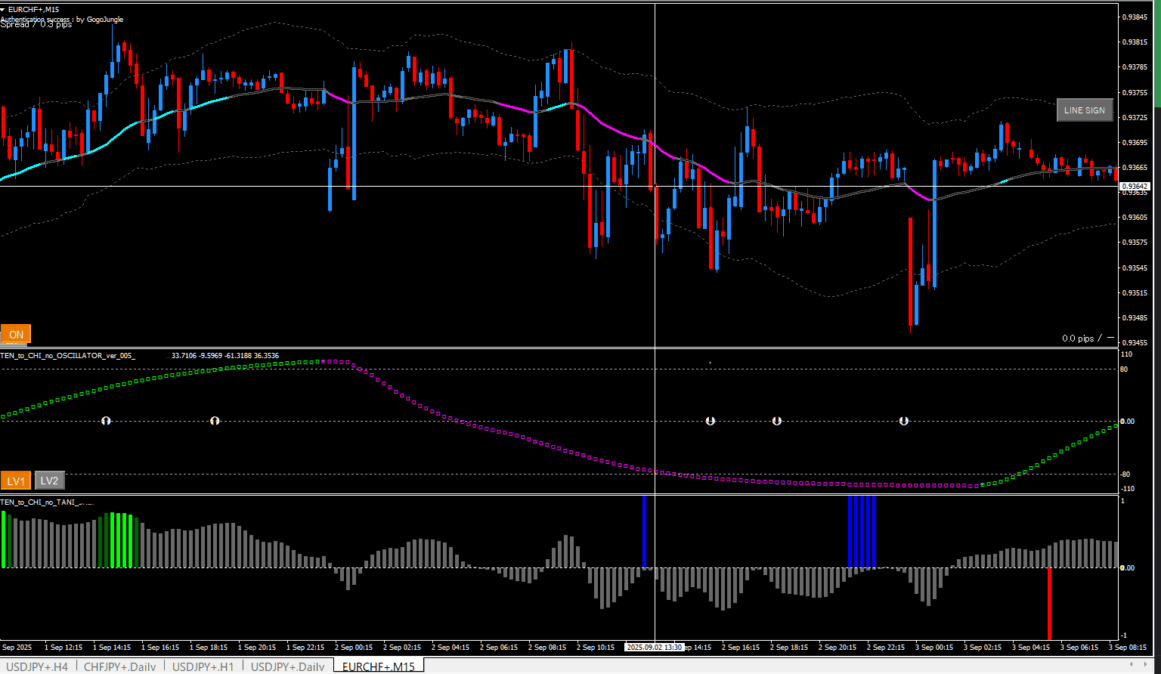
TF2 looks smooth, butthe angle is a bit strong.
Probably, a strong angle means high volatility and a strong trend.
At the cross point, firstthe valley appears at the end of the mountain, so this is a false signal.
If it were me, I would skip entering since it’s outside the rule.
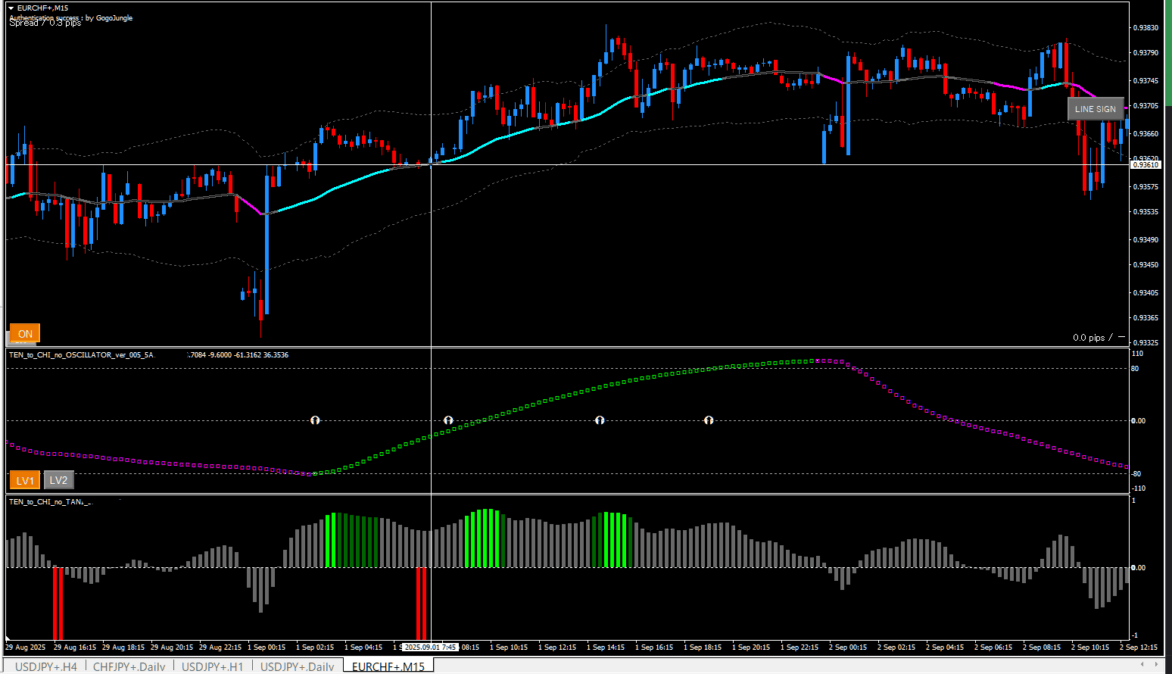
TF2 is a bit sharp in angle, and color-change occurs somewhat mid-way.
However,neither condition is really bad.
Because the valley ends and it touches the line (perhaps reduce lot a little), I would enter.
The most recent high/low is probably early next week, so I’ll invalidate it.
Since it’s extremely close to Heaven and Earth lines, profit-taking and stop settings should be fine with Band Settlement 2.0.
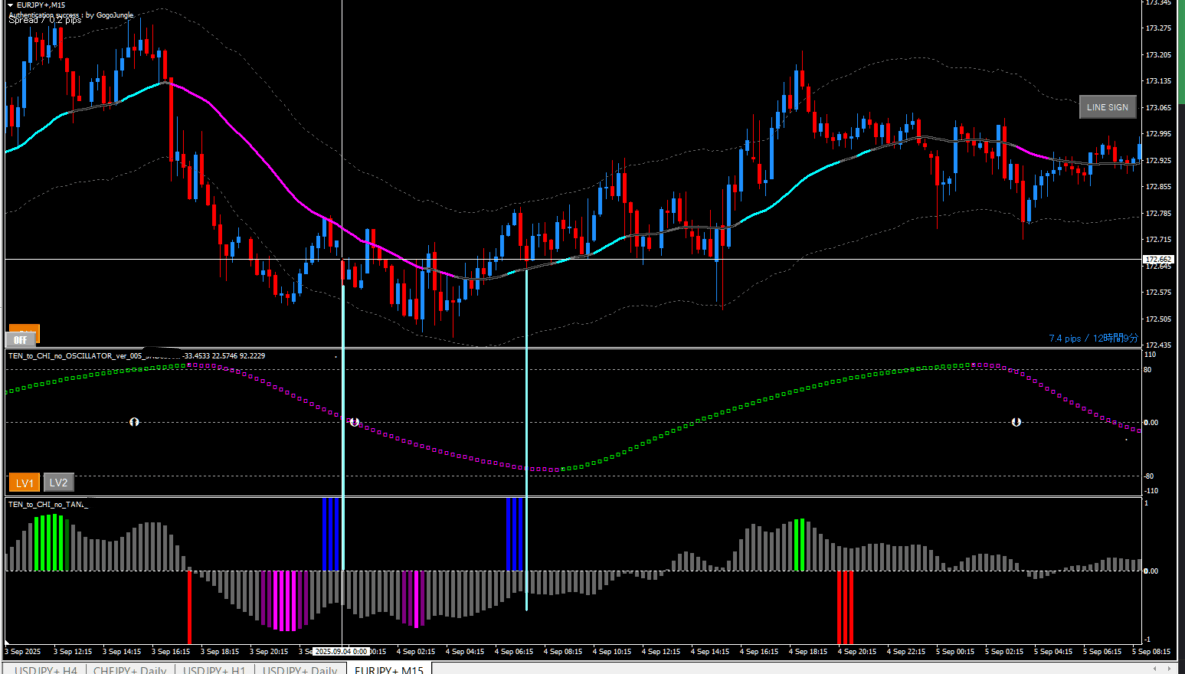
Lastly.
First one.
TF2 is smooth and it's a rebound from being overbought, so it’s a good state
and
there is more than half of the mountain remaining, so the reasoning is solid.
However,
it’s already moved away from the line
.
If it were me, I would enter with half the lot.
Set 1:1 take-profit and stop-loss based on the distance to the candle two bars back.
There is another one.
The central valley.
TF2 conditions are good, and more than half of the mountain remains, which is good.
However, the line position is not good.
Since it has already broken through, there is a possibility of a trend reversal.
If I were trading, I would wait for the candle to break below the line with a solid line.
In this case, TF2 has already switched, so I would reset and end in a skip.
This article ends here, and the valley validation is also concluded for now.
In conclusion
Owari-san’s valley trades are very easy to understand and good.
The key is
Oscillator TF2
- is smooth
- is not a color-change from mid-way
which gives more edge.
Conversely,
- the shape angle is strong
- color-change from mid-way
reduces win rate.
Also, personally I felt valleys with fewer (for example 1–2) tend to have more stable win rates.
Valleys are signals for a trend-following trade, so when there are many of them, it might indicate an unclear sense of direction.