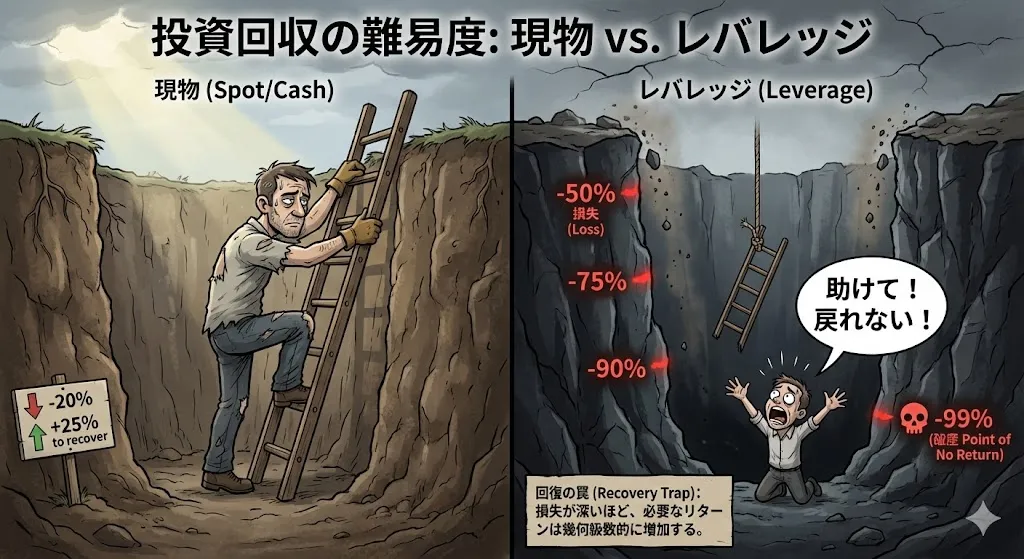

The “death formula” of leverage. Surviving a 90% crash is an impossible game
He is a FP1 level E who manages assets of 150 million yen. A cult-favorite among some circles is the “leverage products (Labanos, etc.).” People are attracted only by their high aggressiveness, without understanding the mathematical trap behind them, and many followers are going all-in.
Investors who cannot do arithmetic are easily ruined on the battlefield called the market. This time, I will explain the most terrifying “death equation” in leveraged investment and the true nature of the bottomless pit you cannot escape once you fall into it.
Can you recover a 50% drop with a 50% rise?
The fear of leverage does not come at the moment of a drop, but when you try to return to where you were. The magnitude of the decline and the rise needed to recover are not equal. There is a bug here.
Let's think with elementary school level arithmetic. For example, the price of a stock you hold drops by 50% and becomes half. To return to the original price (100%), what percentage rise is required?
If your intuition says “+50%,” you should stop investing. The correct answer is a rise of “+100% (doubling).”
If 1,000,000 yen becomes 500,000 yen (−50%), you need a profit of 500,000 yen to return to 1,000,000 yen. In other words, you must double your remaining funds (+100%). A fall loses half of your assets, but a recovery requires twice the energy. This is the weight of defeat.
90% drop = “death”
So, in a leveraged product, what happens if you encounter a crash and it drops 90%? Too many current Leverage NAS (Labanos) believers cannot imagine this fear.
Compute it. From a state where your assets are reduced to one-tenth, what is the required rise to recover the principal?
The answer is “+900% (10x).”
With only a small amount of remaining funds, you must nurture it in the market to become a ten-bagger (10x stock); otherwise you cannot even return to the starting line. The deeper the hole you dug once, the higher the difficulty to climb out, exponentially. That is the reality.
“Deterioration” keeps melting your assets
What makes it even more troublesome is the property of “depreciation (teigen).” Because leveraged products multiply daily fluctuations, even in a “range market” where prices move up and down, the net asset value gradually declines.
Even if the stock price stays flat, your assets will melt away on their own. This is not a structural defect but a mathematical specification.
Conclusion
Leverage is a “short-term antidote” that extracts profits in an instant by timing precisely. Ignoring that nature and clinging to it long-term, praying that “holding on will save me,” is not investing. It is a sacrilege against mathematics.
If you cannot understand the death equation, just quietly invest in indices. It’s for your own sake.