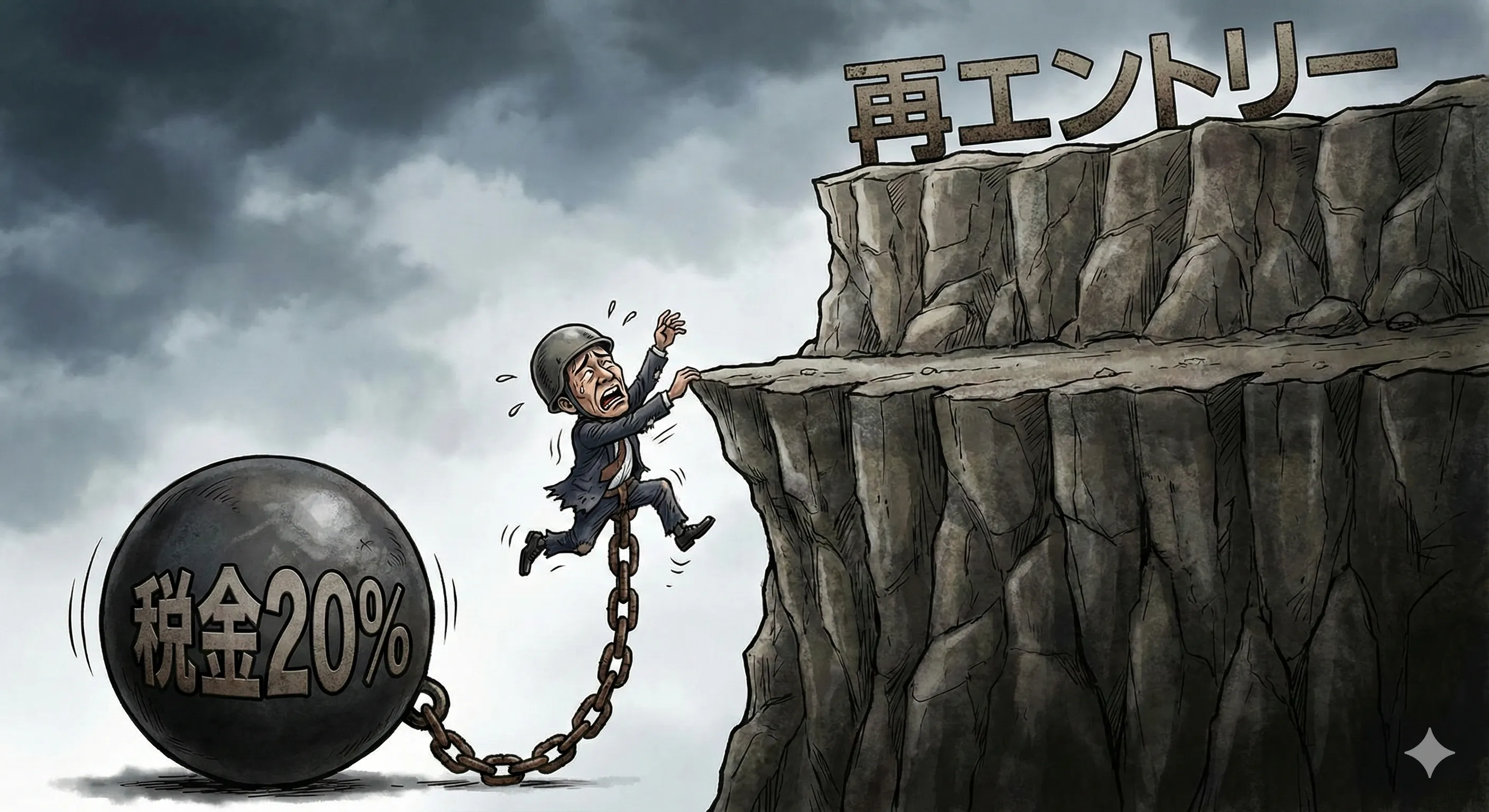

“Taking profits and buying back” is a suicidal act. The more unrealized gains you have, the less you win—this is a mathematical truth.
It is a level FP-1 master who operates assets worth 150 million yen.There is a certain "foolish act" that investment beginners want to do with freshly learned knowledge.“If I take profits once and buy again when the price drops, I can increase the number of shares.”
But I can say this with conviction: this is not investing. It is a bad gamble with unfavorable odds. Many people forget that there is a forced collection system called “taxes” involved in it. This time, I will present the mathematical truth that becomes impossible to rebuy the more unrealized gains accumulate.
The fools who cannot precisely calculate the break-even point
“If it drops a little, buy it back.”
Here is the simple calculation I devised.
[Required drop rate ≒ Profit rate (sale price basis) × 20%]
Why is this? At the moment of sale, about 20% tax is deducted from the profit. In other words, the funds left for reinvestment (principal) are reduced. If you run a simulation with concrete numbers, you will understand how harsh it is.
Case 1: Profit +20% (still a minor wound)
For example, suppose the stock price has risen to 1.2 times and you sell. The profit portion relative to the total assets is small. About 3.3% of the total assets is shaved off by taxes. In other words, if the price drops by 3.3% immediately after selling, you can buy the same number of shares back to break even.
This is a figure that can be targeted in the short-term adjustment phase. This is the stage where beginners gain a success experience on beginner's luck.
Case 2: Profit +100% (double stock)
The problem starts here. Suppose the stock price luckily doubles (double bagger). At this time, half of the selling amount is “profit.” 20% of that profit disappears as tax.
In calculation, 10% of the assets disappear due to taxes. In other words, unless the stock price drops by 10% right after selling, you may not even be able to buy back the same number of shares. A 10% correction does not happen so frequently. If after you sell and the price goes up without dropping, you will never be able to obtain the same number of shares again.
Case 3: Profit +900% (ten-bagger)
Furthermore, suppose you own a ten-bagger in the realm of the wealthy. In that case, 90% of the selling amount is profit. It is almost directly hit by taxes. The break-even point in calculation is, astonishingly, 18%.
Can you understand? Once you sell, unless an 18% crash occurs exactly at that point, you will incur a loss. Do you think a historic crash can be waited for and bought at the bottom? Do you think such a feat is possible for humans?
Conclusion
The conclusion drawn from here is one.“The bigger the lead a stock has, the harder it is to regain the same number of shares once you let go.”
To abandon the strongest psychological stabilizer (margin of unrealized gains) you have built up, pay taxes, and wait for a drop of 10%–20% as a potential outcome. That is not investing. It is a challenge to the gods (foolhardy).
Do not try to skim profits with superficial turnover. Simply hold on for the long term (HODL). That is the only and strongest strategy to maximize compounding without tax costs.