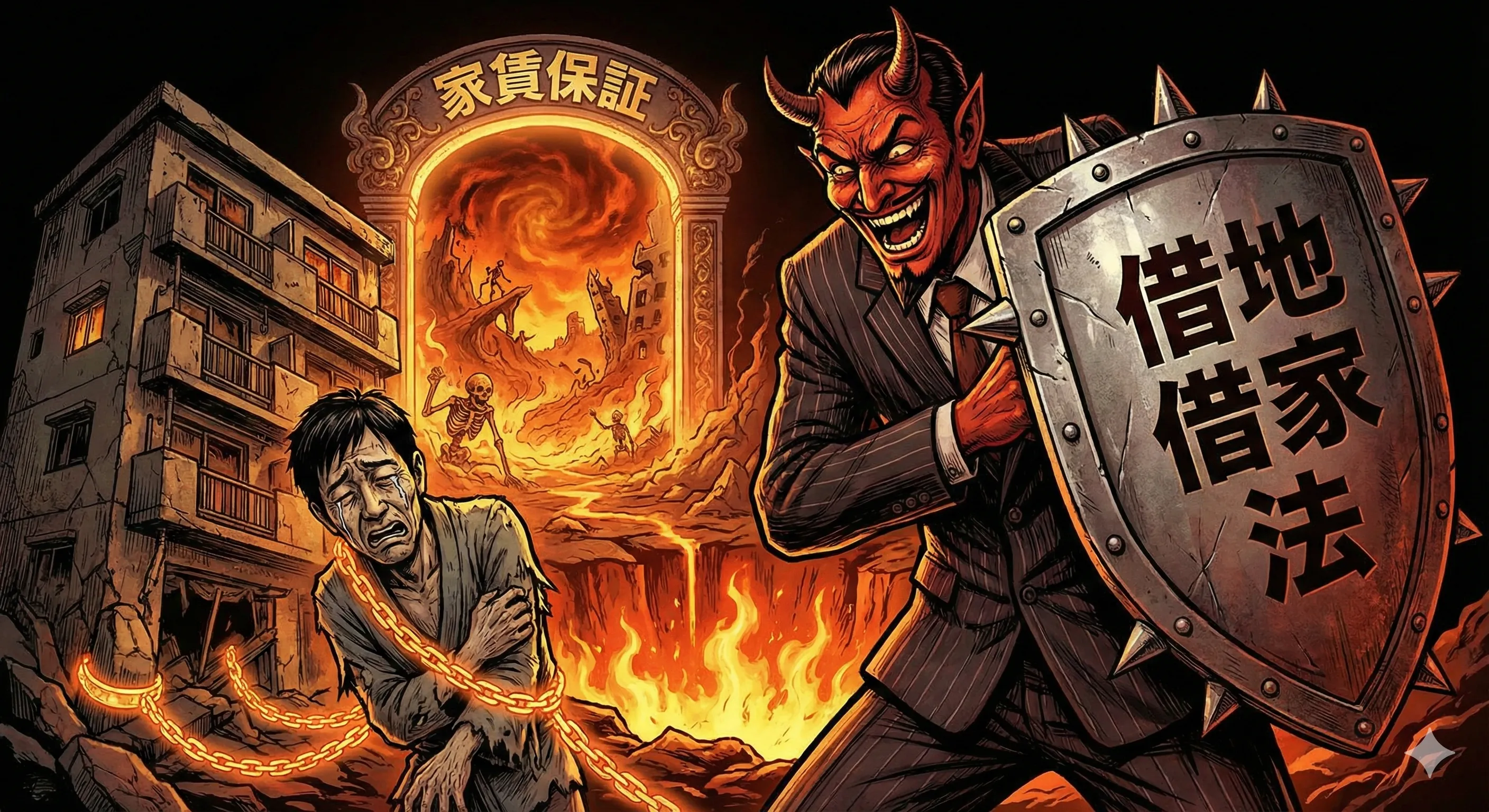

"Rent guarantee" is a contract with the devil. The true face of subleasing as a sucker prey for the ignorant①
He is a FP1st-class level "S" who manages assets of 150 million yen. In real estate investment pitches, there is a “deadly phrase” that salespeople almost always utter. “We will bear the vacancy risk. The owner doesn’t have to do anything. Rent will be guaranteed for 35 years.”
If you feel even a little comfort from these words, your suitability as an investor is zero. That contract is not a shield to protect your assets. It is a one-way ticket to ruin that leads you to hell.
This time, I will explain the darkness of the “sublease (rent guarantee)” which can be called the final form of prey-hunting for the ignorant, and the bugs in the law hidden there.
The worst bug of all: the “Land and House Lease Act”
The greatest darkness of this contract lies in information asymmetry and the “abuse of law.” Japan has a law called the Land and House Lease Act, which heavily protects weak tenants (renters).
Do you understand how this law applies to sublease contracts? Ironically, in this case, you as the owner are defined as the “lessor (the strong party),” and the professional real estate agent is defined as the “lessee (the weak party).”
As a result, the shield that should protect poor tenants is perversely used as “the strongest weapon to protect the savvy professional operators”—the true nature of the structural bug.
Owners have no human rights. The overwhelming “asymmetry of rights”
Because of this bug, the contract terms are distorted as follows.
Termination by the operator:Under the Land and House Lease Act, termination is possible at any time.
Termination by the owner:Just cause (like owner-occupancy) is required, making actual termination virtually impossible.
Rent setting:The operator can legally demand a rent reduction at any time.
Understood? As the owner, you cannot touch your own property, even though it is yours. You cannot terminate, and if the operator says “lower the rent,” you are deprived of any option other than complying.
The contract has the phrase “35-year flat-rate lease” dancing on it. Many naive people mentally convert this to “For 35 years, the current rent will be paid.” That is why they are preyed upon.
The correct translation of this phrase is as follows.“For 35 years, put your property under our control, unhesitatingly reduce the rent if the market goes bad, and, if it stops being profitable, unilaterally cancel the contract and discard you.”
In the initial years, you might be paid high rent. But as the building ages, rent in the market will fall. The operator does not bear that risk. They will exercise legal rights and simply reduce payments to the owner. Meanwhile, the amount you repay on loans from the bank does not decrease at all. When this gap widens, bankruptcy awaits you.
Conclusion
The moment you sign a sublease contract, you cease to be a “real estate owner.” You provide the hardware (the property) and become mere “nominal collateral” whose profits are siphoned by the operator.
The sweet words of “you don’t have to do anything” mean “you should stop thinking and hand over the money.” Do not let others control your assets. Those who cannot bear the risks do not deserve to receive returns.