
Reading FX with Triad Currency Parity — Turning Daily “Distortions” into Profit with TriParity Analysis, Part 2: Can Structure Be Revealed by Analyzing Only Two Currencies? — The Limitations of Analyzing a Single Pair
Previously,"Should the market move according to theory?","Every day, somewhere a small 'distortion' is forming"we explored together up to this point.
This time, that“distortion”is viewed through a single currency pair, and what limits would we bump into if we chase it—
I would like to organize from there.
1. The typical “single currency pair analysis” that many traders do
First, let’s review the common way charts are used.

-
Top left: USDJPY 15-minute chart
-
Top right: the same USDJPY hourly chart
-
Bottom: oscillators like RSI, Stochastics, MACD
-
Overlay Bollinger Bands or moving averages when needed
With this setup,
-
“timing on the short-term chart while checking the direction on higher timeframes”
-
“confirming the direction on higher timeframes”
-
“checking for overbought/oversold with oscillators”
would be the most common style of single-currency-pair analysis, wouldn’t it?
This method itself is by no means wrong.I have used it for a long time and still refer to it.
However,“to truly capture market distortions”, when viewed from the perspective of actively pursuing distortions,there is an inevitable blind spot that cannot be filled by single-pair analysis.
2. Three things you miss with analysis that is limited to one currency pair
When you are only watching one currency pair, the following three things become hard to see.
① You don’t know who is truly pushing the market
For example USDJPY surges, but
-
Is the USD strengthening?
-
Is the JPY weakening?
-
Or are both moving at the same time?

-
EURUSD is also risingas well
-
butEURJPY is flat
Then you might think,
“Ah, the dollar strength is the main driver.”
You might understand that,
but that judgment is ultimatelyan impression built by visually comparing multiple charts.
② You don’t understand the relationships (structure) with other currencies
Technical indicators, basically, look at only the information contained within that currency pair.
-
Bollinger Bands measure the standard deviation of that pair’s price
-
RSI andStochastics indicate the strength of up and down moves for that pair
-
MACD reflects the relationship between moving averages of that pair
In other words,you’re only seeing the extremes within the USDJPY world.
But the actual forex market is,
where rates are formed as a result of the tug-of-war among currencies like USD, JPY, EUR, GBP, AUD, and so on.
With only single-pair indicators, you miss
-
“which currency is really being bought, EUR or GBP?”
-
“in relation to the whole cross-yen movement, is this one currency in an odd position?”
and such“relative distortions” become hard to see.
③ It’s hard to identify why a distortion occurred
As discussed last time, market distortions arise from
-
timing of indicators
-
real demand flows (fixings, fixes, etc.)
-
algorithm biases
and other factors.
However,looking only at a single currency pairmeans you cannot tell
-
“Is this drop because NZD is being sold alone?”
-
“Or is the dollar broadly higher, causing it?”
-
“Or is another currency moving, indirectly causing this one to move?”
and such“structural reasons” remain unknown.

As a result,
-
“buying a currency that looked strong” ends up being swallowed by another currency’s retracement
-
“shorting a pair that looked oversold” gets stepped on by trends led by other currencies
and“losses due to unseen background”increase.
3. Is it true that “arranging multiple pairs solves it”?
Feeling these limits, many people add more and more charts.
-
Top row: major pairs (EURUSD, GBPUSD, AUDUSD, …)
-
Middle: cross-yen pairs (EURJPY, GBPJPY, AUDJPY, …)
-
Bottom: indices and gold, stock indices, etc.
Of course, this helps you get a rough sense of market conditions.“rough market sense”is more accessible.
However, when you actually go to enter, don’t you feel this kind of hesitation?
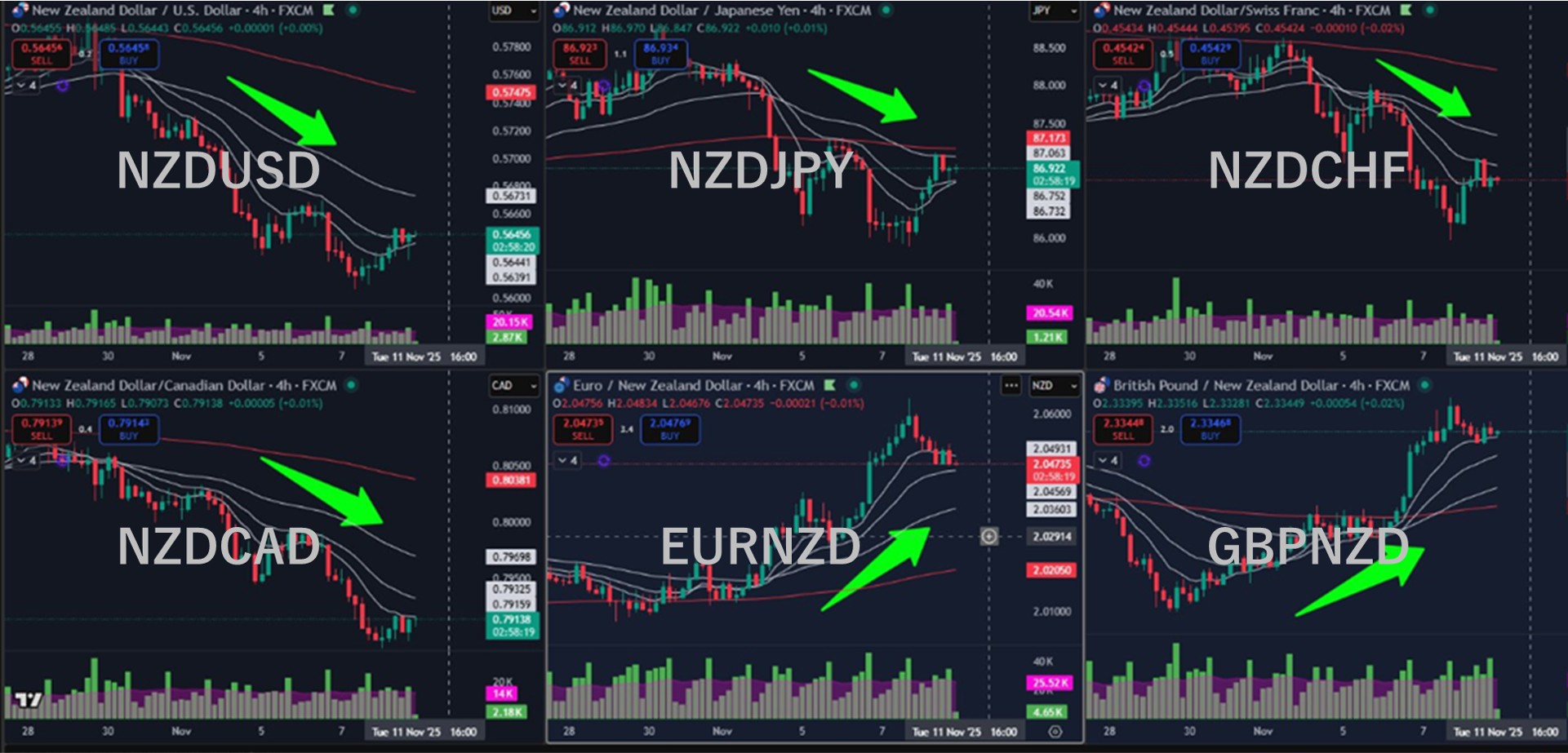
“NZD seems weak, but is it really just NZD’s story?”
“I kind of feel EUR is strong, but I don’t know which pair to enter with most confidently.”
In short,
-
you can discern vague impressions like “NZD is weak” or “EUR is strong” to some extent.
-
but
-
“which pair should you go long/short on?”
-
“how distorted is it?”
-
“how far must it revert for the distortion to be resolved?”
which would translate into concrete trading decisionsis difficult.
-
4. What we want is a structural-level answer
Putting it all together, what we really want is
“What movement is happening, and which currencies are pushing it, and by how much?”
“From the relationships among three currencies or multiple pairs, how distorted is the state?”
“If that distortion rebalances, which pair and roughly how far may it revert?”
In other words,the “structural-level answer”.
With single-pair analysis, you’re only looking at
-
price movement
-
volatility
-
the position of oscillators
and you’re just seeing the numbers that appeared on the surfaceas a result.
To that, you add
-
the alignment among currencies of the fundamentals
-
which pair contributes how much to the distortion”
-
where the “reversion has begun”.
If you combine these“relational information”, you can make completely different judgments even on the same chart.
The next chapter is“5.“How to see a world that isn’t visible with two currencies?””, but from here on, you will need to“apply to view”to see it. We have a video that summarizes the contents in about 10 minutes.