

Understand the reasons for the Nikkei average drop! 900 points gained on a rebound selling, with AI semiconductors and interest rate risks in the background
This Trade Summary
Recently,the adjustment of AI semiconductor stocksandrisks related to interest rates and bondscaused the Nikkei Average to continue on a downtrend.
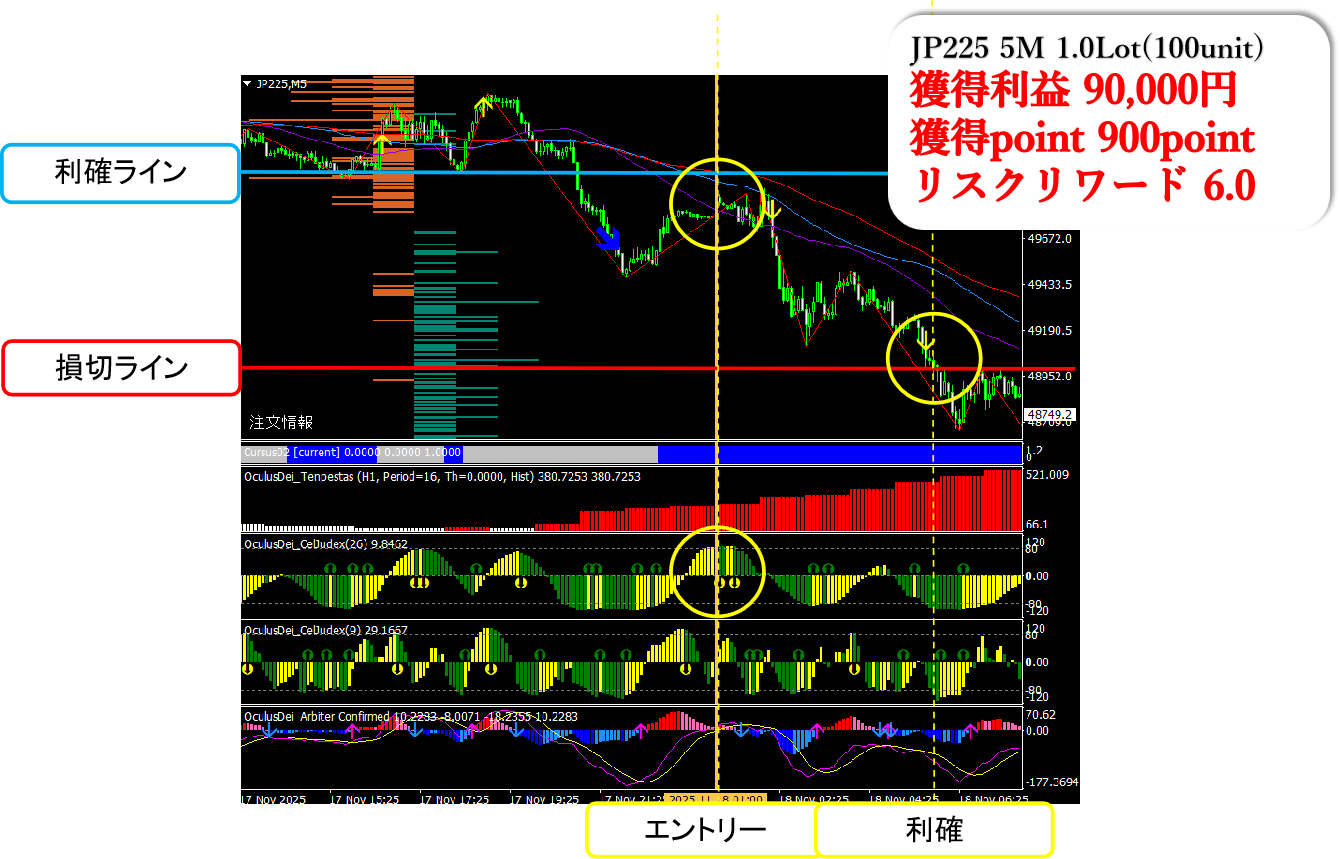
Today, while checking the chart with that flow in mind,the Eyes of Heaven indicatorshowed rising volatility and indicated that a high-probability pullback was forming.
Since the risk-reward was favorable, I entered a short at this stage.
As a result,I was able to gain 900 points.
Actual Chart
? Main Factors Behind the Decline
1. Major adjustments in U.S. tech/AI stocks
-
Concerns about valuations for AI and semiconductor-related stocks like Nvidia spread to Asian and Japanese stocks
-
Sell pressure appeared on Japanese tech and export-related stocks
2. Emergence of interest rate and bond-related risks
-
Long-term Japanese government bond yields rose
-
Concerns about expanded fiscal spending caused funds to flow from stocks to bonds and safe assets
-
This has added downward pressure on the Nikkei Average
Trading Points
-
Entry Reason: Rising volatility + pullback forming + favorable risk-reward
-
Take-Profit Criterion: Expected value calculation using indicators
-
Result: Gained 900 points
Capital Management Example
-
Capital: 1,000,000 yen
-
Single Trade Risk: 3% → 30,000 yen
-
Stop Loss: 150 points
-
Take Profit: 900 points
For this JP225 pullback selling trade, assuming capital1,000,000 yen, 3% risk, the simulation is as follows.
Set stop loss at 150 points and take profit at 900 points.
As a result,if take profit is reachedyou would gain 180,000 yen, and even if stopped out,the loss would be limited to 30,000 yen.
This risk-reward ratio (1:6) is a trading example that takes advantage of the Eyes of Heaven indicator’s strength in targeting high-expected-value situations.
One Final Word
News and background are useful references, but actual trading decisions can be made by observingprice movement, volatility, and indicator signals. In the next session, try aiming for such “high-expected-value points” and test your judgment!
For more details