

What is the “correct expected value” to win in EA? ~How to control your greed~
0
In the world of EA, phrases like "20% monthly return," "1% daily return," and "EA that can aim for billions" flood the scene, appealing to speculation and greed.
Even I sometimes express the advantage of my own EA by saying things like "compound interest to XX billion!"
However, it is necessary to pause and think calmly at that point.
■ The Reality of Investing When Looked at Calmly
In fact, in the world of investing, if you can steadily grow at an annual rate of 20–30%, you are "exceptionally excellent."
- Index investing: average annual return 5–6%
- Well-known hedge funds: 10–20%
- Warren Buffett: about 20% (for over 50 years…!)
In other words, "stable 20% annual return" is actually in the top global tier.
■ Why EAs Excel and the Pitfalls
Indeed, EAs can show short-term, temporary gains of 20% or more per month.
Many operators cherry-pick that and present the EA as amazing.
However, when you look at the darker, uncut parts,
it's not uncommon to see a loss of more than 30% in the following month—that's the reality.
This can be due to an "inferiorly designed EA" or because market conditions entered an unexpectedly temporary period not accounted for by the EA.
When the EA is poorly designed, there can be one month with explosive profits, but in the long run the expectation becomes negative.
When the EA is built honestly and with high quality, you may see temporary gains and losses, but that is natural, and in the long run you can have a positive expectation.
■ The Correct View of Long-Term Backtesting
Many excellent EAs show a net positive over 15–20 years of backtesting.
However, when you look at monthly results—
・Some months are positive
・Some months are negative
・Sometimes there are several consecutive losing months
If a temporary loss is already priced in, there is no problem.
If the long-term expectation is positive, short-term losses can be regarded as noise.
Below is an image of my EA's QuantAnalyzer, showing a positive total across 15–16 years of backtesting. However, if you look inside, you’ll see negative months.
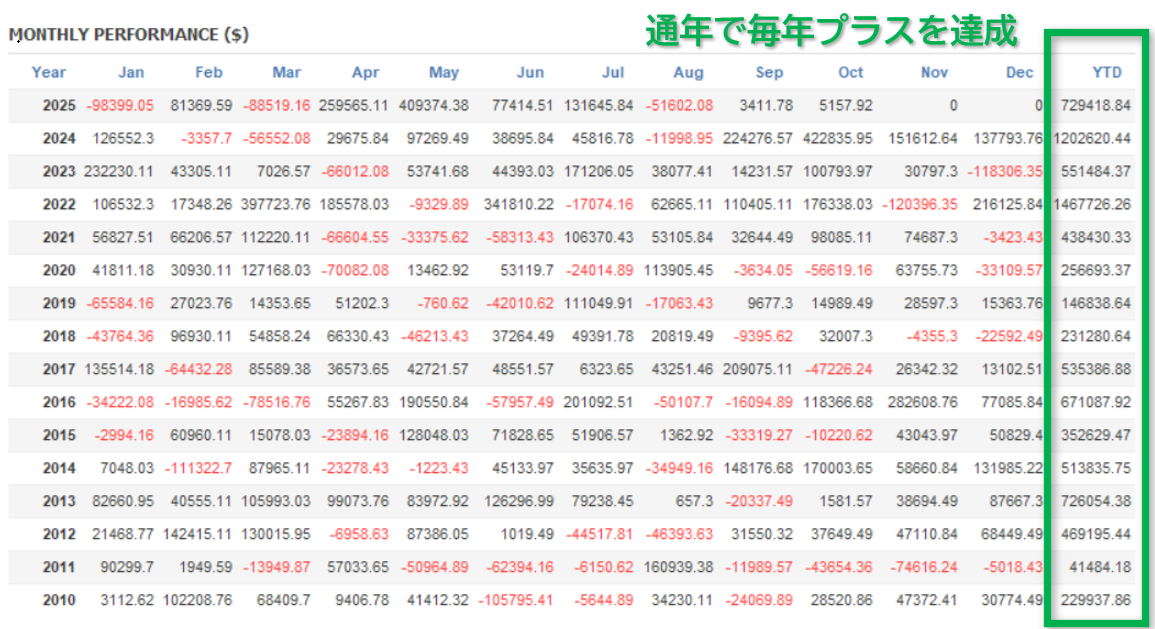
There are EAs that stay profitable with Martingale or averaging down in every month, but that is because drawdowns are not realized until they are eliminated. In reality, as shown above, losses occur, and you aim for a net positive by cutting losses as you go, which is true for both EAs and discretionary trading.
■ Two Perspectives to Control Greed
① Define 30% annual return as "great victory"
- Yearly 10% → Successful
- Yearly 20% → Excellent
- Yearly 30% → Super excellent
Whether you can hold this perspective will greatly affect your investment lifespan.
② Measure expectancy with "multiple EAs × long term"
Do not put all hopes on one EA, but
- Different currency pairs
- Different timeframes
- Different logics
- Different developers
With this perspective, select non-overlapping EAs and diversify your investment as a base approach.
Additionally, an important concept is
"Operate with a capital amount that does not crush your psychology even if it goes negative"
This is the most crucial idea.
Put only money that, even if the account is wiped out, your life would not be affected, into use.
■ Summary
What EA users should possess is not the thrill of "will it rise or fall" but a calm expectation.
Calm expectation:
- Annual return of 10–30% for major success
- Monthly performance will fluctuate
- Losses are okay if they are priced in
- Diversification and long-term focus to seize winning opportunities
Aiming for billions is not a bad thing.
However, it should appear as the result of accumulating correct expectations rather than excessive hopes.
"Desire" is something essential to achieving great things. Cherish it, but do not let it overwhelm you; manage and utilize it properly.
People who win with EAs are not those who have discarded desire, but those who can manage it correctly.
That is the point I want to convey today.
See you next time!
----------------------------------------------------------------------
----------------------------------------------------------------------
× ![]()